

The Indispensable Thread: Unraveling the Logical Connection Between Cause and Effect
The universe, in its bewildering complexity, often presents itself as a tapestry of events, each seemingly leading to the next. But is this succession merely a coincidence, or is there an unbreakable, logical bond that ties an effect irrevocably to its cause? This question, central to philosophy from its earliest stirrings, delves into the very principle of how we understand reality and interact with it. From the ancient Greeks to modern analytical thought, philosophers have grappled with the nature of this relation, seeking to uncover whether the connection is one of necessity, probability, or simply a habitual expectation.
This article explores the historical evolution of thought on causality, examining the intellectual journey from Aristotle's foundational categories to Hume's skeptical empiricism and Kant's transcendental synthesis. We aim to illuminate the profound implications of understanding the logical underpinnings—or lack thereof—of the causal relation, ultimately affirming its indispensable role in our comprehension of the world.
The Enduring Philosophical Question: What Links A to B?
At its heart, the inquiry into cause and effect asks: what makes something happen? When we observe a billiard ball striking another, and the second ball moves, we instinctively perceive a causal relation. But is this perception an accurate reflection of an inherent logic in the universe, or is it a construct of our minds? The answer has profound implications, influencing not just metaphysics but also ethics, science, and our understanding of free will. The quest to define this principle has shaped much of Western philosophical thought, as documented in the Great Books of the Western World.
A Foundation in Necessity: Aristotle's Four Causes
One of the earliest and most enduring frameworks for understanding cause comes from Aristotle. For him, understanding something fully meant grasping its causes, which he categorized into four distinct types. These weren't merely sequential events but different ways of explaining why something is the way it is. This framework provided a robust principle for analyzing the relation between a thing and its origins.
Here are Aristotle's four causes, illustrating the multi-faceted logic behind existence:
- Material Cause: That out of which something is made. (e.g., The bronze of a statue)
- Formal Cause: The form or essence of a thing; its definition. (e.g., The shape of the statue)
- Efficient Cause: The primary source of the change or rest; the agent that brings something about. (e.g., The sculptor who makes the statue)
- Final Cause: The end, purpose, or goal for which a thing exists or is done. (e.g., The reason for creating the statue, perhaps to honor a god)
Aristotle believed that a complete understanding of any phenomenon required addressing all four of these causal principles. For him, the logic of cause and effect was deeply embedded in the very nature of reality, an intrinsic part of how things come to be and fulfill their purpose.
The Skeptical Turn: Hume's Challenge to Necessary Connection
Centuries later, the Enlightenment brought a radical re-evaluation of this classical view. David Hume, a towering figure in empiricism, famously challenged the notion of a logically necessary relation between cause and effect. He argued that our belief in causality stems not from reason or an inherent principle of the universe, but from our repeated observation of events occurring together.
Hume's argument can be summarized thus:
- Contiguity: The cause and effect are always contiguous in space and time.
- Priority: The cause always precedes the effect.
- Constant Conjunction: We invariably observe similar causes followed by similar effects.
What we perceive, Hume asserted, is merely a "constant conjunction" of events, not an actual, observable necessary connection. We infer necessity because of habit and custom. The logic of causality, for Hume, is psychological, not ontological. We expect the second billiard ball to move because it always has, not because there's a discoverable principle that forces it to. This perspective deeply unsettled philosophical thought, questioning the very foundations of scientific induction and our certainty about future events.
Kant's Synthesis: Causality as a Condition of Experience
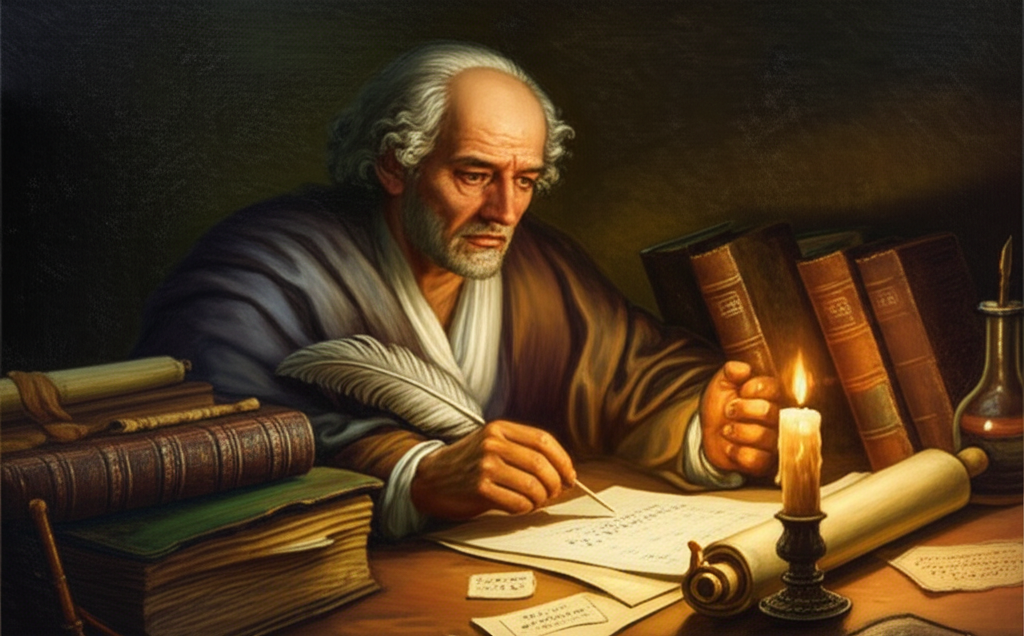
Immanuel Kant, profoundly influenced by Hume's skepticism, sought to rescue the logical necessity of cause and effect without returning to a purely metaphysical assertion. He argued that while Hume was right that we don't observe necessary connection in the empirical world, causality is nonetheless a fundamental principle of our understanding.
For Kant, causality is an a priori category of the understanding, a structure of the mind that we impose upon our experience to make it coherent. We don't find causality in the world as a raw datum; rather, we bring it to the world to organize our perceptions into meaningful sequences. Without the principle of causality, our experience would be a chaotic, disconnected jumble of sensations.
Therefore, the logical connection between cause and effect is not an objective property of things-in-themselves, but a necessary condition for us to experience an objective world. It's a fundamental relation that our minds construct to render reality intelligible.
The Indispensable Principle in Modern Thought
While philosophers continue to debate the precise nature of the logical relation between cause and effect—from probabilistic causality in quantum mechanics to deterministic principles in classical physics—its practical importance remains undisputed. Whether it's an inherent logic of the cosmos, a mental construct, or a statistical regularity, the principle of causality is foundational to:
- Scientific Inquiry: Experiments are designed to isolate causes and observe effects.
- Moral Responsibility: We assign praise or blame based on causal agency.
- Everyday Reasoning: We navigate the world by anticipating consequences.
Even if the ultimate logic of causality remains elusive or a matter of philosophical debate, the concept of cause and effect is an indispensable thread in the fabric of human understanding. It allows us to predict, explain, and ultimately, to act in a world that, without it, would be utterly incomprehensible.
📹 Related Video: PLATO ON: The Allegory of the Cave
Video by: The School of Life
💡 Want different videos? Search YouTube for: ""Hume's Problem of Induction Explained""
📹 Related Video: KANT ON: What is Enlightenment?
Video by: The School of Life
💡 Want different videos? Search YouTube for: ""Kant's Categories of Understanding Causality""