

The Logical Connection Between Cause and Effect: An Enduring Philosophical Inquiry
The relation between cause and effect is not merely an observational phenomenon; it represents one of the most profound and persistent challenges to our understanding of the world, deeply rooted in the very fabric of logic. This article delves into the philosophical quest to establish a necessary or logical connection between events, moving beyond mere temporal sequence to explore whether such a bond can be discerned by reason alone, or if it remains forever an empirical inference. We will examine historical perspectives, from the ancient inquiries into the nature of change to the searing critiques of modern philosophy, aiming to illuminate the intricate dance between observed reality and the principles we use to comprehend it.
Unpacking the Intuition of Causality
At first glance, the concept of cause and effect seems straightforward. A billiard ball strikes another, and the second ball moves. A spark ignites tinder, and a fire ensues. Our everyday experience is saturated with such sequences, leading to an almost innate conviction that one event produces or necessitates another. This intuition forms the bedrock of our ability to navigate the world, to predict, and to plan.
But what precisely constitutes this relation? Is it merely contiguity in space and succession in time? Or is there something more profound, an invisible tether that binds the two events with an unbreakable, logical necessity? The philosophical journey into causality begins precisely at this juncture, questioning the nature of this perceived connection.
The Elements of a Causal Relation
For centuries, philosophers have attempted to define the essential components of a causal link. While the specifics vary, a few common elements consistently emerge:
- Priority of Cause: The cause must precede the effect in time (or be simultaneous, though this is debated).
- Contiguity: Cause and effect are often observed to be close in space, though this is not universally accepted for all types of causes (e.g., action at a distance).
- Constant Conjunction: Similar causes are regularly followed by similar effects. This empirical regularity is a crucial observation.
- Necessity: The contentious element. Does the cause make the effect happen, implying that if the cause occurs, the effect must follow?
Hume's Skeptical Challenge: A Blow to Logical Necessity
Perhaps no philosopher has shaped the debate on the logical connection of cause and effect more profoundly than David Hume. In his An Enquiry Concerning Human Understanding, a cornerstone text in the Great Books of the Western World, Hume launched a devastating critique against the notion of a necessary connection.
Hume meticulously observed that when we perceive a causal event, say, one billiard ball striking another, we witness:
- Contiguity: The balls are close.
- Succession: The first ball moves, then the second.
- Constant Conjunction: In all past instances, similar impacts have led to similar movements.
What we do not perceive, Hume argued, is any force or power that logically compels the second ball to move. We infer it, we expect it, due to habit and custom. Our belief in necessity, he contended, arises not from a rational insight into the inherent nature of things, but from a psychological expectation born of repeated experience.
The Problem of Induction
Hume's argument leads directly to the "problem of induction." We assume that because the sun has risen every day in the past, it will rise tomorrow. We assume that because striking a match has always produced fire, it will do so again. But there is no logical principle that guarantees the future will resemble the past. To argue that it must, based on past experience, is to use induction to justify induction – a circular argument.
- Hume's Conclusion: The relation of cause and effect is ultimately an empirical one, based on observed constant conjunction, and not on any demonstrable logical necessity discoverable by reason alone. Our idea of "necessary connection" is merely a projection of our mind's habit onto the world.
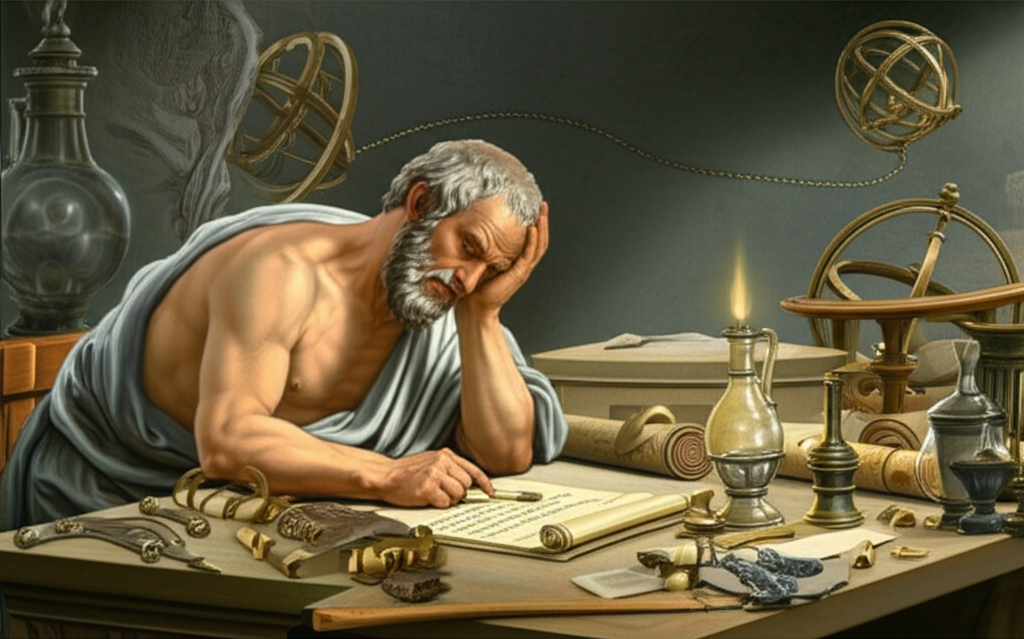
Seeking a Deeper Principle: Beyond Mere Observation
Hume's challenge forced philosophers to reconsider the foundations of knowledge. If causality isn't logically necessary, how can we rely on it for scientific understanding and moral responsibility?
Aristotle's Four Causes
Long before Hume, Aristotle, another titan from the Great Books of the Western World, offered a more expansive view of causation, identifying four distinct types of causes:
| Type of Cause | Description | Example (of a statue) |
|---|---|---|
| Material Cause | That out of which something is made. | The bronze or marble. |
| Formal Cause | The essence or blueprint; what something is. | The idea or design of the statue in the sculptor's mind. |
| Efficient Cause | The primary source of the change or rest; the agent. | The sculptor carving the marble. |
| Final Cause | The end, purpose, or goal for which something is done. | The statue's purpose: to honor a god, adorn a temple. |
While Aristotle's framework doesn't directly address Hume's "necessary connection" in the same way, it highlights that our understanding of "why" something happens can be multifaceted, extending beyond a simple chain of events.
Leibniz and the Principle of Sufficient Reason
Gottfried Wilhelm Leibniz, a rationalist philosopher, proposed the Principle of Sufficient Reason, stating that for every fact, there must be a reason or explanation why it is so and not otherwise. This principle posits a deep-seated rationality in the universe, suggesting that everything has a cause, and that cause is ultimately intelligible. While not directly stating a logical deduction of effect from cause, it underpins the expectation that such a connection exists and is discoverable, even if not immediately apparent.
Kant's Transcendental Solution
Immanuel Kant, profoundly influenced by Hume, sought to rescue causality from pure empiricism. He argued in his Critique of Pure Reason that causality is not something we derive from experience, but rather a fundamental category of the understanding, a necessary structure of the mind itself. For Kant, the principle of causality is a synthetic a priori truth:
- Synthetic: It adds new information (it's not merely a definition).
- A Priori: It is known independently of experience.
We cannot experience the world without imposing the concept of cause and effect upon it. It is a condition for the possibility of experience itself. Thus, for Kant, the logical connection of cause and effect is not in the world per se as a discoverable empirical feature, but as a necessary framework through which we organize and understand the world.
The Enduring Debate: Modern Perspectives
The debate continues into contemporary philosophy. While few today would argue for a purely deductive logical connection between cause and effect in the way one might deduce a conclusion from premises, the search for robust definitions persists.
- Counterfactual Theories: These theories define causality in terms of what would have happened if the cause had not occurred. "If X had not happened, Y would not have happened."
- Interventionist Theories: These focus on the idea that a cause is something we can manipulate to bring about an effect.
These approaches, while more nuanced, still grapple with the core problem: how do we justify the leap from observed regularity to an underlying principle that governs the relation?
Conclusion: A Nexus of Logic and Experience
The logical connection between cause and effect remains one of philosophy's most compelling and elusive puzzles. From Aristotle's comprehensive categories to Hume's skeptical scalpel, and then to Kant's transcendental synthesis, thinkers have wrestled with whether causality is an inherent feature of reality, a product of our minds, or merely a convenient empirical generalization.
What is clear is that the concept of cause is indispensable to human thought and scientific endeavor. While a purely deductive logical necessity for every causal relation remains unproven and perhaps unprovable, the ongoing philosophical inquiry into its nature underscores its fundamental importance. We continue to seek the principle that governs the universe, always aware that our logic plays a crucial role in shaping what we perceive and how we understand the complex tapestry of existence.
YouTube Video Suggestions:
-
📹 Related Video: KANT ON: What is Enlightenment?
Video by: The School of Life
💡 Want different videos? Search YouTube for: "David Hume Causality Explained"
2. ## 📹 Related Video: KANT ON: What is Enlightenment?
Video by: The School of Life
💡 Want different videos? Search YouTube for: "Kant's Synthetic A Priori Causality"