

The Logic of Same and Other in Change
By Chloe Fitzgerald
Change is one of the most fundamental, yet perplexing, aspects of existence. How can something change and still be itself? This seemingly simple question opens a profound philosophical rabbit hole, revealing that change isn't merely the absence of sameness or the presence of difference, but rather a sophisticated logical relation between what persists (the "Same") and what transforms (the "Other"). This article delves into this intricate logic, exploring how identity and difference are not opposing forces, but co-dependent elements essential for any meaningful understanding of change.
The Paradox of Change: A Philosophical Conundrum
The problem of change has haunted philosophers since antiquity, sparking some of the most enduring debates recorded in the Great Books of the Western World. At its core lies a paradox: if something changes completely, is it still the same thing? If it never changes at all, how can we speak of it existing in time?
Heraclitus' River and Parmenides' Being
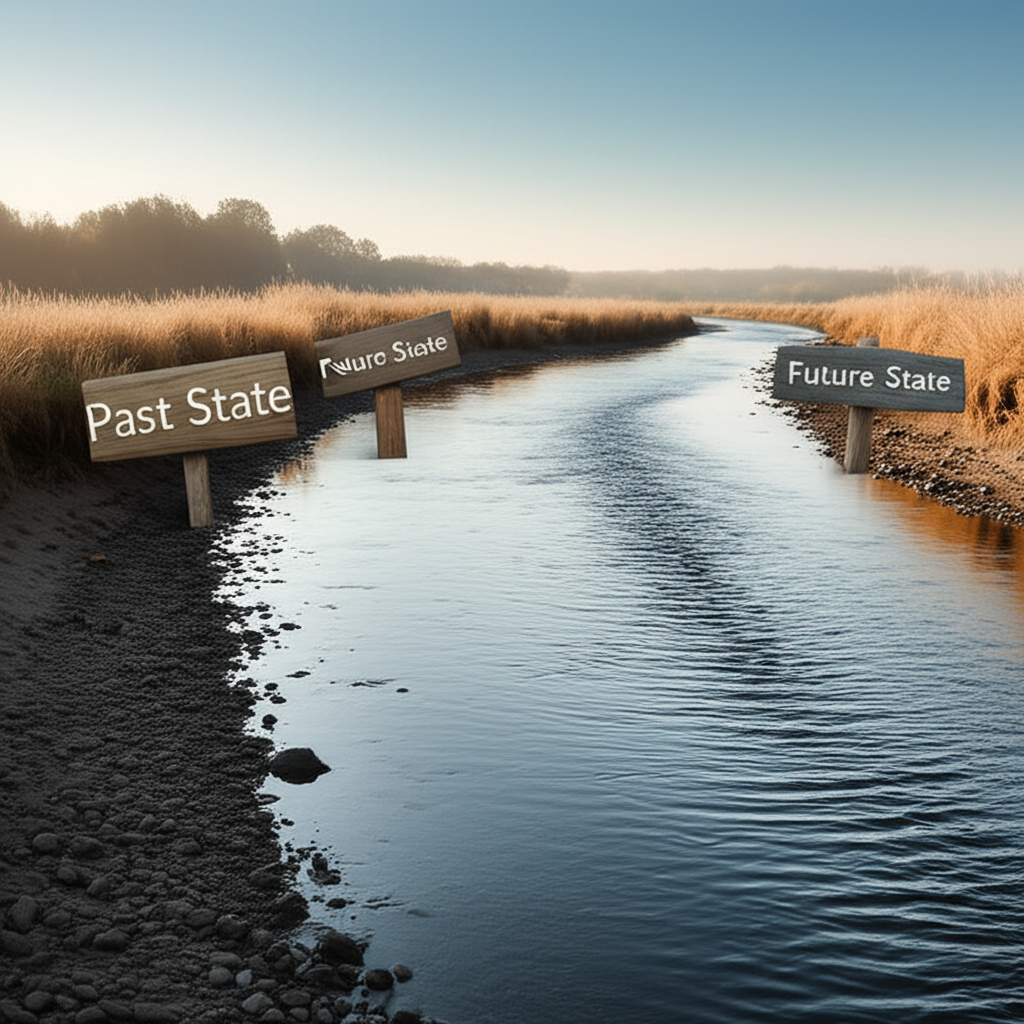
The ancient Greeks offered two starkly contrasting visions. Heraclitus, the philosopher of flux, famously declared, "You cannot step into the same river twice." For Heraclitus, all is change; everything is in a state of constant becoming. The river, though it appears stable, is an ever-new collection of waters. This emphasizes the "Other" – the ceaseless flow of difference.
Conversely, Parmenides argued that true Being is eternal, unchanging, and indivisible. For him, change was an illusion, a deceptive appearance of the senses. If something were to change, it would have to become other than what it is, which would mean becoming "non-being," a logical impossibility. Parmenides champions the "Same" to such an extreme that it eradicates change entirely.
These two titans of early philosophy highlight the tension: one embracing the "Other" to the exclusion of "Same," the other embracing the "Same" to the exclusion of "Other." Yet, our everyday experience of a world in motion demands a reconciliation. The logic of change requires both.
Unpacking "Same" in the Midst of Change
For change to be intelligible, there must be something that endures. If an apple turns brown, it is still the same apple that was once red. If a child grows into an adult, it is still the same person. This enduring aspect is what we refer to as the "Same."
Identity Amidst Transformation
The concept of "Same" in change isn't about absolute, static identity, but rather about a persistence of a subject or substratum that undergoes the transformation. Without this persistent identity, we wouldn't be observing change; we would merely be observing one thing ceasing to exist and an entirely new thing coming into being.
Consider these facets of "Same":
- Numerical Identity: This refers to the oneness of a thing. The tree in your garden today is numerically the same tree that was a sapling decades ago, despite vast physical differences.
- Qualitative Identity (or Partial Sameness): While the tree changes in size, shape, and leaf density, it retains certain defining characteristics that allow us to identify it as a tree and as that specific tree.
The "Same" provides the anchor, the continuous thread that allows us to trace a thing's journey through time. It is the logical necessity that allows us to say, "X changed from A to B," rather than "X ceased, and Y appeared."
Embracing "Other" for True Change
While "Same" provides the enduring subject, "Other" provides the dynamic element. Without difference, without becoming other than what it was, there is no change.
The Necessity of Difference
Change inherently involves a transition from one state or quality to another. This new state or quality is, by definition, "other" than the previous one. The caterpillar becomes a butterfly; the water becomes ice. In each case, the new state is distinct from the old.
The "Other" manifests as:
- Alteration: A change in properties or attributes (e.g., color, size, temperature).
- Generation and Corruption: The coming into being or passing out of being of a substance (though even here, material often persists).
- Motion: A change in place.
The relation between the initial state and the subsequent state is crucial. The "Other" is not just any difference; it's a difference in relation to the "Same" that undergoes it. This is where the true logic of change unfolds.
A Symbiotic Relation: The Logic of Change
The profound insight, accessible through careful study of works like Aristotle's Physics and Metaphysics, is that "Same" and "Other" are not mutually exclusive, but rather interdependent concepts that logically constitute change. Change is the relation between what persists and what transforms.
Aristotle, in his analysis of change, introduces the concepts of potentiality and actuality. A seed has the potential to become a tree (it is the same seed, but can become other than a seed). When it grows, its potential is actualized. The seed is the tree in potential, and the tree is the seed in actuality (transformed). The underlying substance (the "Same") persists, while its form or state (the "Other") changes.
This dynamic interplay can be summarized:
- Persistence (Same): The underlying subject, substance, or identity that endures through the process. It is the 'what' that changes.
- Transformation (Other): The alteration of properties, states, or form that the enduring subject undergoes. It is the 'how' and 'to what' of the change.
- Relation: The logical connection or process that links the enduring "Same" to its transforming "Other." This relation is change itself.
Change is thus the actualization of a potential within a persistent subject, leading to a new state or form. It's a continuous logical thread connecting what was, what is, and what will be, all within the framework of a single identity.
Practical Implications and Modern Thought
Understanding the logic of "Same and Other" in change is not merely an academic exercise. It underpins our comprehension of:
- Personal Identity: How can we be the same person over decades, despite every cell in our body replacing itself and our personalities evolving? The "Same" is our consciousness, our narrative, our unique character; the "Other" is our physical and psychological development.
- Scientific Processes: Chemical reactions involve substances transforming into others, yet the elements (the "Same" at a deeper level) are conserved. Biological evolution sees species change over vast periods, while genetic lineage (the "Same") connects them.
- Social and Political Evolution: Societies transform, but often retain core cultural or institutional identities.
| Concept | Role in Change | Example |
|---|---|---|
| Same | Enduring identity, persistent subject | A person's consciousness over time |
| Other | Manifestation of difference, new state | A person's changing appearance and beliefs |
| Relation | The process of transformation itself | The continuous unfolding of a life story |
Conclusion
The logic of "Same and Other" reveals that change is not a simple phenomenon but a complex, coherent interplay of identity and difference. It is the constant negotiation between what stays and what goes, what endures and what transforms. From the ancient rivers of Heraclitus to the intricate processes of modern science, the world is a testament to this profound logical relation. To truly grasp change is to understand that without the "Same," the "Other" would be unintelligible, and without the "Other," the "Same" would be static and lifeless. Together, they weave the dynamic tapestry of existence.
📹 Related Video: ARISTOTLE ON: The Nicomachean Ethics
Video by: The School of Life
💡 Want different videos? Search YouTube for: ""Heraclitus vs. Parmenides - The Problem of Change Explained""
📹 Related Video: ARISTOTLE ON: The Nicomachean Ethics
Video by: The School of Life
💡 Want different videos? Search YouTube for: ""Aristotle's Metaphysics: Potency and Actuality Explained""