

The Enduring Riddle: Navigating the Logic of Same and Other in Change
Summary: How can anything truly change if, for us to recognize it as changing, it must also remain itself? This article delves into one of philosophy's most profound and persistent problems: the intricate logic of sameness and otherness within the dynamic process of change. Drawing on foundational insights from the Great Books of the Western World, we'll explore how thinkers grappled with this paradox, examining the crucial relation between what endures and what transforms, and why understanding this logic is fundamental to our grasp of reality.
The Shifting Sands of Being: An Introduction
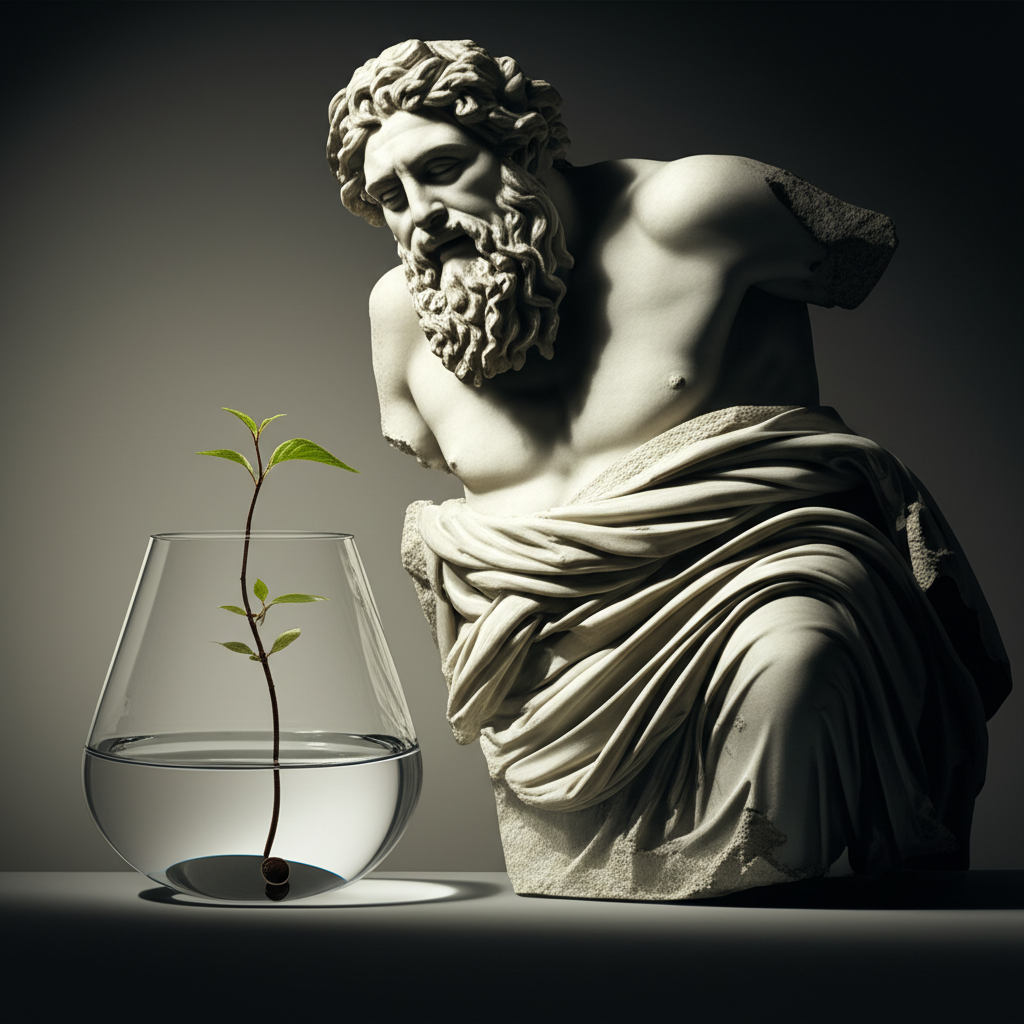
Have you ever looked at an old photograph of yourself and wondered, "Is that still me?" Or watched a tree grow from a tiny sapling into a towering giant and pondered what makes it the same tree? This seemingly simple observation of change opens a philosophical rabbit hole, leading us to a core paradox: for something to change, it must become other than it was, yet for us to say it changed, there must be a persistent same that undergoes the transformation. This isn't just a linguistic quibble; it's a deep metaphysical and logical challenge that has occupied minds for millennia.
The very idea of change forces us to confront the delicate relation between identity and difference. If something becomes entirely other, it ceases to be what it was, and we can't speak of its change. If it remains absolutely the same, then no change has occurred. The logic of change, therefore, lies in understanding how sameness and otherness can coexist, intertwined in a continuous process.
Ancient Echoes: The Poles of Change
The earliest Western philosophers from the Great Books tradition were acutely aware of this tension, often taking extreme positions that set the stage for centuries of debate.
Heraclitus: The River of Perpetual Flux
From the ancient city of Ephesus, Heraclitus famously declared, "Everything flows, nothing stands still." His most enduring metaphor, "You cannot step into the same river twice," captures the essence of his philosophy. For Heraclitus, reality is defined by constant flux, a ceaseless becoming where all things are perpetually changing into their other. Fire, for instance, is a symbol of this dynamic process, consuming and transforming. In this view, otherness is the primary reality, and any apparent sameness is merely a fleeting moment in an unending torrent of change.
Parmenides: The Immutable Unity of Being
In stark contrast, Parmenides of Elea presented a radical logic that denied the very possibility of change. For Parmenides, "What is, is; what is not, is not." He argued that being is eternal, ungenerated, indestructible, and utterly unchangeable. To change would mean to become something other than what it is, which implies a transition from being to non-being or non-being to being – a logical impossibility for him. Thus, sameness is absolute, and otherness (and therefore change) is an illusion of the senses.
The juxtaposition of Heraclitus and Parmenides highlights the fundamental logic problem: if Heraclitus is right, how do we speak of enduring entities? If Parmenides is right, how do we account for the undeniable evidence of our senses?
Plato's Forms: A Realm of Enduring Sameness
Plato, deeply influenced by both Heraclitus's flux and Parmenides's permanence, sought a solution in his theory of Forms. For Plato, the sensible world we experience is indeed a realm of constant change and impermanence, mirroring Heraclitus. However, beyond this changing world lies an intelligible realm of perfect, eternal, and unchanging Forms (e.g., the Form of Beauty, the Form of Justice, the Form of a Tree). These Forms provide the ultimate, stable reference points – the absolute sameness – that allow us to understand and categorize the ever-shifting particulars of our world. A particular tree might grow and decay, but it participates in the unchanging Form of a Tree. This introduces a relation between the temporal and the eternal, attempting to ground change in an underlying sameness.
Aristotle's Dynamic Synthesis: Potentiality and Actuality
Perhaps the most robust and influential framework for understanding the logic of sameness and otherness in change comes from Aristotle. Rejecting Plato's separate realm of Forms, Aristotle grounded his philosophy in the natural world, observing how things actually change.
For Aristotle, change is not an illusion, nor is it a complete annihilation of identity. Instead, he introduced the concepts of potentiality and actuality. A seed is not yet a tree (its actual state), but it has the potentiality to become a tree. When it grows, it actualizes this potential.
This framework allows for the persistence of sameness (the underlying substance) while accounting for otherness (the changing accidents or qualities). A block of marble is actually marble, but potentially a statue. When it becomes a statue, its substance (marble) remains the same, but its form (statue) changes.
| Philosopher | Stance on Change | Emphasis | Key Concept |
|---|---|---|---|
| Heraclitus | Absolute Flux | Otherness | "Everything flows" |
| Parmenides | Absolute Immutability | Sameness | "What is, is" |
| Plato | Sensory World in Flux, Forms Unchanging | Relation between changing particulars and unchanging universals | Forms |
| Aristotle | Change as Actualization of Potential | Sameness of Substance, Otherness of Form/Accident | Potentiality & Actuality |
Aristotle's approach offers a powerful logic: a thing changes by becoming what it was potentially, and thus maintains a continuous relation to its prior state. The sameness is found in the underlying substance and the developmental trajectory, while the otherness is in the specific qualities or forms it takes on.
The Logic of Identity and Difference in Change
At the heart of this philosophical inquiry is the very principle of identity: A is A. How can A change and become B, yet still be A? The logic of this requires us to differentiate between various types of identity and difference:
- Numerical Identity: This refers to being one and the same individual object. (Is this the same river?)
- Qualitative Identity: This refers to having the same properties or qualities. (Does the river have the same water, temperature, depth?)
In change, numerical identity often persists while qualitative identity shifts. The river is numerically the same river, but its water molecules, temperature, and even its banks (due to erosion) are constantly becoming other. The crucial relation here is temporal: the river at time T1 is numerically identical to the river at time T2, even though its constituent parts are entirely different. This is how the logic of sameness and otherness can be reconciled: through a continuous, developmental relation over time.
Why Does This Matter? The Philosophical Stakes
Understanding the logic of sameness and otherness in change isn't just an academic exercise; it has profound implications for how we understand ourselves and the world:
- Personal Identity: Am I the same person I was as a child, given that every cell in my body has regenerated multiple times, and my beliefs and experiences have dramatically altered? What constitutes the enduring sameness of my self?
- Metaphysics: What is the fundamental nature of reality? Is it primarily static and unchanging, or dynamic and in flux?
- Knowledge: How can we have reliable knowledge of a world that is constantly changing? If everything is always becoming other, how can we ever truly grasp it?
- Ethics: How do we hold individuals accountable for past actions if they are no longer the "same" person?
The logic we apply to change shapes our answers to these vital questions, demonstrating the deep relation between abstract philosophical concepts and our lived experience.
The Continuous Becoming: A Conclusion
The problem of sameness and otherness in change remains a vibrant area of philosophical inquiry. From Heraclitus's river to Aristotle's potentiality, the Great Books of the Western World offer a rich tapestry of thought attempting to unravel this fundamental paradox. What emerges is not a simple answer, but a sophisticated understanding that change is not merely an event, but a complex relation where what endures (the same) is inextricably linked with what transforms (the other). Our ability to perceive, understand, and navigate a world in constant flux hinges on our capacity to grasp this intricate logic – the continuous becoming that defines existence itself.
YouTube Video Suggestions:
-
📹 Related Video: What is Philosophy?
Video by: The School of Life
💡 Want different videos? Search YouTube for: "Heraclitus vs Parmenides philosophy of change"
-
📹 Related Video: ARISTOTLE ON: The Nicomachean Ethics
Video by: The School of Life
💡 Want different videos? Search YouTube for: "Aristotle Potentiality and Actuality explained"