

The Unseen Architecture: Unraveling the Logic of Quantity and Relation
Our world, in its bewildering complexity, often appears as a chaotic tapestry of events and objects. Yet, beneath this surface lies a profound order, an underlying structure that allows us to comprehend, measure, and connect. This article delves into "The Logic of Quantity and Relation," exploring these two fundamental categories of thought and existence. We shall journey through philosophical insights, from the ancients to the moderns, to understand how our grasp of "how much" and "how things stand to each other" forms the bedrock of logic, mathematics, and indeed, our very capacity for coherent thought. Drawing from the venerable traditions enshrined in the Great Books of the Western World, we will uncover the enduring significance of these concepts in shaping human understanding.
Introduction: Unpacking the Foundations of Thought
To engage with the world intellectually is, at its core, to apply Logic. Logic provides the framework through which we reason, infer, and construct knowledge. But what are the elemental building blocks that logic operates upon? Among the most crucial are Quantity and Relation. These are not merely abstract concepts for mathematicians; they are the very sinews of reality as we perceive it, shaping our understanding of everything from the simplest count of apples to the intricate causal chains of the cosmos. Without a coherent grasp of quantity, measurement and numerical understanding would be impossible. Without relation, the connections, comparisons, and interactions that define our experience would dissolve into an undifferentiated haze.
I. The Essence of Quantity: How Much and How Many
Quantity refers to the aspect of things that allows them to be counted or measured. It addresses the questions of "how much" or "how many." Philosophically, it's not just about numbers, but about the idea of discreteness and continuity, the very possibility of division and aggregation.
Defining Quantity: More Than Just Numbers
From a philosophical perspective, quantity is one of the primary categories by which we apprehend reality. Aristotle, in his Categories, lists quantity alongside substance, quality, and relation, recognizing its fundamental role in describing what something is. It is the attribute that allows us to speak of magnitudes and multiplicities.
Discrete vs. Continuous Quantity
The philosophical distinction between different types of quantity has profound implications for Mathematics and our understanding of space and time.
- Discrete Quantity: This refers to things that are separate, countable units.
- Examples: The number of books on a shelf, the individual stars in a constellation, the integers.
- Implication: Discrete quantities are characterized by indivisibility in their basic units; you can't have half a book (in a countable sense).
- Continuous Quantity: This refers to things that are infinitely divisible, without distinct breaks.
- Examples: The length of a line, the passage of time, the volume of water in a vessel.
- Implication: Continuous quantities can be divided into smaller and smaller parts indefinitely, leading to concepts like irrational numbers and the challenges posed by Zeno's paradoxes.
The Role of Mathematics: Mathematics, in its purest form, is the language and logic of quantity. From arithmetic (dealing with discrete quantities) to geometry (dealing with continuous quantities like space), and calculus (dealing with change in continuous quantities), mathematics provides the tools to precisely describe, manipulate, and predict quantitative aspects of the world. It is the bridge between the philosophical concept of "how much" and its practical application.
II. The Fabric of Connection: Understanding Relation
While quantity tells us "how much" of something there is, Relation tells us how one thing stands to another. It describes the connections, comparisons, and interactions between entities, rather than their intrinsic properties. A thing cannot be "to the left" or "larger than" in isolation; these predicates only make sense in reference to something else.
Defining Relation: The Ties That Bind
Relation is inherently dyadic or polyadic, meaning it involves two or more terms. It shifts our focus from individual substances to the dynamic interplay between them. Without the concept of relation, our understanding of causality, similarity, difference, and even identity would collapse.
Types of Relation
Relations are incredibly diverse, forming the very scaffolding of our conceptual world. Consider the following:
- Spatial Relations: Above, below, next to, inside.
- Temporal Relations: Before, after, simultaneous with.
- Causal Relations: Cause, effect, produces.
- Comparative Relations: Greater than, less than, equal to, similar to, different from.
- Part-Whole Relations: Is a part of, contains.
- Social Relations: Parent of, citizen of, friend of.
Relation in Logic and Metaphysics: In Logic, relations are crucial for forming propositions and arguments. For instance, the statement "Socrates is taller than Plato" asserts a specific relation between two individuals. In metaphysics, the nature of relations has been a long-standing debate: Do relations exist independently of the mind, or are they constructs? Thinkers like Kant considered relations as fundamental categories of understanding, necessary for structuring our experience.
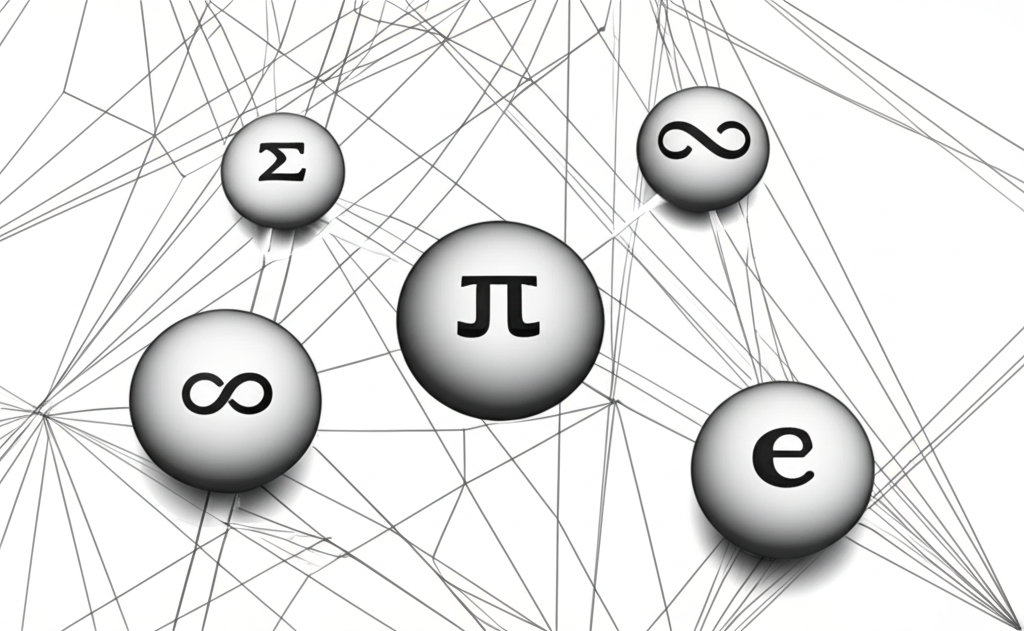 or a relation (e.g., "$>$", "$\leftrightarrow$"). The background is a subtle gradient of deep blues and purples, evoking the vastness of abstract thought.)
III. The Interplay: Quantity and Relation
It is in the synthesis of Quantity and Relation that much of our advanced understanding, particularly in Mathematics and empirical sciences, truly takes flight. These two concepts are rarely found in isolation; rather, they constantly inform and define each other.
Consider the statement: "The Earth is approximately three times larger in diameter than the Moon." Here, "three times larger" is a quantitative relation. It describes not just a quantity (three times) but how that quantity relates the size of two celestial bodies. Similarly, speed is a relation between quantity of distance and quantity of time.
This interplay allows us to build complex models and theories. Without the ability to relate quantities, we could not formulate laws of physics, economic models, or even simple comparisons in daily life. Mathematics, with its sophisticated systems of equations and functions, is the ultimate language for describing these quantitative relations, allowing us to express intricate connections with precision and universality.
IV. Philosophical Perspectives on Quantity and Relation
The philosophical journey to understand quantity and relation spans millennia, with each era adding new layers of insight.
Ancient Insights: The Dawn of Order
- Plato: In his theory of Forms, Plato posited perfect, eternal, and unchanging Forms for mathematical objects. Numbers and geometric figures, as perfect quantities, existed in a realm beyond sensory experience, serving as the ideal blueprints for the imperfect world we perceive. The relations between these Forms were likewise considered eternal truths.
- Aristotle: As mentioned, Aristotle systematically categorized quantity and relation as fundamental ways of being. His empirical approach grounded these concepts in observable reality, analyzing how they manifest in individual substances and their interactions.
Modern Developments: From Cartesian Coordinates to Kantian Categories
- René Descartes: With his development of analytical geometry, Descartes famously united algebra (the study of quantity) and geometry (the study of spatial relations). By representing points in space with numerical coordinates, he demonstrated how quantitative relations could precisely describe spatial configurations, revolutionizing Mathematics and physics.
- Immanuel Kant: In his Critique of Pure Reason, Kant argued that space and time are not properties of things-in-themselves, but rather "pure intuitions" – necessary forms of our sensibility that structure our experience. Quantity and relation, along with other categories, were for Kant "pure concepts of the understanding," fundamental mental frameworks that we impose on raw sensory data to make it intelligible. Without these categories, our experience would be an incoherent jumble. He posited that judgments about quantity and relation are often "synthetic a priori" – informative statements that are known independently of experience, yet are necessarily true for any possible experience.
The ongoing debate continues: are quantity and relation inherent features of an external, objective reality, waiting to be discovered, or are they primarily constructs of the human mind, essential tools for organizing and making sense of our subjective experience?
Conclusion: The Enduring Significance
From the ancient Greek philosophers pondering the nature of numbers to modern physicists mapping the quantitative relations of the universe, the Logic of Quantity and Relation has remained a central pillar of philosophical inquiry. These concepts are not merely academic curiosities but are deeply embedded in our everyday cognition, allowing us to count, measure, compare, and connect the myriad elements of our existence. They underscore the profound interdependence of Mathematics and philosophy, each informing and enriching the other in our collective quest to understand the structure of the cosmos and our place within it. To delve into quantity and relation is to grasp the unseen architecture that gives form and meaning to reality itself.
YouTube Video Suggestions:
-
📹 Related Video: ARISTOTLE ON: The Nicomachean Ethics
Video by: The School of Life
💡 Want different videos? Search YouTube for: ""Aristotle Categories Quantity Relation Philosophy""
2. ## 📹 Related Video: KANT ON: What is Enlightenment?
Video by: The School of Life
💡 Want different videos? Search YouTube for: ""Kant Categories of Understanding Explained""