

Here's a supporting article on "The Logic of Quantity and Measure" for planksip.org, written in the style of Chloe Fitzgerald:
The Logic of Quantity and Measure: Unpacking the "How Much" of Existence
Summary: At its core, philosophy seeks to understand reality, and a fundamental aspect of reality is its quantity – how much of something there is, or how large it is. This article explores how logic provides the essential framework for comprehending and defining quantity and measure, tracing its philosophical roots from ancient Greece to modern thought. We'll delve into how mathematics emerged as the ultimate language for expressing these concepts, revealing the profound interplay between abstract reasoning and our perception of the world.
Introduction: Beyond the Numbers – The Philosophical Heart of Quantity
Hey everyone! Chloe here, diving into something that feels so fundamental we often take it for granted: the simple act of counting, or weighing, or measuring. We live in a world obsessed with data – how many likes, how much money, how long until the weekend? But have you ever stopped to think about the logic underpinning these seemingly straightforward concepts of quantity and measure? It’s not just about crunching numbers; it’s about how we fundamentally structure our understanding of existence itself.
From the moment we distinguish "one apple" from "two apples," we're engaging with the logic of quantity. When we say something is "bigger" or "smaller," we're applying a principle of measure. This isn't just practical; it's profoundly philosophical. It forces us to ask: What is quantity? How do we define it? And what does it mean to truly measure something?
The Ancient Roots: From Aristotle's Categories to Euclid's Elements
Our philosophical journey into quantity and measure truly begins with the titans of ancient thought. The Great Books of the Western World are brimming with these foundational discussions.
- Aristotle and the "How Much": In his Categories, Aristotle famously identified quantity (ποσόν - poson) as one of the ten fundamental ways we can describe something. It answers the question "how much?" or "how many?". He distinguished between discrete quantities (like numbers of things – 1, 2, 3) and continuous quantities (like lines, surfaces, and time, which can be divided infinitely). This was a crucial definition that separated the enumerable from the measurable. For Aristotle, understanding quantity was essential to understanding the very nature of being.
- Plato's Ideal Forms and Numbers: While perhaps less direct in his treatment of measure, Plato's theory of Forms profoundly influenced how we conceive of ideal numbers and geometric shapes. For Plato, the perfect circle or the number "two" existed as eternal, unchanging Forms, accessible through reason, not just empirical observation. This provided an intellectual blueprint for the precision that mathematics would later demand.
- Euclid and the Axiomatic Measure: Perhaps no single work better illustrates the logic of measure than Euclid’s Elements. Here, geometry is built from a handful of definitions, postulates, and common notions. Euclid showed how, starting from simple axioms (like "a straight line may be drawn between any two points"), we could logically deduce complex theorems about lengths, areas, and volumes. This wasn't just practical geometry; it was a monumental demonstration of how rigorous logic could establish precise measures and relationships, providing a model for all subsequent scientific and mathematical inquiry.
The Logic of Discreteness and Continuity
The philosophical challenge of quantity often boils down to distinguishing between things we can count individually (discrete) and things that flow seamlessly (continuous).
- Discrete Quantity: This is the realm of numbers – individual units that can be clearly separated. Think of "three books" or "five ideas." The logic here is straightforward enumeration.
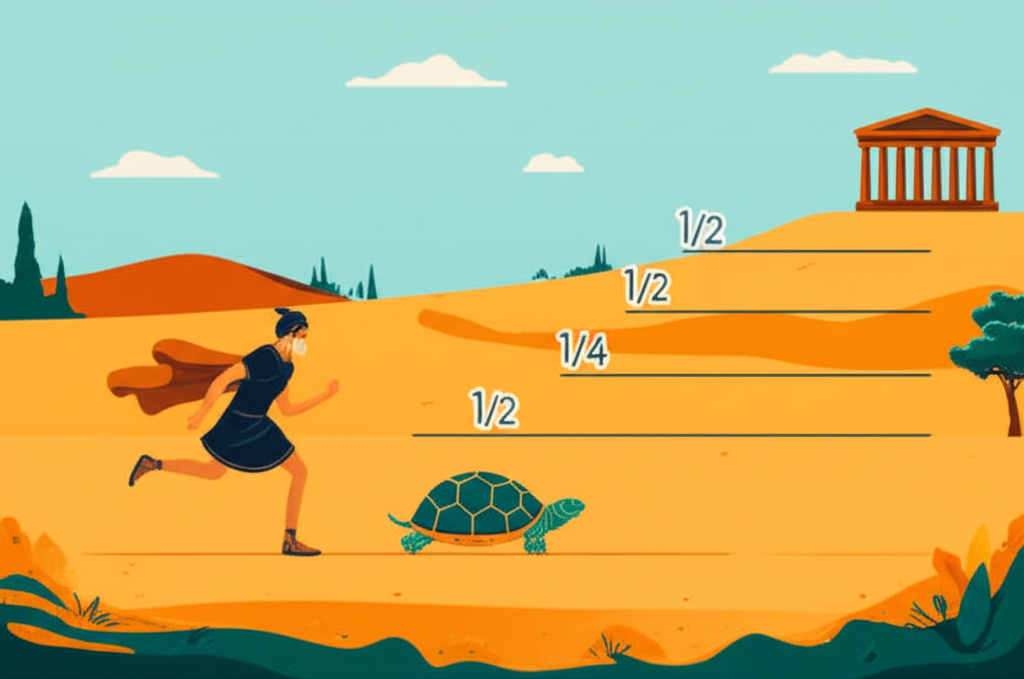
- Continuous Quantity: This is where things get fascinating. Length, time, space – these can be divided infinitely. How many points are on a line? Infinitely many. This leads to profound philosophical puzzles, like Zeno's paradoxes, which challenged the very logic of motion and divisibility. For example, Achilles can never catch the tortoise if he must first cover half the distance, then half of the remaining distance, and so on, infinitely. Zeno forced us to critically examine our definitions of space, time, and movement, pushing the boundaries of what our logic could reconcile.
Mathematics: The Language of Precise Measure
It’s no accident that mathematics evolved alongside philosophy. It’s the ultimate tool – a formal system of logic – for expressing and manipulating quantity and measure.
- From Abstract to Concrete: Mathematics allows us to move beyond vague notions of "many" or "large" to precise statements like "x units" or "y degrees." It provides the definitions and axioms needed to build complex structures of understanding.
- The Power of Definition: In mathematics, definition is paramount. What is a triangle? What is a prime number? Clear, unambiguous definitions are the bedrock upon which all proofs and calculations rest. This logical rigor is what gives mathematics its unparalleled certainty and predictive power.
- Measuring the Immeasurable: Think of calculus, developed by Newton and Leibniz. It provided the mathematics – and therefore the logic – to understand continuous change, rates, and accumulations, essentially allowing us to measure dynamic processes that were previously elusive.
| Philosophical Concept | Role in Quantity & Measure | Key Thinkers (Great Books Context) |
|---|---|---|
| Categories of Being | Identifying Quantity as a fundamental attribute. | Aristotle |
| Forms/Ideals | Establishing perfect, unchanging conceptual models for numbers and shapes. | Plato |
| Axiomatic Systems | Building logically consistent frameworks for geometric measure. | Euclid |
| Primary/Secondary Qualities | Distinguishing objective, measurable properties from subjective perceptions. | Locke, Descartes |
| Categories of Understanding | How the mind structures experience, including quantity. | Kant |
Defining Measure: Standards, Abstraction, and Reality
What does it truly mean to measure something? It's more than just applying a ruler.
- Standardization: To measure is to compare against a known standard. Whether it’s a meter, a kilogram, or a second, these standards are agreed-upon definitions that allow for consistent and universal understanding of quantity.
- Abstraction: When we measure, we abstract a specific attribute (length, weight, time) from the complex whole of a thing. This act of abstraction is a logical process, allowing us to focus on quantifiable aspects.
- The Problem of Precision: While mathematics can be infinitely precise, physical measure always involves some degree of approximation. This philosophical tension between ideal mathematical precision and the inherent fuzziness of empirical reality continues to be a rich area of inquiry.
Why It Matters Today: The Enduring Logic of Our World
The philosophical exploration of the logic of quantity and measure isn't just an academic exercise. It underpins our entire scientific and technological world. From the algorithms that power our devices to the economic models that shape societies, the ability to quantify, define, and measure is paramount. Understanding its philosophical foundations helps us critically evaluate the data we encounter daily, question its assumptions, and appreciate the profound logical structures that allow us to make sense of the "how much" of everything around us.
Further Exploration
📹 Related Video: ARISTOTLE ON: The Nicomachean Ethics
Video by: The School of Life
💡 Want different videos? Search YouTube for: ""Aristotle Categories Quantity Philosophy Explained""
📹 Related Video: ARISTOTLE ON: The Nicomachean Ethics
Video by: The School of Life
💡 Want different videos? Search YouTube for: ""Euclid's Elements Explained: Axioms and Postulates""