

The Logic of Quality and Definition: Unpacking Philosophical Foundations
The human endeavor to comprehend reality fundamentally rests on our ability to articulate what things are. This intricate process, often taken for granted, is governed by a profound interplay between logic, quality, and definition. This article delves into how these three concepts are inextricably linked, forming the bedrock of philosophical inquiry as illuminated by the foundational texts within the Great Books of the Western World. We will explore how the rigorous pursuit of a clear definition for an idea is not merely an academic exercise, but a vital tool for navigating and understanding the world around us.
The Inseparable Triad: Logic, Quality, and Definition
At the heart of all reasoned thought lies logic – the systematic study of valid inference and demonstration. It provides the rules and structures through which we can organize our thoughts, evaluate arguments, and distinguish truth from falsehood. But what is it that logic helps us understand? It is, in essence, the qualities of things.
- Quality: In philosophy, a quality refers to an inherent characteristic, property, or attribute of a thing. It's what something is like – its color, shape, virtue, or nature. Without qualities, things would be indistinguishable, and our world utterly featureless.
- Definition: To define something is to state its meaning, to delineate its boundaries, and to explain its essential qualities. A robust definition aims to capture the essence of a thing, distinguishing it from all other things. It articulates an idea with precision.
- Logic: Logic acts as the method, the instrument, through which we formulate, test, and refine our definitions of qualities. It ensures our definitions are coherent, non-contradictory, and accurately reflect the reality they attempt to describe.
The idea of understanding emerges from this triad. We form an idea of justice, for instance, by logically analyzing its qualities and then articulating these qualities into a comprehensive definition.
Socrates and the Quest for Universal Definitions
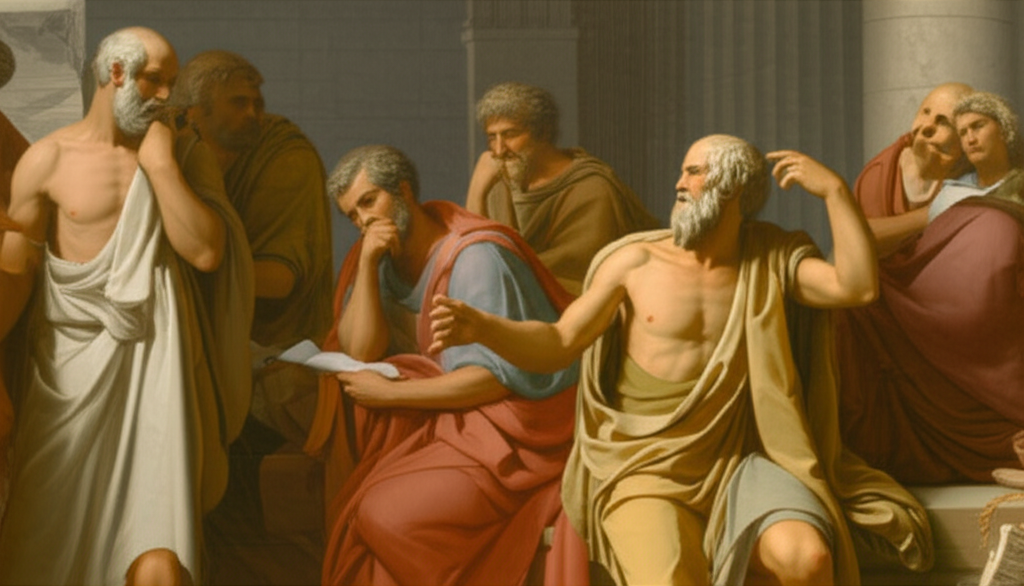
The genesis of this rigorous approach can be traced directly to ancient Greece, most vividly in the dialogues of Plato featuring Socrates. Socrates’ method, famously known as the Socratic method, was a relentless pursuit of universal definitions. He challenged his interlocutors to move beyond mere examples or opinions and to articulate the essential quality of concepts like justice, piety, courage, or virtue.
In dialogues such as Euthyphro, Socrates presses for a definition of piety, not just pious acts. He demonstrates through logic how proposed definitions fail because they are either too narrow, too broad, or contradictory. This quest was driven by the profound idea that if we cannot define a virtue, how can we truly possess or teach it?
Key Socratic Inquiries for Definition:
- What is Piety? (As explored in Plato's Euthyphro)
- What is Virtue? (Central to Meno and other dialogues)
- What is Justice? (The foundational question of Plato's Republic)
- What is Knowledge? (A core theme in Theaetetus)
Socrates believed that by logically stripping away misconceptions and focusing on the core qualities, one could arrive at a true and universal definition, an articulation of the Idea or Form itself.
Aristotle's System: Categorizing Qualities and Defining Essences
Building upon Plato's insights, Aristotle provided an even more systematic framework for understanding quality and definition within the realm of logic. In his seminal work, Categories, Aristotle identified ten fundamental ways in which things can be said to exist or be predicated of a subject. Quality is one of these ten, standing alongside substance, quantity, relation, place, time, position, state, action, and affection.
Aristotle's logic, particularly his theory of definition, became the standard for centuries. He proposed that a proper definition should consist of two parts:
- Genus: The broader class or kind to which the thing belongs.
- Differentia: The specific characteristic or quality that distinguishes it from other members of that class.
For example, the definition of "human" is "rational animal." Here, "animal" is the genus, and "rational" is the differentia – the unique quality that sets humans apart. This precise logical method allowed for the systematic categorization and understanding of the qualities of all things, aiming to capture their essential nature or idea.
Medieval Scholasticism: Precision in Definition and Divine Qualities
The philosophical tradition of the Middle Ages, particularly Scholasticism, embraced and further refined Aristotelian logic and its emphasis on definition. Thinkers like Thomas Aquinas, whose works are central to the Great Books, meticulously applied these principles to theological and metaphysical questions.
Scholastics understood that grasping the qualities of God, angels, or the human soul required exceptionally precise definitions. They grappled with questions like: What are the essential qualities of God? How can we define the nature of grace or sin? Their extensive commentaries and disputations were rigorous exercises in logic, constantly seeking to clarify ideas through exact definitions and to categorize the qualities of existence, both material and immaterial. The idea of God, for instance, was meticulously defined through divine attributes or qualities such as omnipotence, omniscience, and omnipresence.
The Enduring Philosophical Idea: Why Definitions Matter
From the Socratic quest for virtue to Aristotle's comprehensive categories and the scholastic pursuit of divine essence, the journey through the Great Books reveals a consistent thread: the profound importance of logic in establishing clear definitions for the qualities we perceive and conceptualize.
This isn't merely an academic exercise. In law, precise definitions clarify justice; in science, they categorize species and phenomena; in ethics, they delineate right from wrong. The ongoing human effort to clarify our ideas through precise definitions of qualities, guided by the principles of logic, remains a fundamental aspect of all rational inquiry. The Great Books serve as an enduring testament to this continuous philosophical dialogue, offering timeless insights into how we construct our understanding of reality.
Visualizing the Pursuit of Definition
Further Exploration: Digital Resources
📹 Related Video: PLATO ON: The Allegory of the Cave
Video by: The School of Life
💡 Want different videos? Search YouTube for: ""Socratic Method and the Pursuit of Definition Plato""
📹 Related Video: ARISTOTLE ON: The Nicomachean Ethics
Video by: The School of Life
💡 Want different videos? Search YouTube for: ""Aristotle's Categories and Logic Explained""