

The Logic of Opposition: Navigating the Philosophical Battlefield
In the grand tapestry of philosophical inquiry, few concepts are as fundamental, yet as often misunderstood, as The Logic of Opposition. Far from being merely a descriptor for conflict, opposition, when viewed through a philosophical lens, becomes a powerful tool for reasoning, a crucible in which ideas are forged and refined. It is the very engine of intellectual progress, guiding us through the intricate dance of contrasting notions to a deeper understanding of truth itself. At planksip.org, we believe that grappling with these fundamental structures of thought is not just an academic exercise, but an essential skill for anyone seeking to make sense of a complex world.
The Inescapable Presence of Opposition
From the earliest musings of pre-Socratic thinkers to the towering systems of modern philosophy, the concept of opposition has been an enduring preoccupation. It's the recognition that reality, and our understanding of it, is often illuminated by the tension between seemingly contradictory elements. Light needs darkness, good needs evil, being needs non-being to fully define itself. This isn't just poetic flourish; it's a profound insight into the structure of thought and the world.
What is Philosophical Opposition?
At its core, opposition in philosophy refers to a relationship between propositions, concepts, or forces that are mutually exclusive or contrary in some significant way. It's not simply disagreement, but a structured relationship that allows for rigorous logic and analysis. Understanding these relationships is crucial for coherent reasoning and avoiding fallacies.
Aristotle's Enduring Legacy: The Square of Opposition
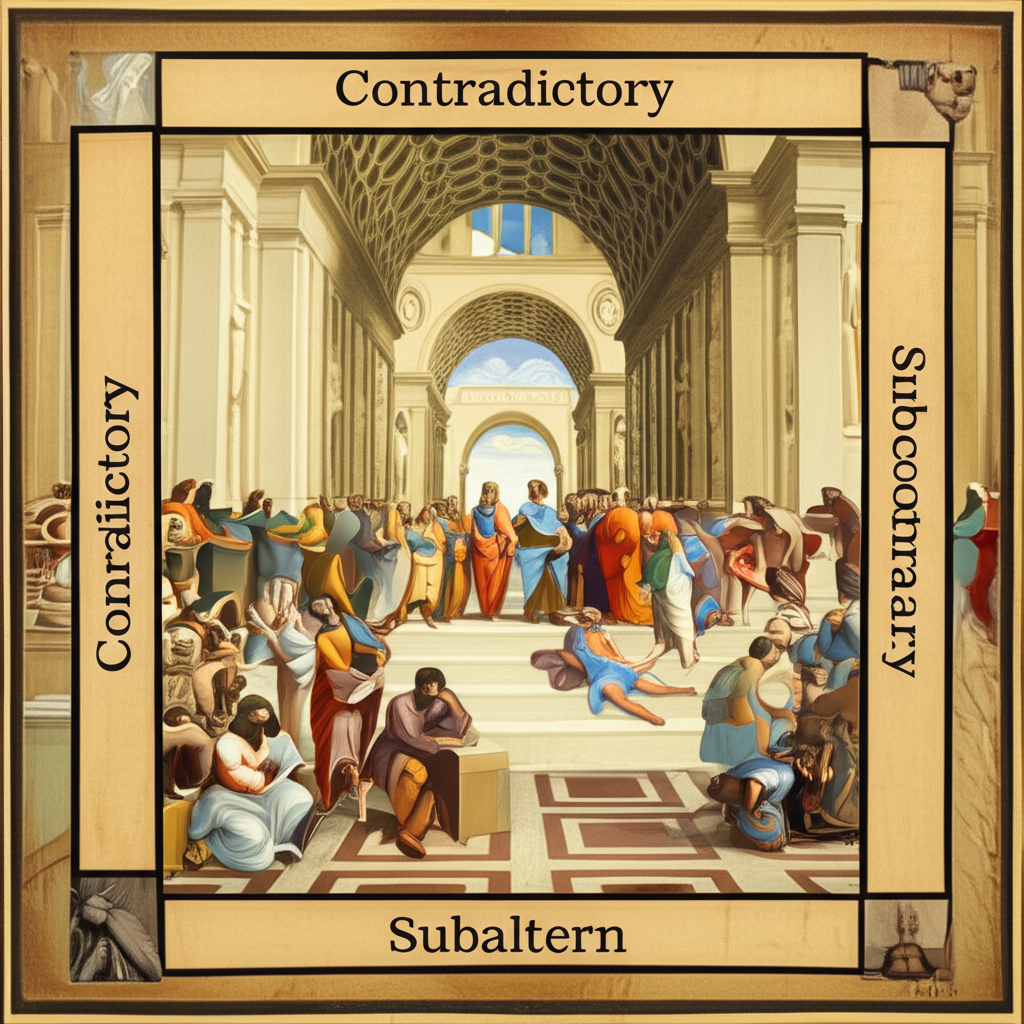
One of the most foundational and influential frameworks for understanding opposition comes from the Great Books of the Western World, specifically the work of Aristotle. His Square of Opposition provides a precise system for analyzing the relationships between four types of categorical propositions. This elegant model is a cornerstone of traditional logic and demonstrates the power of structured reasoning.
| Type of Opposition | Description | Example | Logical Implication |
|---|---|---|---|
| Contradictories | Two propositions that cannot both be true and cannot both be false. They are the direct opposite of each other. | "All S are P" vs. "Some S are not P" | If one is true, the other must be false, and vice-versa. |
| Contraries | Two universal propositions that cannot both be true, but can both be false. | "All S are P" vs. "No S are P" | If one is true, the other must be false. If one is false, the other might be true or false. |
| Subcontraries | Two particular propositions that cannot both be false, but can both be true. | "Some S are P" vs. "Some S are not P" | If one is false, the other must be true. If one is true, the other might be true or false. |
| Subalterns | A relationship between a universal proposition and its corresponding particular proposition. | "All S are P" (Superaltern) vs. "Some S are P" (Subaltern) | If the universal (superaltern) is true, the particular (subaltern) must be true. If the particular is false, the universal must be false. |
This Aristotelian framework is more than just a historical curiosity; it's a robust tool for assessing the validity of arguments and clarifying the precise nature of disagreements. It teaches us to dissect statements and understand their inherent logical implications.
The Dialectical Dance: Opposition as a Path to Synthesis
Beyond formal logic, the concept of opposition takes on a dynamic character in the dialectic. From the Socratic method of questioning to the grand historical narratives of Hegel, dialectic is a mode of philosophical inquiry that thrives on the confrontation of opposing ideas.
Socrates and Plato: Questioning to Truth
In the Great Books, we see Socrates masterfully employing dialectic to expose contradictions in commonly held beliefs. By posing a thesis and then relentlessly challenging it with an antithesis, he would guide his interlocutors towards a more refined understanding, often revealing the limits of their initial reasoning. Plato, in turn, used the interplay of opposites (e.g., the One and the Many, Being and Becoming) to explore the nature of Forms and the structure of reality itself. The dialectic here is not about winning an argument, but about collaborative reasoning towards truth.
Hegel's Grand Synthesis: Thesis, Antithesis, Synthesis
Later, in the works of G.W.F. Hegel, the dialectic becomes a comprehensive system for understanding historical and intellectual development. Hegel proposed that ideas (the thesis) inevitably generate their opposites (the antithesis), and the tension between them leads to a new, higher-level concept that incorporates elements of both (the synthesis). This synthesis then becomes a new thesis, continuing the process. This monumental contribution, found in his challenging but rewarding texts, frames opposition not as a barrier, but as the very mechanism through which consciousness, history, and reality evolve. It’s a powerful testament to the idea that progress often arises from the clash of ideas.
The Practical Power of Oppositional Reasoning
Understanding the logic of opposition isnends itself to profound benefits in everyday thought and critical analysis:
- Clarifying Arguments: By identifying the precise nature of opposition between propositions, we can better understand the core of a disagreement. Are they contradictories (only one can be true)? Or contraries (both could be false)? This precision is vital.
- Strengthening Beliefs: Grappling with opposing viewpoints forces us to rigorously examine our own assumptions and arguments, strengthening them in the process. If a belief can withstand robust opposition, it is likely well-founded.
- Fostering Intellectual Humility: Recognizing the validity or partial validity of an opposing view cultivates a more nuanced and open-minded approach to knowledge. It pushes us beyond simplistic binaries.
- Driving Innovation: In science, art, and philosophy, new ideas often emerge from challenging existing paradigms – from proposing an antithesis to a prevailing thesis.
Conclusion: Embracing the Tension
The logic of opposition is not merely a dry academic concept; it is the vibrant pulse of intellectual life. From Aristotle's precise definitions of logical relations to the grand dialectic of Hegel, the Great Books of the Western World consistently demonstrate that to understand, to reason, and to grow, we must engage with opposing forces. By learning to navigate these philosophical battlefields with careful logic and open minds, we not only sharpen our own intellects but contribute to the ongoing, dynamic conversation that is philosophy itself.
YouTube Video Suggestions:
-
📹 Related Video: ARISTOTLE ON: The Nicomachean Ethics
Video by: The School of Life
💡 Want different videos? Search YouTube for: ""Aristotle's Square of Opposition explained""
2. ## 📹 Related Video: ARISTOTLE ON: The Nicomachean Ethics
Video by: The School of Life
💡 Want different videos? Search YouTube for: ""Hegelian Dialectic explained simply""