

The Logic of Opposition: Navigating the Philosophical Terrain
In the vast landscape of philosophical inquiry, few concepts are as fundamental and pervasive as The Logic of Opposition. Far from being a mere intellectual hurdle, opposition serves as a vital engine for deeper understanding, critical reasoning, and the very advancement of thought. It is through the encounter with conflicting ideas, propositions, and forces that our understanding is refined, our arguments sharpened, and new truths brought to light. This exploration delves into how the systematic study of opposition, a cornerstone of logic, has shaped philosophical discourse from ancient Greece to the present day, revealing its indispensable role in the dialectic process of intellectual growth.
The Inescapable Presence of Opposition in Thought
At its core, opposition in philosophy refers to the relationship between two propositions, concepts, or terms that stand in contrast to each other. This contrast is not merely a difference but a specific kind of incompatibility or tension that compels closer examination. Without the ability to discern and analyze these opposing elements, our capacity for coherent reasoning would be severely limited. It is the very structure of our thought that often relies on defining something by what it is not, or by understanding a concept in relation to its antithesis.
The study of such relationships is central to logic, providing the framework for valid inference and sound argumentation. From the simple act of affirming or denying a proposition to the complex interplay of ideas in a philosophical debate, opposition is the invisible architecture that supports our intellectual structures.
From Aristotle's Foundations to the Dynamic Dialectic
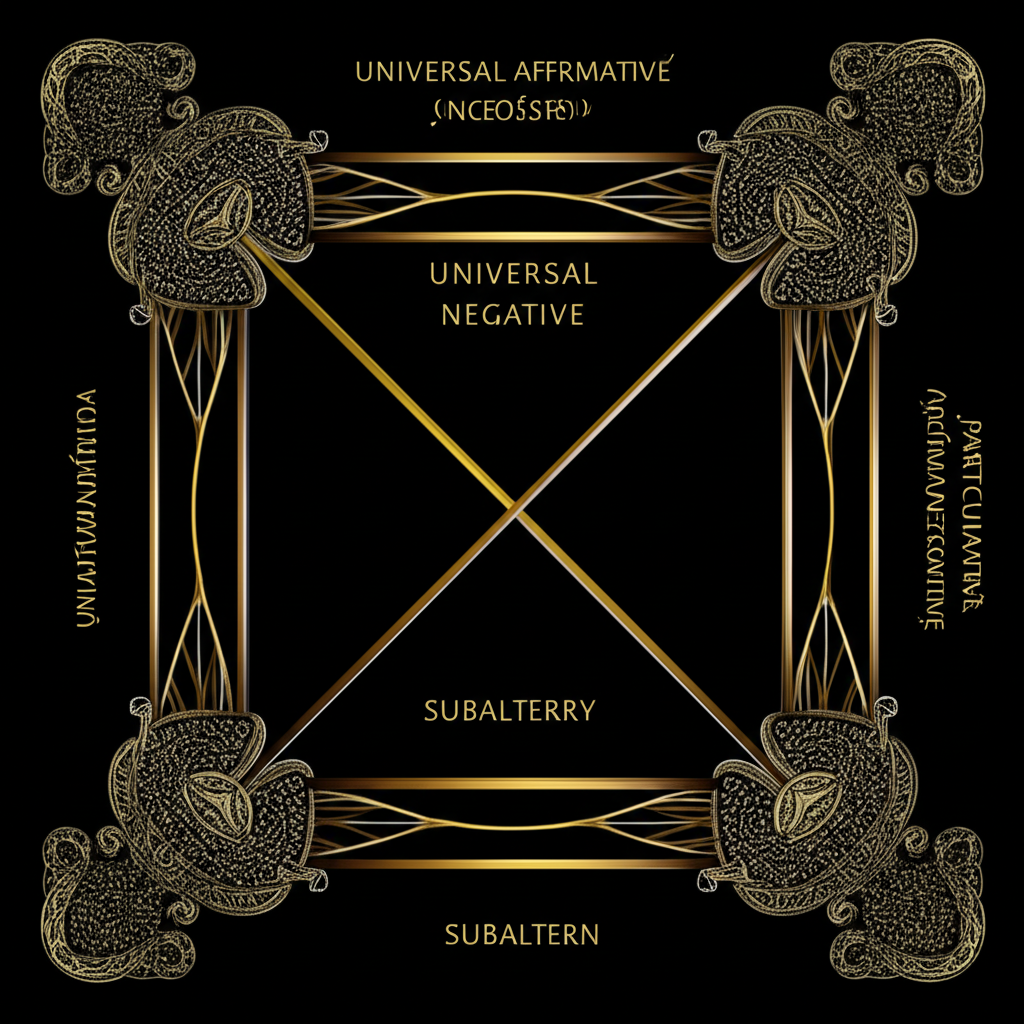
The systematic study of opposition has a rich lineage within the Great Books of the Western World. One of the earliest and most influential treatments comes from Aristotle, particularly in his Categories and On Interpretation. He meticulously laid out different forms of opposition between propositions, forming the basis of what later became known as the Square of Opposition. This foundational work provided a rigorous framework for understanding how the truth or falsity of one statement impacts the truth or falsity of its opposing counterparts.
However, the concept of opposition evolved beyond mere formal logic. The Socratic method, as depicted in Plato's Dialogues, exemplifies a practical application of opposition. Through relentless questioning (elenchus), Socrates would expose contradictions in his interlocutor's beliefs, using the tension of opposing viewpoints to dismantle false assumptions and guide towards a more coherent understanding. This was an early form of dialectic, a method of philosophical inquiry that progresses through the interplay of opposing ideas.
Later, Georg Wilhelm Friedrich Hegel revolutionized the understanding of opposition with his grand system of dialectic. For Hegel, opposition was not merely a static logical relationship but a dynamic process inherent in reality itself. His famous triad of thesis, antithesis, and synthesis posited that ideas (thesis) inevitably generate their opposite (antithesis), and the conflict between them leads to a higher, more comprehensive understanding (synthesis). This Hegelian dialectic underscored how conflict and opposition are not impediments but necessary conditions for the unfolding of truth and the development of consciousness.
Dissecting Opposition: A Categorical Approach
To truly grasp the power of opposition, it's essential to differentiate between its various forms. Aristotle's work provides a classic categorization that remains incredibly useful for precise reasoning:
| Type of Opposition | Description | Example | Logical Relationship |
|---|---|---|---|
| Contradiction | Two propositions that cannot both be true and cannot both be false. | All S are P vs. Some S are not P | If one is true, the other must be false, and vice versa. |
| Contrariety | Two propositions that cannot both be true, but can both be false. | All S are P vs. No S are P | They cannot simultaneously be true, but both could be false (e.g., if Some S are P and Some S are not P). |
| Subcontrariety | Two propositions that cannot both be false, but can both be true. | Some S are P vs. Some S are not P | They cannot simultaneously be false, but both could be true. |
| Subalternation | A relationship where the truth of a universal proposition implies the truth of its particular counterpart. | All S are P implies Some S are P | If the universal is true, the particular must be true; if the particular is false, the universal must be false. |
Understanding these distinctions is crucial for robust logic and for avoiding fallacies in argumentation. It allows us to analyze precisely where disagreements lie and how different statements relate to each other's truth values.
The Productive Power of Opposing Ideas
The enduring lesson from philosophers throughout history is that opposition, when engaged with thoughtfully, is profoundly productive. It is not merely about identifying differences, but about using those differences to forge stronger arguments, uncover hidden assumptions, and arrive at more nuanced conclusions.
The dialectic process, whether in the Socratic method of exposing contradictions or in Hegel's grand philosophical system, demonstrates that intellectual progress often arises from the tension between opposing viewpoints. By confronting an antithesis, we are forced to re-evaluate our thesis, leading to a synthesis that incorporates the strengths of both while overcoming their limitations. This dynamic interplay is the very engine of philosophical reasoning and the pathway to deeper wisdom.
Conclusion: Embracing the Tension for Deeper Understanding
The Logic of Opposition is not merely an academic exercise; it is an essential tool for navigating the complexities of thought, ethics, and existence. From the precise analytical distinctions offered by Aristotelian logic to the transformative power of Hegelian dialectic, the engagement with opposing ideas has consistently driven philosophical inquiry forward. By understanding and embracing the inherent tensions of opposition, we sharpen our reasoning, expand our perspectives, and ultimately move closer to a more comprehensive and truthful understanding of the world.
📹 Related Video: ARISTOTLE ON: The Nicomachean Ethics
Video by: The School of Life
💡 Want different videos? Search YouTube for: ""Aristotle Square of Opposition Explained""
📹 Related Video: What is Philosophy?
Video by: The School of Life
💡 Want different videos? Search YouTube for: ""Hegel Dialectic Explained Philosophy""