

The Enduring Power of Opposites: Exploring the Logic of Opposition
Summary: At the very heart of reasoning and philosophical inquiry lies a foundational concept: opposition. Far from being a mere stumbling block, the interplay of opposing ideas, propositions, and forces is a dynamic engine for understanding truth, refining thought, and driving intellectual progress. From the rigorous formal logic of Aristotle to the grand dialectic of Plato and Hegel, the logic of opposition has been a constant theme, revealing how contradictions and contraries are not just points of conflict but essential components of profound thought. This article delves into how the Great Books of the Western World illuminate this crucial aspect of our intellectual landscape.
Understanding Opposition in Classical Logic
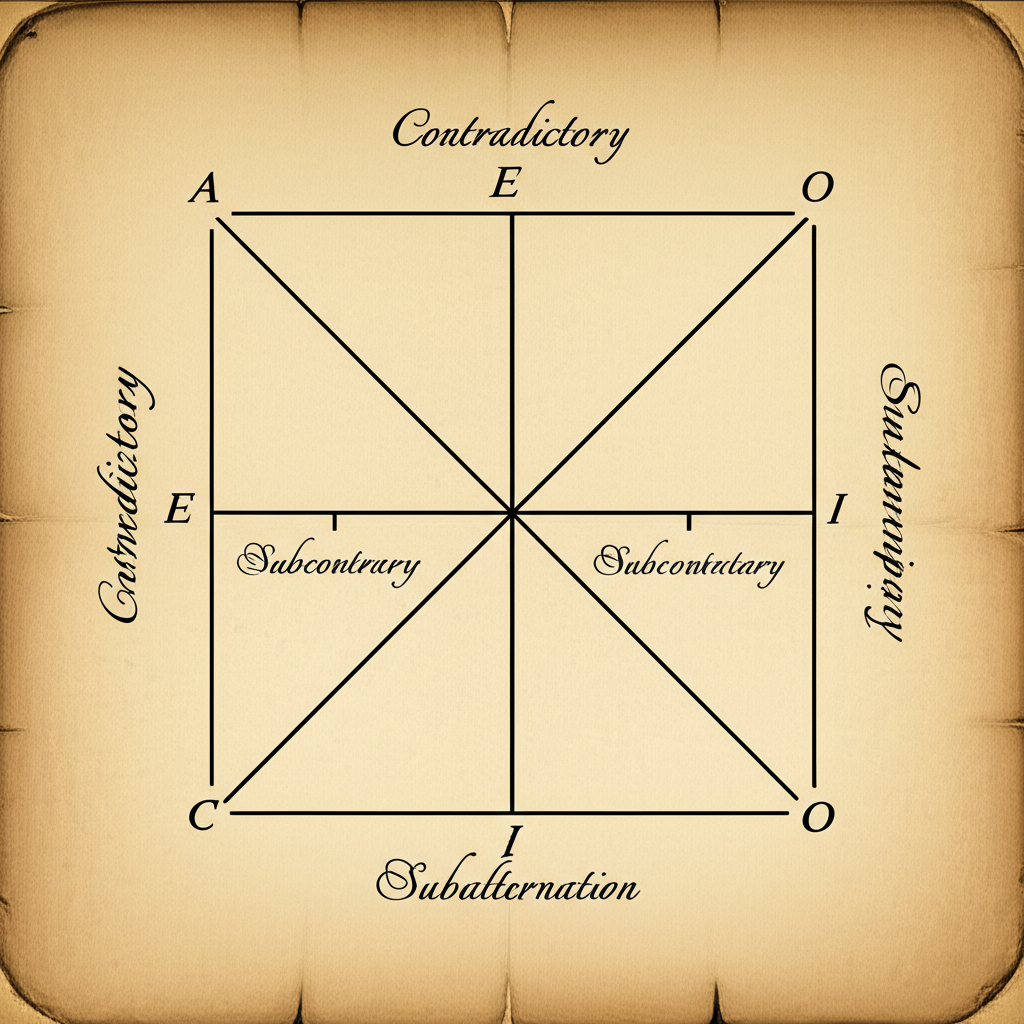
When we speak of logic, particularly its classical forms, the concept of opposition is indispensable. Aristotle, in his Organon, meticulously laid out the framework for understanding how propositions relate to one another, forming what later became known as the Square of Opposition. This ancient model provides a rigorous system for analyzing the truth values of statements based on their quantity (universal or particular) and quality (affirmative or negative).
Consider the fundamental types of opposition defined by Aristotle:
- Contradictories: These are propositions that cannot both be true and cannot both be false. They negate each other entirely.
- Example: "All S are P" and "Some S are not P." If one is true, the other must be false, and vice-versa.
- Contraries: These propositions cannot both be true, but they can both be false.
- Example: "All S are P" and "No S are P." A world where some S are P and some S are not P makes both false.
- Subcontraries: These propositions cannot both be false, but they can both be true.
- Example: "Some S are P" and "Some S are not P." In most real-world scenarios, both can be true.
- Subalterns: This relationship describes a truth inference from a universal proposition to a particular proposition of the same quality.
- Example: If "All S are P" is true, then "Some S are P" must also be true.
This precise categorization of opposition is not merely an academic exercise; it's a bedrock for valid reasoning. Without understanding these relationships, our arguments risk incoherence, and our pursuit of truth becomes a haphazard endeavor. The clarity offered by Aristotle's logic remains a powerful tool for dissecting arguments and ensuring intellectual integrity.
Beyond Formal Logic: The Dialectical Dance
While classical logic provides a static framework for propositional opposition, the concept takes on a more dynamic and generative role in the realm of dialectic. From the Socratic method to the grand philosophical systems of German Idealism, dialectic posits opposition not as an endpoint, but as a driving force of intellectual discovery and historical development.
Plato, a titan among the Great Books authors, masterfully employed dialectic in his dialogues. For Plato, particularly in works like Parmenides or Sophist, the clash of opposing ideas—thesis and antithesis—was the very path to deeper understanding, to move beyond mere opinion towards true knowledge. It was through rigorous questioning, exploring the implications of various standpoints, that one could hope to ascend to the Forms.
Later, G.W.F. Hegel elevated dialectic to the central mechanism of historical and philosophical progress. His famous model of thesis, antithesis, and synthesis describes a process where an initial idea (thesis) generates its opposition (antithesis), and the ensuing conflict leads to a new, higher-level concept (synthesis) that incorporates elements of both, yet transcends them. This synthesis then becomes a new thesis, perpetuating the cycle of intellectual evolution. For Hegel, the logic of opposition was the engine of spirit itself, unfolding through history.
- Dialectic as a Process of Growth:
- Thesis: An initial idea or proposition.
- Antithesis: The opposition or negation of the thesis.
- Synthesis: A new concept that resolves the conflict, incorporating aspects of both, leading to a higher truth.
This dialectic understanding of opposition emphasizes that conflict, when approached intellectually, is not destructive but constructive, pushing the boundaries of human reasoning and societal development.
The Practicality of Paradox: Opposition in Everyday Reasoning
Understanding the logic of opposition extends far beyond academic philosophy; it profoundly impacts our everyday reasoning, critical thinking, and communication. In a world saturated with information and diverse viewpoints, the ability to discern, analyze, and engage with opposing perspectives is paramount.
- Enhancing Critical Thinking: Recognizing contradictory statements or contrary arguments allows us to identify flaws in reasoning and avoid fallacies. It sharpens our ability to evaluate claims and sources.
- Navigating Debates and Discussions: A grasp of opposition equips us to understand the core disagreements in any debate, articulate our own positions more clearly, and anticipate counter-arguments. It encourages a more nuanced approach than simply dismissing opposing views outright.
- Problem-Solving and Innovation: Often, the solution to a complex problem emerges not from a single idea, but from the creative tension between seemingly opposing approaches. Innovation frequently arises from challenging existing paradigms and embracing alternative perspectives.
- Understanding Complex Realities: Many real-world phenomena are inherently paradoxical or contain elements of opposition. From political systems balancing freedom and security to individual choices weighing competing values, the logic of opposition helps us embrace and navigate these complexities without succumbing to oversimplification.
The Great Books remind us that true intellectual maturity involves not shying away from opposition, but engaging with it thoughtfully. It is through this engagement that our reasoning becomes more robust, our understanding more profound, and our capacity for wisdom expanded.
YouTube Video Suggestions:
-
📹 Related Video: What is Philosophy?
Video by: The School of Life
💡 Want different videos? Search YouTube for: "The Square of Opposition Explained Philosophy"
2. ## 📹 Related Video: ARISTOTLE ON: The Nicomachean Ethics
Video by: The School of Life
💡 Want different videos? Search YouTube for: "Hegel Dialectic Thesis Antithesis Synthesis Explained"