

The Logic of Opinion and Knowledge: Navigating the Intellectual Landscape
In our daily lives, we constantly form beliefs, make judgments, and assert claims. But how do we distinguish between a mere opinion and genuine knowledge? This fundamental question, a cornerstone of Western philosophy, hinges critically on the application of logic. This article will explore the intricate relationship between opinion, knowledge, and the indispensable role of logic in our relentless pursuit of truth, drawing insights from the enduring wisdom found within the Great Books of the Western World. We will delve into how logical reasoning provides the framework to evaluate, refine, and ultimately elevate our understanding from the subjective realm of belief to the more objective ground of justified conviction.
Distinguishing Shadows from Substance: What We Think We Know
From the casual chatter of everyday conversation to the most rigorous scientific inquiry, the human mind is ceaselessly engaged in constructing an understanding of the world. Yet, this understanding exists on a spectrum. At one end lies the fleeting, often unexamined belief; at the other, the robust, defensible conviction. The challenge, as philosophers from Plato onward have highlighted, is to discern which is which, and to understand the mechanisms by which we might transition from the former to the latter. It is in this crucial endeavor that logic emerges not merely as a tool, but as the very architect of intellectual progress.
Opinion: The Shifting Sands of Belief
Opinion (or doxa, as Plato termed it) is the realm of subjective belief, often influenced by perception, experience, emotion, or hearsay. It is fallible, contingent, and often lacks a firm foundation in demonstrable evidence or rigorous argument. We hold opinions about everything from the best coffee to complex political policies. These beliefs, while personally significant, do not necessarily carry the weight of universal acceptance or objective verification.
Consider, for instance, a belief that "the new novel by author X is excellent." This is an opinion, rooted in personal taste, perhaps supported by a few positive reviews, but not universally provable. It is a statement of probability or preference, not a claim to absolute truth.
The Influence of Logic on Opinion
While opinion is inherently subjective, logic still plays a vital role in its formation and evaluation. Even an opinion can be more or less logically sound. For example, an opinion based on consistent personal experience and a pattern of observation (inductive reasoning) is generally stronger than one based purely on an emotional whim or a single anecdote.
- Weak Opinions: Often based on fallacies, emotional appeals, or insufficient evidence.
- Stronger Opinions: Supported by some degree of evidence, coherent reasoning, or a broader pattern of observation, even if not fully conclusive.
The application of logic helps us identify the weaknesses in our own opinions and those of others, prompting us to seek better justification.
Knowledge: The Firm Foundation of Justified Truth
In contrast to opinion, knowledge demands a higher standard. Traditionally, knowledge has been defined as "justified true belief." This tripartite definition, often attributed to Plato in his Theaetetus, asserts that for something to be known, three conditions must be met:
- Belief: You must believe the proposition to be true.
- Truth: The proposition must actually be true.
- Justification: You must have good reasons or evidence for your belief.
The third condition—justification—is where logic becomes paramount. It is the process of providing sound arguments, empirical evidence, or rigorous demonstrations that elevate a mere belief to the status of knowledge. Aristotle, in his Organon, meticulously laid out the principles of deductive logic, particularly the syllogism, as the means by which we can arrive at necessary truths and demonstrate conclusions from foundational premises.
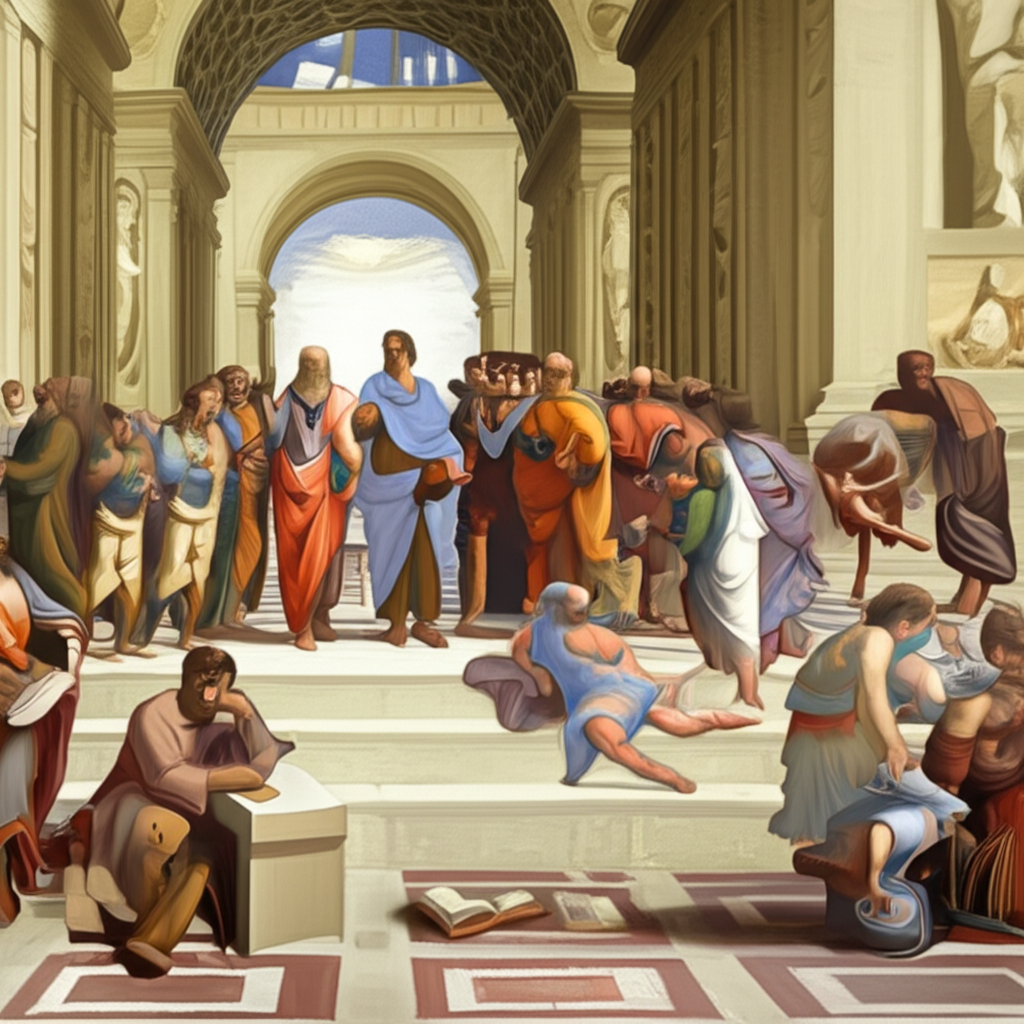
The pursuit of knowledge is not simply about collecting facts; it's about understanding the why and the how. It's about constructing a coherent and defensible framework of understanding, where conclusions are necessitated by premises and evidence is rigorously evaluated through logic.
Logic: The Architect of Understanding and the Path to Truth
Logic is the systematic study of valid inference, the rules by which we can move from premises to conclusions in a way that preserves truth. It serves as the indispensable bridge between fleeting opinion and enduring knowledge. Without logic, our intellectual landscape would be a chaotic sea of unexamined beliefs, with no reliable compass to guide us toward truth.
Tools of Logical Inquiry
- Deductive Reasoning: This form of logic moves from general principles to specific conclusions. If the premises are true and the argument is valid, the conclusion must be true. This is the hallmark of mathematical proofs and formal philosophy.
- Example: All humans are mortal (Premise 1). Socrates is a human (Premise 2). Therefore, Socrates is mortal (Conclusion).
- Inductive Reasoning: This form of logic moves from specific observations to general conclusions. While not guaranteeing certainty, strong inductive arguments make conclusions highly probable. This is crucial for scientific hypotheses and everyday generalizations.
- Example: Every swan I have ever seen is white (Observation). Therefore, all swans are white (Conclusion – though this can be disproven by a black swan).
- Abductive Reasoning: Often called "inference to the best explanation," this form of logic involves finding the simplest and most likely explanation for a set of observations. It's common in diagnostics and detective work.
By employing these logical tools, we can critically analyze arguments, identify fallacies, assess the strength of evidence, and construct more robust justifications for our beliefs. This process is not merely academic; it is how we discern reliable information from misinformation, make informed decisions, and progress in our understanding of the world.
The Dynamic Interplay: From Conjecture to Certainty
The relationship between opinion and knowledge is not always a stark dichotomy but often a continuum. Many areas of inquiry begin with informed opinions, which are then subjected to rigorous logical and empirical testing, gradually solidifying into knowledge. Science itself is a testament to this process, constantly refining hypotheses (opinions) through experimentation and observation, using logic to build theories that approach truth.
The journey from a casual belief to justified knowledge is a testament to human intellectual endeavor and the power of reasoned thought. It requires humility to acknowledge the fallibility of our initial opinions and the discipline to subject them to the scrutiny of logic. The ultimate goal is always the pursuit of truth, understood not as a static endpoint, but as a guiding star for continuous inquiry.
Conclusion: Embracing the Rigor of Thought
In an age inundated with information, the ability to distinguish between mere opinion and genuine knowledge has never been more critical. The logic of opinion and knowledge is not just a philosophical abstraction; it is a practical methodology for navigating the complexities of our world. By understanding the principles of sound reasoning, we empower ourselves to build stronger arguments, evaluate claims more effectively, and ultimately draw closer to a more profound and justified understanding of truth. As the great thinkers of the Western tradition have shown, the path to wisdom is paved with rigorous thought and an unwavering commitment to logic.
📹 Related Video: PLATO ON: The Allegory of the Cave
Video by: The School of Life
💡 Want different videos? Search YouTube for: ""Plato Theory of Knowledge Doxa Episteme" and "Aristotle Logic and Syllogisms Explained""