

The Logic of Opinion and Knowledge: A Journey from Mere Belief to Justified Truth
Summary: In an age awash with information, discerning between mere opinion and genuine knowledge is more critical than ever. This article delves into the fundamental distinctions, arguing that logic serves as the indispensable architect in building a bridge from subjective belief to objective understanding, all in the perennial pursuit of truth. Drawing from the enduring insights of the Great Books of the Western World, we explore how philosophers have grappled with these concepts, offering a framework for intellectual rigor.
The Shifting Sands of Belief: Navigating Opinion
We live in a world where everyone seems to have an opinion on everything. From the mundane to the profound, assertions fly thick and fast, often presented with an air of certainty that belies their true nature. But what, precisely, is an opinion?
An opinion, at its core, is a belief or judgment that is not necessarily based on fact or knowledge. It is often subjective, influenced by personal experience, emotion, cultural background, or even sheer prejudice. While opinions are a vital part of human discourse and personal identity, they lack the rigorous grounding that characterizes knowledge.
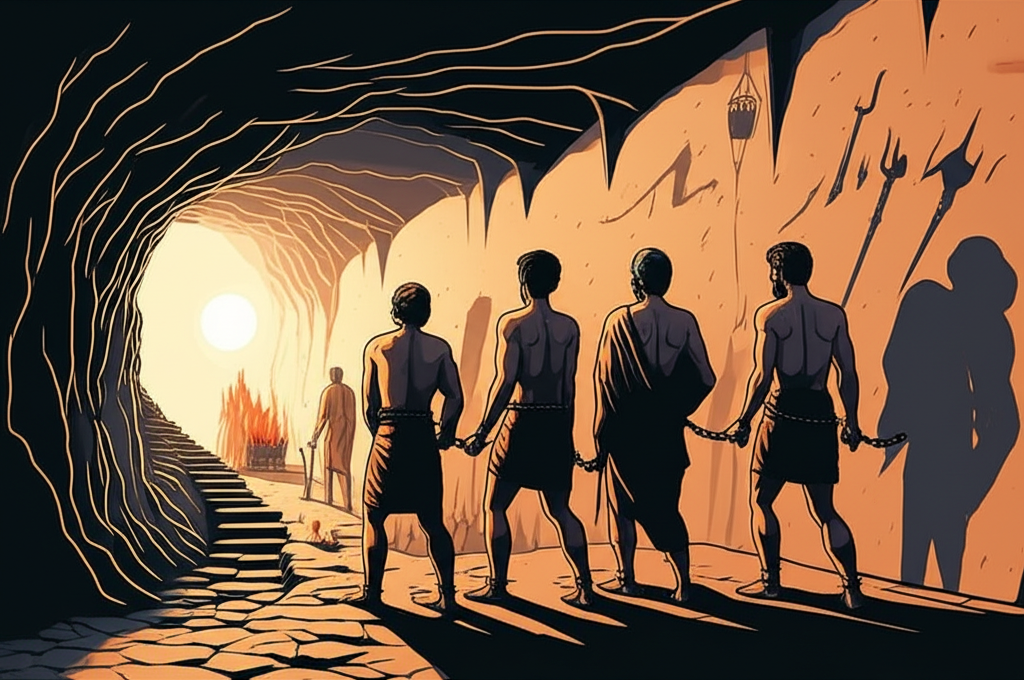
Consider the ancient Greek concept of doxa, often translated as common belief or popular opinion. Philosophers like Plato, as explored in works such as The Republic, viewed doxa with suspicion. It was the realm of appearances, constantly shifting, unreliable, and easily swayed by rhetoric or superficial observation. While not inherently wrong, opinion, without proper logical scrutiny, can lead us astray, mistaking shadows for substance.
Characteristics of Opinion:
- Subjective: Rooted in individual perspective.
- Variable: Can change easily, often without new evidence.
- Lacks Justification: Not necessarily supported by strong evidence or reasoning.
- Often Emotional: Influenced by feelings and biases.
- Persuasive, not Demonstrative: Relies on rhetoric more than proof.
The Rigorous Ascent: Towards Knowledge
In stark contrast to opinion stands knowledge. For centuries, philosophers have sought to define what constitutes genuine knowledge, aiming to distinguish it from mere belief or lucky guess. A widely accepted definition, tracing its roots back to Plato's Theaetetus, posits knowledge as justified true belief. This simple phrase unpacks a profound set of criteria:
- Belief: One must believe the proposition to be true. It’s hard to claim knowledge of something you don't even believe.
- Truth: The proposition must actually be true. You cannot "know" something that is false, even if you firmly believe it.
- Justification: This is the crucial differentiator. The belief must be justified by adequate evidence, reason, or reliable processes. It's not enough to merely believe something true; one must have good reasons for that belief.
The pursuit of knowledge, or episteme in Greek, was the highest aim for many classical thinkers. Aristotle, in his Posterior Analytics, meticulously laid out the structure of demonstrative knowledge, emphasizing syllogistic reasoning and first principles. For him, knowledge was about understanding causes and necessary truths, a stable and universal understanding far removed from the fluctuating world of opinion.
Comparison: Opinion vs. Knowledge
| Feature | Opinion | Knowledge |
|---|---|---|
| Foundation | Subjective feelings, personal experience, common belief | Objective evidence, rigorous reasoning, established facts |
| Stability | Highly variable, susceptible to change | Stable, universal, resistant to arbitrary change |
| Basis | Often emotional, anecdotal, or intuitive | Rational, empirical, demonstrable |
| Truth Claim | May or may not be true; truth is incidental | Must be true; truth is a prerequisite |
| Justification | Weak or absent | Strong, verifiable, logical justification |
| Purpose | Expression of preference, personal view | Understanding, explanation, prediction |
Logic: The Architect of Rational Ascent
This is where logic enters the stage as the indispensable tool. Logic is the systematic study of valid inference and demonstration. It provides the rules and principles by which we can move from premises to conclusions in a sound and reliable manner. Without logic, our beliefs remain adrift, susceptible to sophistry and wishful thinking.
From Aristotle's foundational work on syllogisms to the symbolic logic of modern philosophy, the discipline of logic offers a framework for evaluating arguments. It teaches us to:
- Identify premises and conclusions: What are the foundational claims, and what is being argued for?
- Assess validity: Does the conclusion necessarily follow from the premises?
- Evaluate soundness: Are the premises themselves true, and is the argument valid?
- Detect fallacies: Identify common errors in reasoning that undermine an argument's strength.
The application of logic allows us to scrutinize our own beliefs and those of others, demanding justification and coherence. It forces us to move beyond mere assertion ("I believe X") to reasoned argument ("I believe X because Y and Z, and Y and Z are supported by A, B, C"). This systematic approach is what transforms a belief into a justified belief, bringing it closer to the threshold of knowledge.
Truth: The Guiding Star
Ultimately, the entire endeavor of distinguishing opinion from knowledge, and employing logic, is in service of truth. But what is truth? This question has vexed philosophers for millennia. Is truth correspondence to reality, coherence within a system of beliefs, or simply what works in practice?
While the precise nature of truth remains a complex philosophical debate, it serves as the ultimate benchmark for knowledge. A belief, no matter how strongly held or logically structured, cannot be knowledge if it is not true. The pursuit of truth, therefore, is not merely an academic exercise but a fundamental human drive to understand the world as it truly is, not just as we wish it to be or as it appears to us.
The Great Books continually remind us of this profound quest. From the Socratic method, which aimed to expose false beliefs and ignorance, to Descartes' search for indubitable certainty, the thread of truth runs through the heart of Western thought. It is the destination towards which logic guides our journey from the foggy realm of opinion to the clear light of knowledge.
Conclusion: A Call to Intellectual Rigor
In our interconnected, information-saturated world, the distinction between opinion and knowledge has never been more vital. The ease with which opinions can be formed, shared, and amplified demands a renewed commitment to intellectual rigor. By understanding the nature of opinion, striving for the criteria of knowledge, and diligently applying the principles of logic, we can navigate the complexities of modern discourse with greater clarity and purpose.
The wisdom gleaned from the Great Books of the Western World offers not just historical insight but a timeless challenge: to not merely hold beliefs, but to know – to seek justification, to pursue truth, and to build our understanding on the firm bedrock of reason.
YouTube Video Suggestions:
-
📹 Related Video: PLATO ON: The Allegory of the Cave
Video by: The School of Life
💡 Want different videos? Search YouTube for: ""Plato's Allegory of the Cave explained""
-
📹 Related Video: What is Philosophy?
Video by: The School of Life
💡 Want different videos? Search YouTube for: ""What is Knowledge? Epistemology Introduction""