

The Logic of Monarchy and Tyranny: A Philosophical Disquisition
This article explores the inherent logic underpinning the forms of government known as monarchy and tyranny, drawing from the foundational texts of Western philosophy. We will examine the theoretical justifications for monarchical rule, its potential for stability and efficacy, and how its very structure contains the seeds of its degeneration into tyranny. Understanding this philosophical distinction is crucial for discerning the nature of power, legitimacy, and the common good.
Unpacking the Logic of Single Rule
The concept of a single ruler, whether a king, queen, or emperor, has captivated philosophers for millennia. At its core, the logic of monarchy often rests on principles of unity, efficiency, and stability.
The Appeal of the Benevolent Sovereign
In an ideal sense, a monarch embodies the collective will and welfare of the state. Thinkers like Plato, in his Republic, posited the notion of the "Philosopher King" – a ruler whose wisdom, virtue, and dedication to justice would ensure the flourishing of the polis. The logic here is that a singular, enlightened intellect, unburdened by the squabbles of factions, can make swift, decisive, and ultimately beneficial decisions for all.
- Efficiency: Decisions can be made quickly without the need for extensive debate or compromise.
- Stability: A clear line of succession can prevent civil strife and ensure continuity of government.
- Unity: The monarch can serve as a unifying symbol for the nation, embodying its traditions and aspirations.
Thomas Hobbes, in Leviathan, also presented a powerful argument for absolute sovereignty, often manifesting as a monarchical system. For Hobbes, the horrors of the "state of nature" – a war of all against all – necessitated a powerful, unquestionable sovereign to maintain order and prevent societal collapse. The logic is stark: better absolute rule than utter chaos.
The Perilous Path: From Monarchy to Tyranny
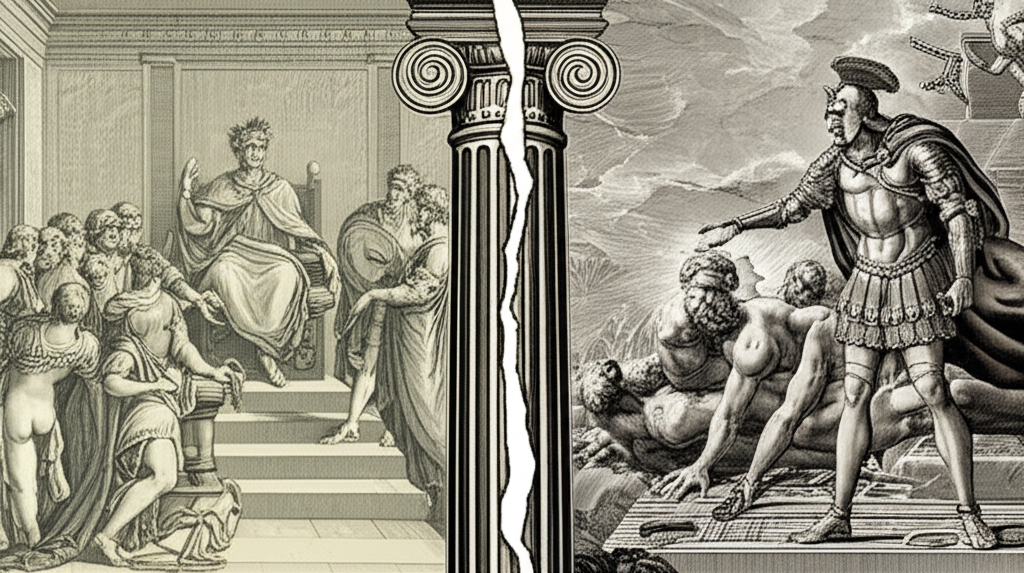
However, the very concentration of power that gives monarchy its theoretical strength also contains its greatest weakness: the potential for corruption and the slide into tyranny. Aristotle, in his Politics, famously classified governments not just by the number of rulers, but by their purpose. A monarchy, he argued, is a rule by one for the common good. Its perversion, tyranny, is a rule by one for the self-interest of the ruler.
This degeneration is not merely a moral failing but often follows a discernible logic:
- Concentration of Power: Absolute power, as the adage goes, tends to corrupt absolutely.
- Lack of Accountability: Without checks and balances, the monarch's will becomes law, unconstrained by external forces.
- Erosion of Law: The rule of law, which ideally binds even the monarch, can be superseded by arbitrary decrees.
- Self-Interest: The ruler begins to prioritize personal gain, legacy, or security over the welfare of the subjects.
Niccolò Machiavelli, in The Prince, while not explicitly advocating for tyranny, certainly explored the ruthless logic required for a ruler to acquire and maintain power, often at the expense of conventional morality. His work highlights the practical considerations that can lead a prince, initially perhaps well-intentioned, to adopt tyrannical methods to secure his rule.
Distinguishing the Two: A Philosophical Lens
The crucial distinction between a legitimate monarchy and an illegitimate tyranny lies not in the number of rulers, but in the nature of their rule, their ends, and their relationship to the governed.
Key Differentiators
| Feature | Monarchy (Aristotelian Ideal) | Tyranny (Aristotelian Perversion) |
|---|---|---|
| Purpose of Rule | The common good, welfare of the state | Self-interest of the ruler, personal gain |
| Source of Legitimacy | Tradition, divine right, consent, justice | Force, usurpation, fear |
| Rule of Law | Governed by established laws, traditions | Arbitrary decrees, ruler's whim is law |
| Treatment of Subjects | Citizens with rights and duties | Subjects or slaves, objects of the ruler's will |
| Stability | Tends towards long-term stability | Prone to rebellion, instability, and violence |
| Virtue | Aims for justice, prudence, courage | Characterized by avarice, cruelty, deceit |
The Right to Resist Tyranny
This philosophical distinction has profound implications for the concept of political obligation. If a monarch rules justly for the common good, their authority is often seen as legitimate. However, when a ruler descends into tyranny – violating natural rights, ruling arbitrarily, and prioritizing self-interest – the logic shifts. Thinkers like John Locke, in his Two Treatises of Government, argued that government derives its just powers from the consent of the governed. When a ruler acts tyrannically, breaking the social contract, the people retain the right, and sometimes the duty, to resist and overthrow such an illegitimate regime. This represents a fundamental shift in the logic of power, from divine right or inherited authority to the sovereignty of the people.
Conclusion: A Delicate Balance of Power
The logic of monarchy presents a compelling vision of unified and efficient government, capable of steering the state towards prosperity and stability. Yet, as the historical record and philosophical inquiry consistently demonstrate, this very concentration of power is a double-edged sword. The potential for a monarch to become a tyrant is a constant shadow, a testament to the fragile nature of human virtue and the corrupting influence of unchecked authority. Understanding this dynamic interplay, as explored by the great minds of Western thought, remains essential for any serious consideration of political philosophy and the enduring quest for just governance.
YouTube: "Plato Aristotle forms of government"
YouTube: "John Locke social contract tyranny"
📹 Related Video: What is Philosophy?
Video by: The School of Life
💡 Want different videos? Search YouTube for: "The Logic of Monarchy and Tyranny philosophy"