

The Logic of Judicial Judgment: A Philosophical Inquiry into Legal Decision-Making
Judicial judgment, at its core, is a profound exercise in practical philosophy, demanding a rigorous application of logic to the intricate tapestry of human affairs. This article explores how judges, tasked with upholding justice within the framework of law, navigate the complexities of evidence, precedent, and ethical considerations. We will delve into the philosophical underpinnings that seek to transform subjective interpretation into an objective and defensible judgment, drawing insights from the Great Books of the Western World to illuminate the enduring quest for rational and equitable legal outcomes.
The Quest for Rational Judgment in Law
From the earliest philosophical inquiries, humanity has grappled with the notion of fairness and the systematic application of rules to resolve disputes. The very foundation of a civilized society rests upon the expectation that legal judgments are not arbitrary pronouncements but reasoned conclusions. How, then, do we ensure that a judge’s decision is a product of sound reasoning rather than mere opinion or prejudice? This question leads us directly to the heart of our inquiry: the indispensable role of logic in the judicial process.
The ancients, particularly the Greeks, understood that the administration of justice required a coherent method. Plato, in his Laws, envisioned a state governed by reason, where laws were not simply commands but expressions of a higher order. Aristotle, with his meticulous analysis of syllogistic reasoning, provided the very tools for deductive thought that would later become cornerstones of legal argumentation. The ideal judge, therefore, is not merely an interpreter of statutes but a philosopher-king of sorts, capable of applying universal principles to particular cases with precision and equity.
The Foundational Role of Logic in Judicial Reasoning
At its most fundamental level, judicial judgment is an exercise in applied logic. Judges are presented with premises – facts, statutes, precedents – and are expected to arrive at a conclusion through a process of valid inference. This often involves both deductive and inductive reasoning:
- Deductive Reasoning: This is the classic legal syllogism.
- Major Premise: A general rule of law (e.g., "All persons who commit premeditated murder shall be punished by life imprisonment.").
- Minor Premise: A specific fact pattern (e.g., "John Doe committed premeditated murder.").
- Conclusion: The resulting judgment (e.g., "Therefore, John Doe shall be punished by life imprisonment.").
This form of logic aims for certainty, provided the premises are true and the inference is valid.
- Inductive Reasoning: This involves drawing general conclusions from specific instances, often seen in the development of common law or the interpretation of legislative intent. A judge might observe a pattern of previous judgments in similar cases and infer a broader principle, which then informs future decisions. While not yielding the same certainty as deduction, it is crucial for adapting law to evolving societal norms and unforeseen circumstances.
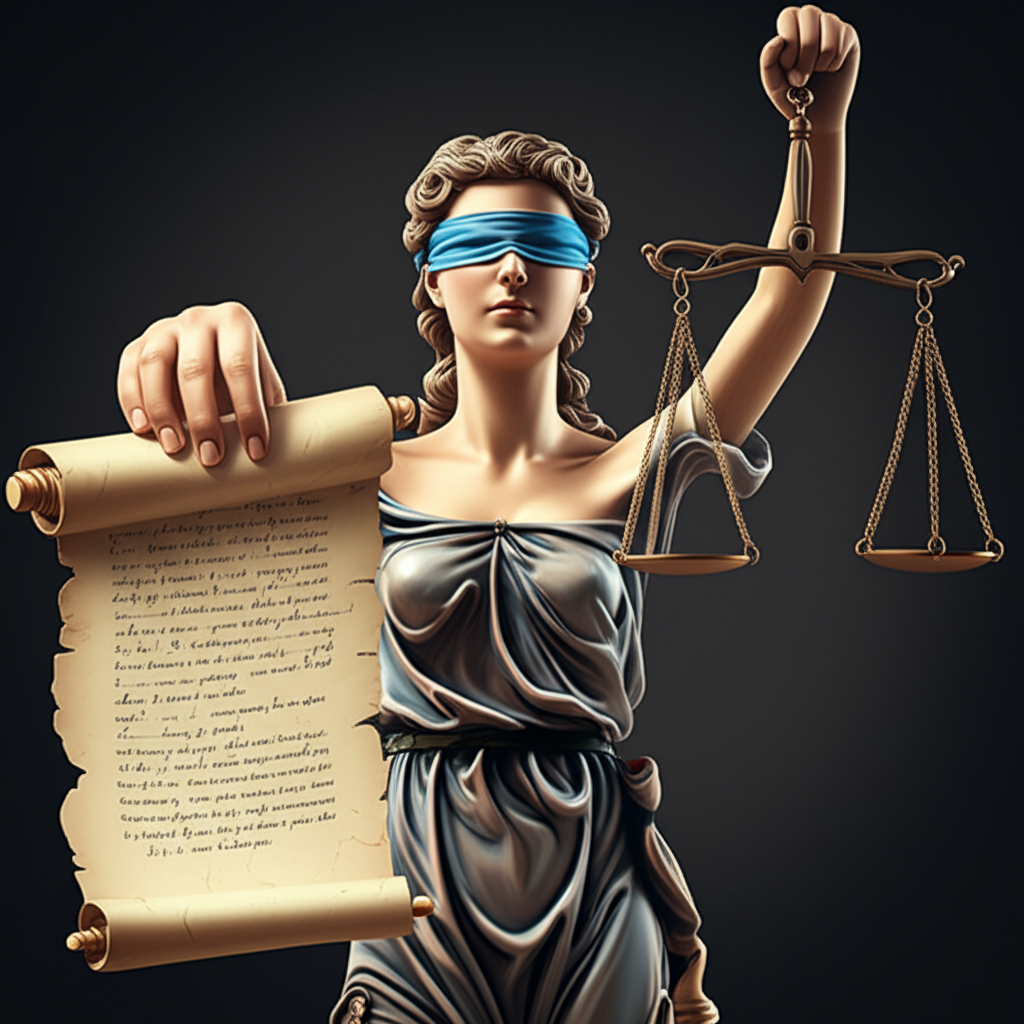
The challenge lies in ensuring that the premises themselves are sound and that the logical leaps are not fallacious. This demands not only intellectual rigor but also a profound understanding of the human condition, echoing the Socratic injunction to "know thyself" and, by extension, to understand the world in which law operates.
Judgment Beyond Mere Syllogism: The Nuances of Justice
While logic provides the skeleton for judicial reasoning, the flesh and blood of justice often demand more than a simple syllogism. Legal cases are rarely as neat as textbook examples. Facts are contested, statutes are ambiguous, and precedents can conflict. Here, the judge's judgment transcends purely formal logic and enters the realm of practical wisdom, or phronesis, as Aristotle termed it.
- Interpretation of Law: Statutes are not always perfectly clear. Judges must interpret legislative intent, often considering the historical context, the purpose of the law, and its potential societal impact. This requires a form of interpretive logic that goes beyond the literal text.
- Equity and Fairness: Strict adherence to the letter of the law can sometimes lead to unjust outcomes. The concept of equity, deeply rooted in Roman law and later elaborated upon by thinkers like Aquinas, allows for flexibility to mitigate harshness and ensure a fairer judgment in exceptional circumstances. This is where the pursuit of justice guides the application of law, sometimes adjusting the purely logical conclusion for a more humane one.
- Discretion: Many laws grant judges a degree of discretion in sentencing or applying remedies. This discretion is not an invitation to arbitrariness but a call for a reasoned judgment informed by principles of proportionality, rehabilitation, and public safety.
The tension between strict logical application and the pursuit of substantive justice is a perennial philosophical debate. It highlights that legal judgment is not merely mechanical but a sophisticated act of balancing competing principles and values.
The Interplay of Principles and Precedent
The stability and predictability of the law depend heavily on the principle of stare decisis, or adherence to precedent. Past judicial judgments serve as guiding principles, creating a framework of established law.
Factors Influencing Judicial Judgment:
- Statutory Text: The precise wording of the law passed by the legislature.
- Constitutional Principles: Overarching mandates and rights enshrined in the constitution.
- Case Precedent: Previous judgments by higher courts or courts of equal standing in similar cases.
- Legislative History: The records and debates surrounding the creation of a law, used to discern intent.
- Public Policy: Considerations of the broader societal impact and goals of the law.
- Legal Philosophy: Underlying theories of justice, rights, and the role of the state.
The judge must logically distinguish relevant precedents from irrelevant ones, identify the ratio decidendi (the rationale for the decision), and apply it consistently. However, logic also dictates that precedents can be overturned if they are found to be based on flawed reasoning, have become unworkable, or are no longer aligned with evolving constitutional understanding or societal values. This dynamic process ensures that while law maintains stability, it also possesses the capacity for necessary evolution, always striving for a more perfect justice.
The Challenge of Subjectivity and the Pursuit of Objectivity
A critical philosophical challenge in judicial judgment is the inherent subjectivity of human decision-making. Judges are individuals with their own experiences, biases, and worldviews. The pursuit of objectivity in law is an ongoing battle against these subjective inclinations. Thinkers like Immanuel Kant, with his emphasis on universal moral law and the categorical imperative, provide a philosophical framework for transcending individual inclination in favor of universally applicable principles.
The rigorous application of logic, the adherence to established legal methodologies, and the constant scrutiny of appellate review are all mechanisms designed to minimize individual bias and steer judgment towards a more objective, impartial outcome. The ideal, often articulated by figures like John Locke, is a rule of law where decisions are based on established, clear principles, ensuring that all citizens are treated equally before the law, rather than being subject to the whims of an individual.
Conclusion: The Enduring Pursuit of Logical Justice
The logic of judicial judgment is a sophisticated blend of formal reasoning, interpretive wisdom, and an unwavering commitment to justice. It is a process deeply rooted in the philosophical traditions that have shaped Western thought, constantly striving to bridge the gap between abstract principles and the concrete realities of human disputes. From Aristotle's syllogisms to Kant's categorical imperatives, the Great Books of the Western World offer a timeless dialogue on how reason can guide the difficult task of administering law and achieving justice. The ideal judge, therefore, is not merely a technician of the law but a philosopher in practice, whose judgments reflect a profound understanding of logic, an acute awareness of human context, and an enduring dedication to fairness. The quest for perfectly logical justice remains an ongoing, essential philosophical endeavor.
YouTube Video Suggestions:
-
📹 Related Video: ARISTOTLE ON: The Nicomachean Ethics
Video by: The School of Life
💡 Want different videos? Search YouTube for: ""Aristotle Logic Syllogism Law""
2. ## 📹 Related Video: What is Philosophy?
Video by: The School of Life
💡 Want different videos? Search YouTube for: ""Philosophy of Law Justice Judicial Reasoning""