

The Logic of Judgment: Unpacking the Foundation of Thought
Summary: At its core, the logic of judgment is the philosophical and formal study of how we affirm or deny something about something else, and how these assertions relate to truth. It is the fundamental act of mind that bridges individual concepts into meaningful propositions, forming the bedrock upon which all complex reasoning is built. Understanding this logic is crucial for distinguishing valid arguments from mere opinion and for systematically pursuing knowledge.
The Essence of Judgment: Our Mental Architecture
As Daniel Fletcher, I've always found the seemingly simple act of making a judgment to be one of the most profound functions of the human intellect. Before we can engage in elaborate arguments or construct grand theories, we must first be able to say, with some degree of certainty, that "X is Y" or "X is not Y." This seemingly straightforward mental operation—the judgment—is the very crucible in which concepts are forged into propositions capable of bearing truth or falsehood.
Consider the vast landscape of human knowledge, from the ancient treatises of Aristotle to the intricate theorems of modern science. Every single piece of understanding, every assertion of fact, every moral decree, begins with a judgment. It is the moment the mind declares a relationship between two or more ideas, moving beyond mere apprehension of concepts to an assertion about reality. Without this foundational logic, our thoughts would remain fragmented and uncommunicative.
Aristotle's Foundation: Predication and Truth
When we delve into the Great Books of the Western World, few figures loom larger in the domain of logic than Aristotle. His works, particularly On Interpretation and Prior Analytics, lay the groundwork for understanding the structure and function of judgment. For Aristotle, a judgment, or a proposition, is a statement that can be either true or false. It is not merely a word or a phrase, but a complete thought that affirms or denies something.
The heart of an Aristotelian judgment lies in predication: the act of attributing a property or characteristic (the predicate) to a subject. When we say, "Socrates is a man," we are predicating 'man' of 'Socrates'. This act of predication is what allows a statement to correspond (or fail to correspond) with reality, thereby acquiring a truth value.
- Truth Conditions: A judgment is true if what it asserts corresponds to the state of affairs in reality. If Socrates is indeed a man, the judgment is true. If we were to say "Socrates is a rock," the judgment would be false because it does not correspond to reality.
- The Law of Non-Contradiction: Central to Aristotle's logic of judgment is the principle that a thing cannot both be and not be in the same respect at the same time. A judgment cannot be simultaneously true and false. This bedrock principle ensures the coherence of our thought and reasoning.
The Anatomy of a Judgment: Subject, Predicate, Copula
To fully appreciate the logic of judgment, it's helpful to dissect its basic components. Every simple categorical judgment, as understood in traditional logic, consists of three essential parts:
- Subject (S): That about which something is affirmed or denied. It is the entity or concept being discussed.
- Predicate (P): That which is affirmed or denied about the subject. It describes a quality, characteristic, or relationship.
- Copula: The linking verb (typically "is" or "is not") that connects the subject and the predicate, indicating the affirmation or denial.
Let's illustrate with a simple table:
| Component | Description | Example: "All humans are mortal." |
|---|---|---|
| Subject | The entity or concept being discussed. | Humans |
| Copula | The linking verb, affirming or denying. | are |
| Predicate | The quality or characteristic attributed to the subject. | mortal |
This structure, simple as it may seem, is the universal template for declarative statements across languages and cultures, forming the basis for how we express and evaluate truth claims.
Judgment and Reasoning: Building Blocks of Thought
Individual judgments are not isolated islands of thought. Instead, they serve as the fundamental building blocks for more complex forms of reasoning. When we link two or more judgments together in a structured way to derive a new judgment, we are engaging in inference, or argumentation. Aristotle's theory of the syllogism, detailed in Prior Analytics, is the quintessential example of how judgments combine:
- Premise 1 (Judgment): All men are mortal.
- Premise 2 (Judgment): Socrates is a man.
- Conclusion (Derived Judgment): Therefore, Socrates is mortal.
Here, two distinct judgments (premises) are logically connected to yield a third (conclusion). The truth of the premises, combined with the validity of the reasoning structure, determines the truth of the conclusion. This demonstrates how the logic of judgment is not merely about individual statements but about the coherent and systematic progression of thought.
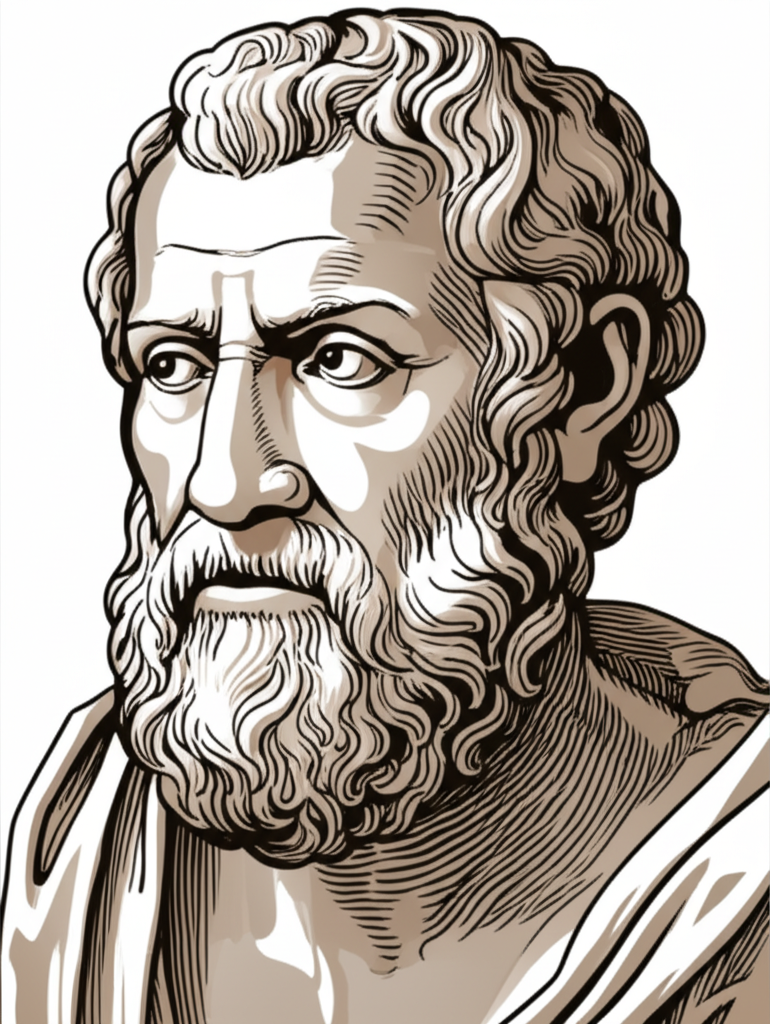 standing before a blackboard or tablet, on which a simple syllogism is clearly written. The philosopher is pointing thoughtfully at the conclusion, while a group of students in togas observe intently. The background shows an Athenian stoa or academy, emphasizing the pursuit of knowledge and logical inquiry.)
The Quest for Truth: Beyond Mere Assertion
The very purpose of understanding the logic of judgment is to navigate the complex relationship between our thoughts and reality, ultimately in the pursuit of truth. A judgment is not merely an expression of an opinion; it is a claim about how things are. The rigorous analysis of judgment allows us to:
- Clarify our thoughts: By dissecting our judgments into subject, copula, and predicate, we can identify ambiguity and vagueness.
- Evaluate claims: We can assess whether a judgment has a coherent structure and whether its components are well-defined.
- Test for truth: The logic provides the framework for asking: "Does this judgment correspond to reality?" or "Is this judgment consistent with other established truths?"
Without the ability to critically examine the judgments we make and encounter, we would be adrift in a sea of unsubstantiated claims, unable to distinguish knowledge from mere belief. The logic of judgment provides the compass for this intellectual journey.
Conclusion: The Enduring Significance of Judgment
From the foundational texts of the Great Books of the Western World to contemporary philosophical discourse, the logic of judgment remains an indispensable area of study. It reminds us that clear reasoning and the pursuit of truth begin with the careful formation and evaluation of our most basic assertions. To understand how we judge, what a judgment entails, and how it connects to the broader tapestry of logic, is to understand the very architecture of human thought. It is the essential first step on any philosophical journey, enabling us to build robust arguments and cultivate genuine knowledge.
YouTube Video Suggestions:
-
📹 Related Video: ARISTOTLE ON: The Nicomachean Ethics
Video by: The School of Life
💡 Want different videos? Search YouTube for: ""Aristotle Logic Basics" or "Introduction to Aristotelian Logic""
-
📹 Related Video: What is Philosophy?
Video by: The School of Life
💡 Want different videos? Search YouTube for: ""What is a Proposition in Philosophy" or "Truth and Falsehood in Logic""