

The Logic of Judgment: Navigating the Architecture of Thought
A Clear Path to Understanding How We Know
At the heart of human understanding lies the act of judgment. It's not merely an opinion, but a fundamental operation of the mind where we affirm or deny something about reality. The logic of judgment explores the rules and structures governing this crucial mental process, revealing how we move from raw perception to coherent assertions, and ultimately, how we strive for truth. This article delves into the philosophical underpinnings of judgment, drawing insights from the "Great Books of the Western World" to illuminate the pathways of sound reasoning and the pursuit of verifiable truth. Understanding the logic of judgment is essential for anyone seeking to think critically, communicate clearly, and navigate the complex tapestry of knowledge.
What is Judgment? More Than Just an Opinion
In philosophy, a judgment is the mental act by which we relate two concepts, a subject and a predicate, and either affirm or deny that the predicate belongs to the subject. It is the assertion of a proposition, such as "The sky is blue" or "Justice is not merely the interest of the stronger." Unlike simple apprehension (grasping a concept) or reasoning (connecting multiple judgments), judgment is the decisive "yes" or "no" that forms the building blocks of our knowledge.
- Affirmation: Asserting that something is the case. (e.g., "All humans are mortal.")
- Denial: Asserting that something is not the case. (e.g., "No squares are circles.")
This act is intrinsically linked to the pursuit of truth. When we make a judgment, we implicitly claim that our mental assertion corresponds to a state of affairs in reality. The logic of judgment provides the framework for evaluating whether these claims are well-founded, consistent, and ultimately, true.
The Aristotelian Foundation: Logic and the Structure of Propositions
The systematic study of judgment finds its roots deep within classical philosophy, most notably in Aristotle's Organon. Aristotle laid the groundwork for formal logic by analyzing the structure of propositions (the linguistic expressions of judgments). He identified the core components:
- Subject (S): What the judgment is about.
- Predicate (P): What is affirmed or denied about the subject.
- Copula: The verb "is" or "is not," which connects the subject and predicate and expresses the affirmation or denial.
For Aristotle, a judgment like "Socrates is mortal" is a simple categorical proposition. The logic then extends to how these simple judgments combine to form complex reasoning processes, such as syllogisms. Every premise in a syllogism is itself a judgment, and the validity of the reasoning depends on the logical relationships between these constituent judgments.
- Example of a Syllogism:
- Judgment 1 (Premise): All men are mortal.
- Judgment 2 (Premise): Socrates is a man.
- Judgment 3 (Conclusion): Therefore, Socrates is mortal.
Here, the conclusion is a new judgment derived logically from the preceding ones, demonstrating the power of reasoning built upon sound judgments.
The Pursuit of Truth: The Guiding Star of Judgment
The ultimate purpose of sound judgment is to arrive at truth. While opinions can be subjective and vary widely, truth aims for objectivity – a correspondence between our mental assertions and reality itself. The logic of judgment is the intellectual discipline that helps us distinguish between well-founded judgments and mere assertions lacking substantiation.
Truth is not simply a matter of belief; it requires justification. Through rigorous reasoning and adherence to logical principles, we strive to ensure our judgments are:
- Consistent: Free from internal contradictions.
- Coherent: Fitting together logically with other established truths.
- Evidentially Supported: Backed by sensory experience, empirical data, or rational demonstration.
Without the logic of judgment, our assertions would lack a basis for evaluation, and the very concept of truth would become elusive.
Historical Echoes: Great Minds on Judgment and Reasoning
The concept of judgment and its logic has been a central concern for philosophers throughout history, each adding layers of complexity and insight.
Key Philosophical Contributions to the Logic of Judgment:
| Philosopher | Key Contribution to Judgment and Logic | Relevant Work(s) |
|---|---|---|
| Aristotle | Established formal logic, analyzing the structure of propositions (judgments) as subject-predicate relationships. Developed the syllogism as a system of deductive reasoning from premises (judgments) to conclusions. Defined truth as the correspondence between a judgment and reality. | Organon (especially On Interpretation and Prior Analytics) |
| René Descartes | Emphasized the importance of clear and distinct perceptions for forming reliable judgments. Advocated for systematic doubt to clear away preconceived notions, allowing for judgments to be based on indubitable certainty. The will's role in assenting to judgments is crucial. | Meditations on First Philosophy |
| Immanuel Kant | Distinguished between analytic and synthetic judgments, and a priori and a posteriori judgments. Introduced the concept of synthetic a priori judgments, arguing that the mind actively structures experience through categories of understanding, thereby making judgments about the world possible. Judgment is not merely passive reception but active constitution. | Critique of Pure Reason |
| Thomas Aquinas | Integrated Aristotelian logic with Christian theology. Discussed judgment in relation to natural law, moral reasoning, and the intellect's apprehension of truth as a reflection of divine order. Judgment is a key act of the practical intellect in discerning good from evil. | Summa Theologica |
| John Locke | Explored the origins of ideas in experience (empiricism) and how the mind forms judgments by comparing and combining these ideas. Emphasized the role of sensation and reflection in the formation of complex judgments and the limits of human understanding. | An Essay Concerning Human Understanding |
These thinkers, among many others, collectively shaped our understanding of how judgment functions, its relationship to perception and reason, and its essential role in the construction of knowledge.
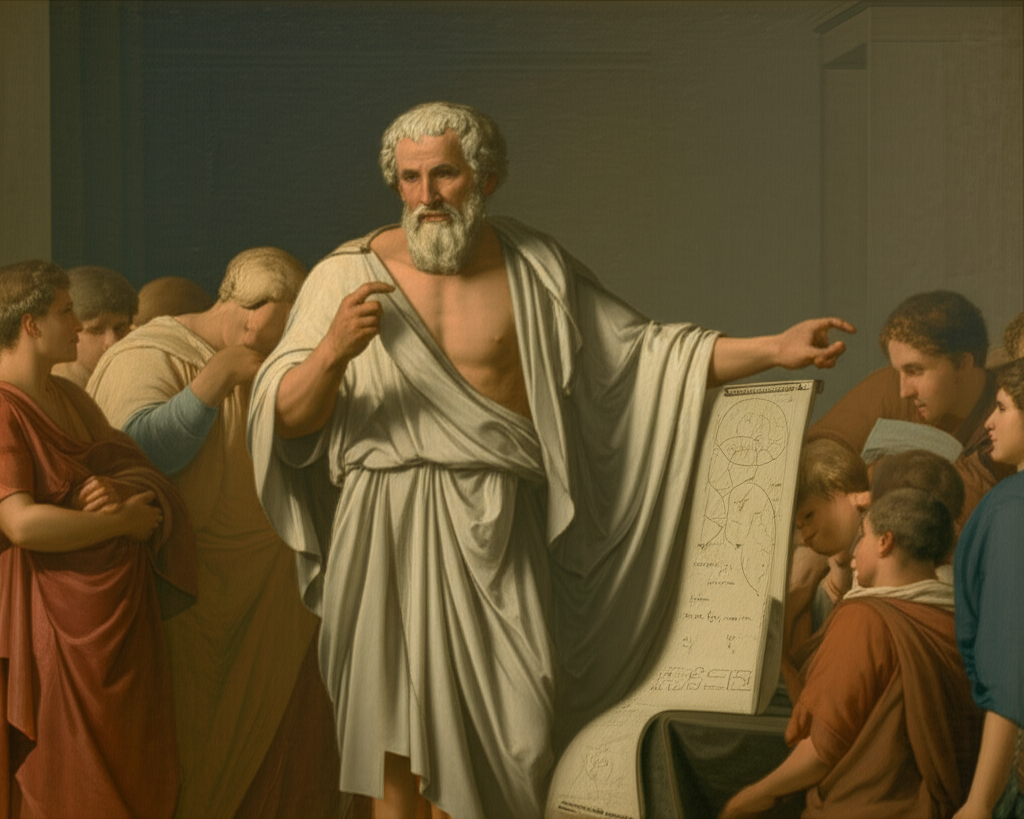
The Act of Reasoning: Building Chains of Judgment
Reasoning is the process of connecting multiple judgments in a logical sequence to arrive at a new judgment, a conclusion. Whether deductive (from general to specific) or inductive (from specific to general), reasoning relies on the soundness of its constituent judgments. Errors in judgment at any stage can lead to flawed reasoning and ultimately, to false conclusions.
The logic of judgment thus underpins all forms of intellectual inquiry:
- Scientific Inquiry: Formulating hypotheses (judgments), testing them through observation and experiment, and drawing conclusions (new judgments).
- Ethical Deliberation: Making moral judgments about actions and their consequences, often based on principles and values.
- Legal Processes: Evaluating evidence and making judgments of guilt or innocence based on established laws and facts.
- Everyday Decision-Making: Weighing options, forming judgments about the best course of action.
Understanding the principles of logic allows us to scrutinize our own judgments and the judgments of others, identifying fallacies and strengthening our capacity for critical thought.
Conclusion: Cultivating Sound Judgment for a Clearer World
The logic of judgment is not an arcane philosophical pursuit; it is a vital discipline for anyone seeking to understand the world and their place within it. From the foundational analyses of Aristotle to the critical insights of Kant, the "Great Books" continually remind us that the ability to form sound judgments is paramount to the pursuit of truth, the advancement of knowledge, and the flourishing of human reason. By consciously engaging with the structures of logic and the processes of reasoning, we cultivate a more discerning mind, capable of navigating complexity, challenging assumptions, and building a more coherent and truthful understanding of reality.
📹 Related Video: ARISTOTLE ON: The Nicomachean Ethics
Video by: The School of Life
💡 Want different videos? Search YouTube for: ""Aristotle Logic Judgment Great Books""
📹 Related Video: KANT ON: What is Enlightenment?
Video by: The School of Life
💡 Want different videos? Search YouTube for: ""Kant Synthetic A Priori Judgments Explained""