

From Particulars to Universals: The Enduring Logic of Induction and Experience
The human quest for knowledge is fundamentally intertwined with our ability to learn from the world around us. At the heart of this process lies induction, a form of logic that allows us to move from specific observations to general principles. This supporting article explores how induction, fueled by constant experience, forms the bedrock of our understanding, from everyday predictions to scientific discovery, while also acknowledging its inherent philosophical challenges. We will delve into how thinkers throughout the history of thought, as captured in the Great Books of the Western World, have grappled with the mechanisms and implications of drawing universal truths from particular instances.
The Everyday Act of Knowing: A Foundation in Experience
Every moment of our lives, we engage in inductive reasoning. When we assume the sun will rise tomorrow because it always has, or that a dropped object will fall because it always does, we are employing inductive logic. This isn't a complex philosophical exercise for most; it’s an intuitive, almost automatic, process rooted in our continuous interaction with the world. This continuous interaction is, of course, experience.
- Observation: Noticing patterns and regularities.
- Generalization: Forming a rule or principle based on these patterns.
- Prediction: Applying the rule to new, unobserved instances.
This cycle of observation, generalization, and prediction is the engine driving our practical knowledge and our ability to navigate reality.
Defining Induction: A Leap of Logic from the Particular
At its core, induction is a method of reasoning that derives general propositions from specific observations. Unlike deductive logic, which guarantees the truth of its conclusion if its premises are true, inductive reasoning offers conclusions that are probable, not certain.
-
Example 1: The Black Swan
- Premise 1: All swans observed so far are white.
- Conclusion: Therefore, all swans are white. (This was a widely held belief until black swans were discovered in Australia, illustrating induction's fallibility.)
-
Example 2: Gravity
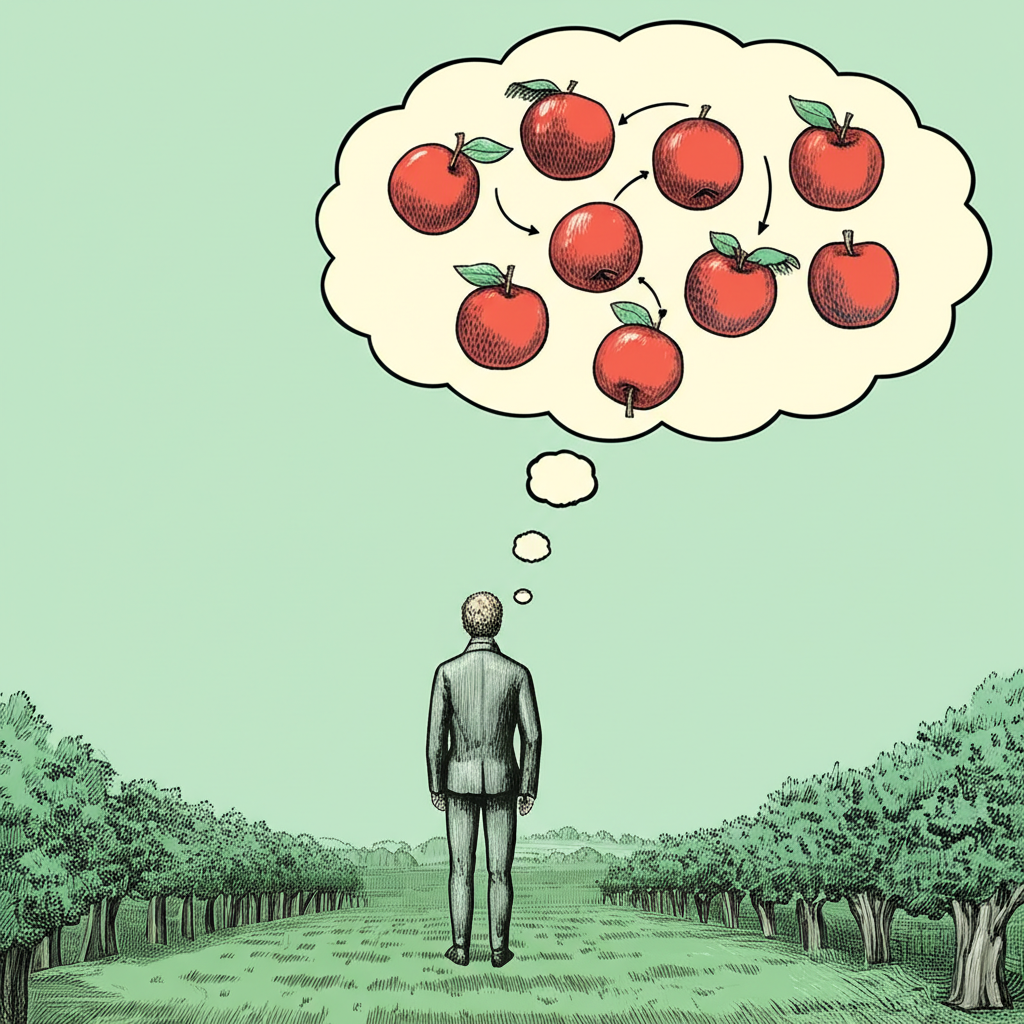
- Premise 1: Every time an apple has been released, it falls to the ground.
- Conclusion: Therefore, all apples, when released, will fall to the ground. (A highly probable generalization, though still based on past experience.)
The power of induction lies in its ability to expand our knowledge beyond what is immediately given, allowing us to formulate theories, scientific laws, and practical guidelines for life.
The Pillars of Experience: Foundation of Inductive Knowledge
For philosophers like John Locke, whose ideas greatly influenced empiricism, all knowledge begins with experience. Our minds are not born with innate ideas, but rather are like a "tabula rasa" – a blank slate – upon which experience writes. This perspective places experience as the indispensable raw material for induction.
| Source of Experience | How it Fuels Induction | Philosophical Connection |
|---|---|---|
| Sensory Data | Direct observation of events, properties, and relationships in the world. | Aristotle (empiricist tendencies), Locke, Hume |
| Memory | Recall of past observations, allowing for the recognition of patterns over time. | General human cognitive function |
| Experimentation | Deliberate manipulation of variables to test hypotheses and gather new data. | Francis Bacon's Novum Organum |
| Testimony | Learning from the experience and observations of others. | Shared knowledge acquisition |
Without a rich tapestry of experience, our capacity for inductive reasoning would be severely limited, and our pursuit of knowledge would falter.
Induction and the Growth of Knowledge: From Bacon to the Scientific Method
The systematic application of inductive logic to experience was championed by figures like Francis Bacon in his Novum Organum. Bacon argued for a new method of inquiry, one that moved away from purely deductive scholasticism and embraced careful observation and experimentation to build knowledge. He envisioned a scientific method that would accumulate observations, identify recurring patterns, and gradually ascend to more general axioms. This inductive approach laid much of the groundwork for modern science.
Consider the development of medical knowledge:
- Observation: A doctor notices many patients with similar symptoms respond positively to a particular treatment.
- Hypothesis (Inductive): This treatment is effective for these symptoms.
- Testing (Further Experience): Clinical trials are conducted on more patients.
- Theory/Practice: If results are consistently positive, the treatment becomes a standard practice, a piece of established knowledge.
This iterative process, driven by induction and refined by further experience, is how much of our scientific and practical knowledge is built.
The Problem of Induction: Hume's Enduring Challenge to Logic
Despite its undeniable utility, the logic of induction presents a profound philosophical challenge, most famously articulated by David Hume in An Enquiry Concerning Human Understanding. Hume argued that there is no purely logical justification for assuming that the future will resemble the past.
Hume's core argument rests on two points:
- No Deductive Justification: We cannot deductively prove that the future will be like the past without circular reasoning (i.e., assuming the very thing we are trying to prove).
- No Inductive Justification: To justify induction inductively would be to use induction to prove induction, which is also circular.
Therefore, our belief in the uniformity of nature, which underpins all inductive reasoning, is not based on logic but on custom or habit formed through experience. We expect the sun to rise not because of a logical necessity, but because our experience has always shown it to do so. This "Problem of Induction" remains a cornerstone of epistemological debate, highlighting the inherent uncertainty in even our most robust inductive knowledge.
Modern Perspectives and the Inductive Gambit
While Hume's challenge demonstrates that induction lacks absolute logical certainty, it does not render it useless. Rather, it underscores that our knowledge of the world is probabilistic and contingent, constantly open to revision based on new experience. Modern philosophy of science and statistical reasoning embrace this probabilistic nature.
- Falsification (Popper): Karl Popper argued that scientific theories can never be definitively proven true by induction, but they can be falsified by a single counter-example. Science progresses by eliminating false theories.
- Bayesian Inference: This statistical approach provides a formal framework for updating our beliefs (probabilities) in hypotheses based on new evidence or experience.
The "inductive gambit" is that despite its lack of logical certainty, it is the only viable path to gaining predictive and explanatory knowledge about the world. It’s a pragmatic necessity, a leap of faith grounded in the consistent patterns of experience.
Conclusion: The Enduring Necessity of Inductive Thought
The logic of induction, inextricably linked to our capacity for experience, remains a cornerstone of human understanding and the pursuit of knowledge. From Aristotle's observations of the natural world to Bacon's call for systematic empirical inquiry, and even in Hume's profound skepticism, the process of drawing general conclusions from particular instances has shaped our intellectual history. While the "Problem of Induction" reminds us of the inherent limits and uncertainties in our knowledge, it does not diminish induction's practical indispensability. Instead, it encourages a cautious, iterative approach to understanding, one where our generalizations are continually tested and refined by new experience, ever pushing the boundaries of what we know and how we know it.
📹 Related Video: PLATO ON: The Allegory of the Cave
Video by: The School of Life
💡 Want different videos? Search YouTube for: ""The Problem of Induction Explained""
📹 Related Video: SOCRATES ON: The Unexamined Life
Video by: The School of Life
💡 Want different videos? Search YouTube for: ""Francis Bacon's Scientific Method""