

The Indispensable Leap: Unpacking the Logic of Induction and Experience
The human mind, in its ceaseless quest for Knowledge, often employs a form of reasoning that, while incredibly effective, lacks the ironclad certainty of its deductive cousin. This is the domain of Induction, a process inextricably linked to our Experience of the world, and one whose underlying Logic has puzzled philosophers for centuries. In essence, induction is the method by which we move from specific observations to general principles, forming the very bedrock of scientific inquiry and our everyday understanding of how the world operates. It is the leap from "this swan is white" and "that swan is white" to "all swans are white," a leap justified by consistent Experience, yet never absolutely guaranteed by Logic. This article delves into the nature of inductive reasoning, its historical treatment within the Great Books of the Western World, and the enduring challenges it presents to our pursuit of reliable Knowledge.
The Foundations of Inductive Reasoning
At its core, induction is a form of inference that derives a probable conclusion from a set of specific premises. Unlike deduction, where conclusions necessarily follow from premises (if the premises are true, the conclusion must be true), inductive conclusions are merely probable. Our reliance on it stems from our fundamental need to predict and understand the world around us.
Consider these common inductive processes:
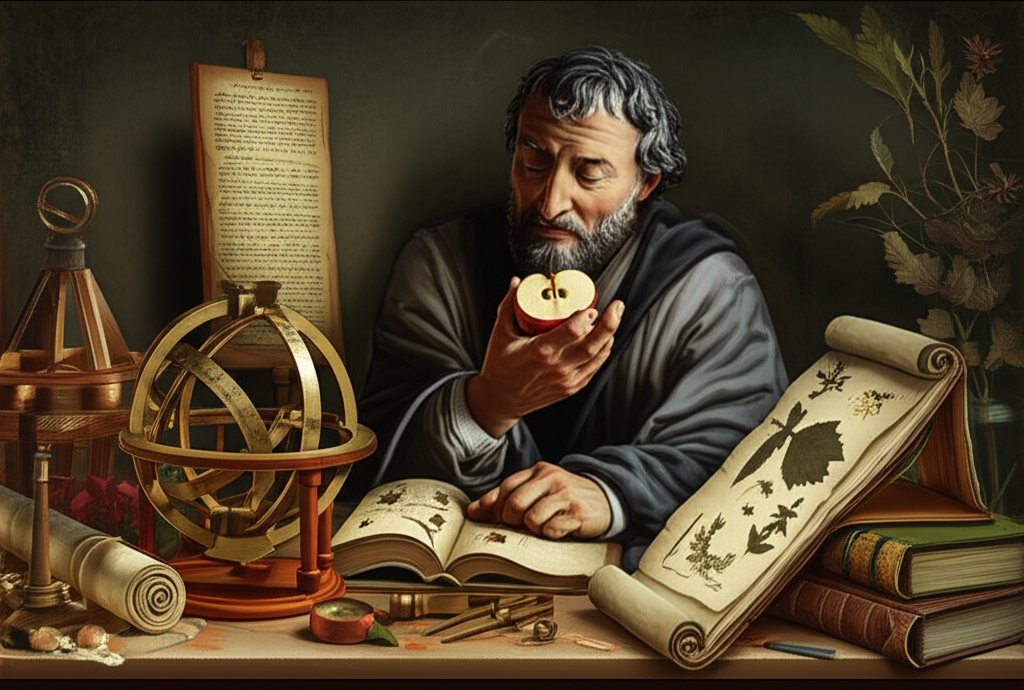
- Generalization: Observing many individual instances and inferring a general rule. (e.g., Every time I've dropped this apple, it falls. Therefore, the apple will always fall when dropped.)
- Causal Inference: Observing repeated sequences of events and inferring a causal link. (e.g., Every time the sun rises, it gets light. Therefore, the sun's rising causes daylight.)
- Prediction: Using past observations to forecast future events. (e.g., The sun has risen every day of my life. Therefore, the sun will rise tomorrow.)
These are not mere academic exercises; they are the very fabric of how we navigate reality, forming the basis of scientific laws, medical diagnoses, and even simple decisions like carrying an umbrella after observing dark clouds.
From Aristotle to Hume: A Historical Trajectory
The problem and utility of induction have been central to philosophical inquiry since antiquity.
Aristotle's Empirical Ascent
In the Great Books, Aristotle, particularly in works like the Posterior Analytics and Metaphysics, recognized the importance of moving from particular observations to universal principles. For him, Experience was the starting point for Knowledge. We observe particulars, and through repeated Experience and intellectual insight, we grasp the universal. This ascent from sense perception to memory, then to Experience, and finally to art and science, is an inductive process, though Aristotle's primary focus was often on the deductive structure of scientific demonstration once universal premises were established. He understood that universal premises themselves must be acquired through an inductive process of observing particulars.
Bacon's New Organon and the Scientific Method
Centuries later, Francis Bacon, in his revolutionary Novum Organum (a direct counter to Aristotle's Organon), championed a systematic inductive method as the true path to scientific Knowledge. He criticized the deductive, syllogistic approach for being prone to errors and biases, advocating instead for meticulous observation, experimentation, and the gradual ascent from particulars to axioms. Bacon's method, often summarized as moving from "facts to laws," laid the groundwork for modern empirical science, emphasizing the systematic collection and analysis of data derived from Experience to build robust theories.
Hume's Skeptical Challenge: The Problem of Induction
Perhaps the most profound challenge to the Logic of Induction came from David Hume in his An Enquiry Concerning Human Understanding. Hume famously argued that there is no rational, deductive justification for induction. Our belief that the future will resemble the past, or that observed regularities will continue, is not based on Logic, but on custom or habit. We assume the "uniformity of nature" – that unobserved instances will resemble observed ones – but this assumption itself is based on past Experience, creating a circular argument.
Hume's argument can be summarized:
- All reasoning concerning matters of fact is either demonstrative (deductive) or probable (inductive).
- Inductive reasoning assumes the principle of the uniformity of nature (PUN) – that the future will resemble the past.
- The PUN cannot be proven demonstratively, as its negation is conceivable.
- The PUN cannot be proven probably, as any such proof would itself rely on induction, leading to circularity.
- Therefore, our belief in the PUN, and thus in induction, is not based on reason but on custom and habit.
Hume's "problem of induction" remains one of philosophy's most enduring puzzles, highlighting that while induction is pragmatically indispensable for acquiring Knowledge, its ultimate Logic remains elusive.
The Enduring Role of Experience in Shaping Knowledge
Despite Hume's unsettling conclusion, Experience remains the crucible in which our Knowledge is forged. Every scientific breakthrough, every technological advance, every lesson learned in daily life, is built upon the foundation of inductive reasoning informed by Experience.
Embracing the Probable: Induction's Practical Logic
While induction may lack deductive certainty, its practical utility is undeniable. Scientists don't stop experimenting because of Hume; they refine their methods, seek more data, and formulate theories that are robustly supported by Experience. The Logic of induction, therefore, shifts from absolute proof to degrees of probability and predictive power.
Key Characteristics of Strong Inductive Arguments:
- Large and Diverse Sample Size: The more varied the experiences, the stronger the generalization.
- Relevance: The observed instances must be relevant to the conclusion.
- Consistency: Lack of counter-examples strengthens the argument.
- Testability/Falsifiability: A good inductive hypothesis can be tested and potentially disproven.
The constant interplay between specific Experience and general Knowledge is what drives intellectual progress. We formulate hypotheses inductively, test them against further Experience, and refine or reject them accordingly. This iterative process, though never reaching absolute certainty, continually brings us closer to a more comprehensive and accurate understanding of the world. The Logic of Induction is not one of absolute truth, but of increasing reliability and predictive power, grounded firmly in the lessons of Experience.
YouTube: "David Hume Problem of Induction Explained"
YouTube: "Inductive vs Deductive Reasoning: Crash Course Philosophy"
📹 Related Video: What is Philosophy?
Video by: The School of Life
💡 Want different videos? Search YouTube for: "The Logic of Induction and Experience philosophy"