

Navigating the Labyrinths of Thought: An Exploration of Hypothetical Reasoning
The Logic of "What If?"
Summary: Hypothetical reasoning is the fundamental cognitive process of exploring possibilities, consequences, and explanations by positing "what if" scenarios. It forms the bedrock of scientific inquiry, philosophical speculation, and even everyday decision-making, allowing us to test ideas, predict outcomes, and construct coherent arguments before confronting reality. This article delves into its logical structure, historical development, and profound importance, drawing insights from the Great Books of the Western World.
In the grand tapestry of human thought, few threads are as pervasive and indispensable as the ability to reason hypothetically. From the simple act of wondering "What if I take this route?" to the complex formulation of a scientific theory, our minds constantly engage in the intricate dance of Logic and imagination. This isn't merely idle speculation; it is a structured, often rigorous, form of Reasoning that empowers us to navigate an uncertain world, anticipate challenges, and forge paths to understanding.
The Anatomy of a Hypothesis
At its core, hypothetical reasoning revolves around the Hypothesis. But what, precisely, is a hypothesis?
A hypothesis is a proposed explanation for a phenomenon, a tentative answer to a question, or a preliminary assumption made in order to draw out and test its logical or empirical consequences. It is not a mere guess, but an educated proposition, often grounded in prior observation or existing knowledge.
Consider the following characteristics:
- Testable: A good hypothesis must be capable of being proven true or false through observation or experimentation.
- Falsifiable: It must be possible to conceive of an observation or experiment that could demonstrate the hypothesis to be incorrect. This concept, championed by Karl Popper, is crucial for distinguishing scientific hypotheses from untestable assertions.
- Specific: Vague statements are difficult to test. A hypothesis should clearly define the relationship between variables or the nature of the phenomenon it seeks to explain.
- Predictive: It should offer a prediction about what will happen under certain conditions.
The Engines of Reasoning: Induction and Deduction
Hypothetical reasoning often employs both inductive and deductive Logic.
- Inductive Reasoning: This is the process of moving from specific observations to general principles or hypotheses. If you observe that every swan you've ever seen is white, you might inductively form the hypothesis: "All swans are white." This process is vital for generating hypotheses in Science.
- Deductive Reasoning: Once a hypothesis is formed, deductive reasoning allows us to predict specific consequences if that hypothesis is true. If our hypothesis is "All swans are white," then deductively, we can predict that "The next swan I see will be white." This allows for rigorous testing.
The interplay between these two forms of Logic is a cornerstone of the scientific method and philosophical inquiry. As Francis Bacon, a pivotal figure in the Great Books tradition, argued, true knowledge comes from systematic observation (induction) and then testing those observations through experiment and logical inference (deduction).
From Ancient Greece to Modern Science: A Historical Perspective
The roots of hypothetical reasoning stretch deep into the history of thought.
- Aristotle and Syllogistic Logic: While Aristotle primarily focused on deductive syllogisms (e.g., "All men are mortal; Socrates is a man; therefore, Socrates is mortal"), his emphasis on structured argument laid the groundwork for understanding the logical flow from premises to conclusions, a skill indispensable for evaluating hypotheses. His work, foundational in the Great Books, provided the first systematic treatise on Logic.
- The Enlightenment and the Scientific Revolution: The explosion of Science during the Enlightenment brought hypothetical reasoning to the forefront. Thinkers like Isaac Newton formulated grand hypotheses about gravity and motion, which were then rigorously tested against empirical data. The very structure of the scientific method – observation, hypothesis, prediction, experimentation, conclusion – is a testament to the power of structured hypothetical thought.
- Descartes' Method of Doubt: René Descartes, another giant from the Great Books, employed a radical form of hypothetical reasoning through his method of systematic doubt. He asked, "What if everything I believe is false?" to arrive at indubitable truths, such as "Cogito, ergo sum" (I think, therefore I am). This philosophical exercise, though not a scientific hypothesis, perfectly illustrates the power of exploring extreme hypotheticals to reach profound conclusions.
The Role of Hypothetical Reasoning in Science
The scientific enterprise is arguably the most sophisticated application of hypothetical Reasoning. Every scientific discovery, every technological advancement, begins with a question and a proposed answer – a hypothesis.
Consider the process:
- Observation: Noticing a phenomenon or pattern.
- Question: Posing a query about the observation.
- Hypothesis Formulation: Developing a testable explanation or prediction.
- Example: "If plants are given more sunlight, then they will grow taller."
- Prediction: Deducing specific, measurable outcomes if the hypothesis is true.
- Example: "A plant receiving 12 hours of sunlight daily will be 5cm taller than a plant receiving 6 hours daily after two weeks."
- Experimentation/Further Observation: Designing and conducting tests to see if the predictions hold true.
- Analysis and Conclusion: Interpreting results to support, refute, or modify the original hypothesis.
This iterative process, driven by Logic and empirical evidence, is how Science progresses, constantly refining our understanding of the universe through the lens of "what if."
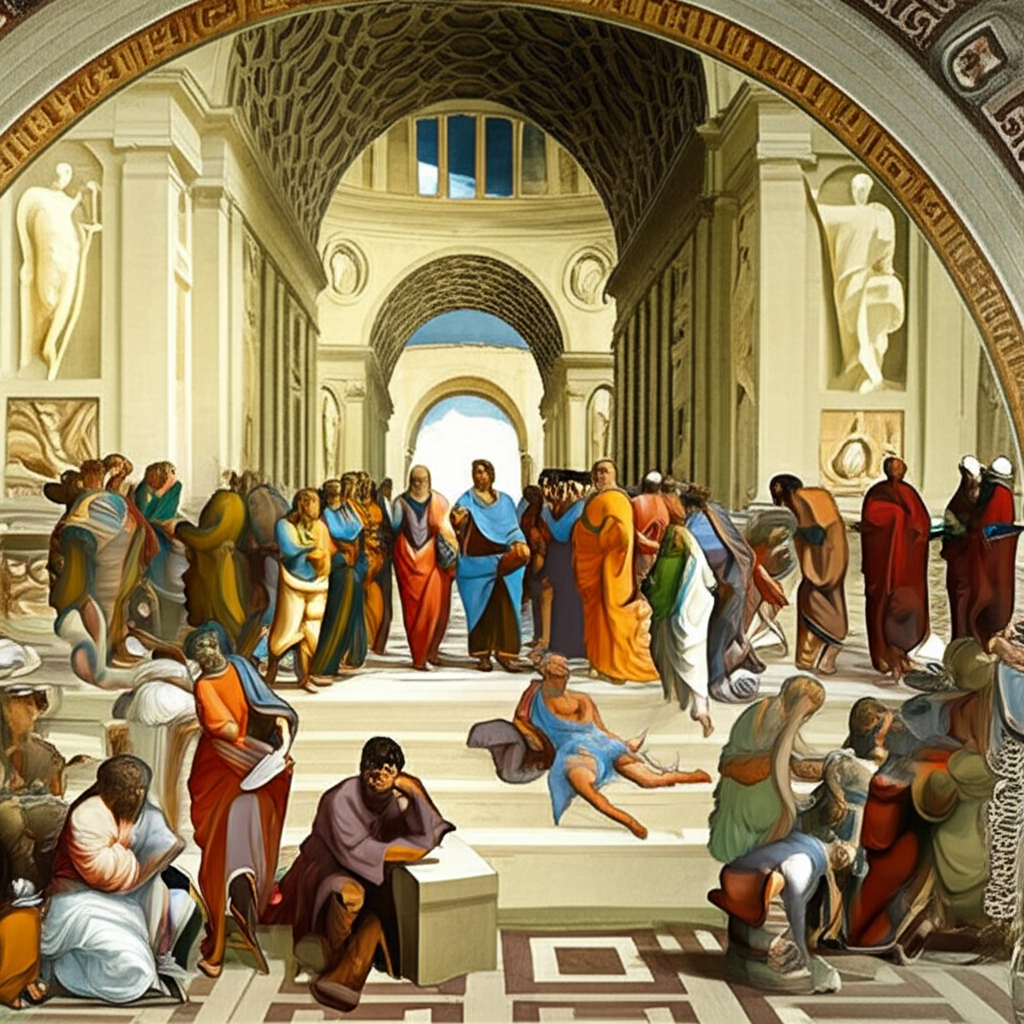 and empirical observation (Aristotle gesturing to the earth). Surrounding them are various scholars and scientists from different eras, engrossed in thought, writing, and demonstration, representing the diverse intellectual pursuits and the collaborative nature of knowledge acquisition through reasoning and hypothesis formation.)
Everyday Applications and Philosophical Implications
Beyond the laboratory and the philosophical treatise, hypothetical Reasoning permeates our daily lives:
- Decision-Making: "If I leave now, I'll avoid traffic."
- Problem-Solving: "What if I try restarting the computer?"
- Empathy: "If I were in their shoes, how would I feel?"
- Planning: "If we save X amount per month, we can afford a house in Y years."
Philosophically, understanding hypothetical reasoning is crucial for grappling with concepts like:
- Counterfactuals: Statements about what would have happened if something else had been true (e.g., "If Cleopatra's nose had been shorter, the whole face of the world would have been changed").
- Modal Logic: The Logic of possibility and necessity, which explores different possible worlds where certain hypotheses might hold true or false.
- Epistemology: How do we know what we know? Hypothetical reasoning is central to how we acquire, test, and justify beliefs.
The Nuances and Challenges
Despite its power, hypothetical reasoning is not without its pitfalls:
- Confirmation Bias: The tendency to seek out and interpret evidence that confirms one's existing hypothesis, while ignoring evidence that contradicts it.
- The Problem of Induction: As David Hume famously pointed out, no amount of past observation can logically guarantee future outcomes. Just because the sun has risen every day doesn't logically necessitate it will rise tomorrow, though we hypothesize it will based on past experience.
- Unfalsifiable Hypotheses: Hypotheses that cannot be disproven pose a challenge to scientific and rational inquiry, as they exist outside the realm of empirical testing.
To master hypothetical Reasoning is to cultivate an open, critical, and agile mind. It means being willing to entertain possibilities, to follow ideas to their logical conclusions, and to rigorously test those conclusions against the vast, complex reality we inhabit. It is the very engine of intellectual progress, guiding us through the intricate "what ifs" towards deeper understanding.
YouTube Suggestions:
-
📹 Related Video: SOCRATES ON: The Unexamined Life
Video by: The School of Life
💡 Want different videos? Search YouTube for: ""Crash Course Philosophy The Scientific Method""
2. ## 📹 Related Video: ARISTOTLE ON: The Nicomachean Ethics
Video by: The School of Life
💡 Want different videos? Search YouTube for: ""Aristotle Logic and Syllogisms Explained""