

The Logic of Hypothesis and Testing: Unraveling the Threads of Inquiry
The pursuit of knowledge, whether in the grand halls of philosophy or the meticulous labs of Science, fundamentally relies on a structured approach to understanding the world. At its heart lies the intricate dance between Logic, Hypothesis, and empirical verification. This article delves into how we formulate educated guesses, known as hypotheses, and rigorously test them through systematic Reasoning, a process that forms the bedrock of scientific discovery and critical thought, echoing principles explored throughout the Great Books of the Western World.
From Observation to Conception: The Birth of a Hypothesis
Our journey of understanding often begins with simple observation. We notice patterns, anomalies, or phenomena that pique our curiosity. Why does the apple fall? Why do stars twinkle? These initial observations, however mundane or profound, are the seeds from which hypotheses sprout. A hypothesis is more than just a guess; it's an informed, testable explanation for an observed phenomenon. It's a provisional statement that proposes a relationship between variables, designed to be either supported or refuted by evidence.
This initial phase heavily relies on inductive reasoning. We move from specific observations to broader generalizations. For instance, observing countless apples fall to the ground might lead us to hypothesize about a universal force of gravity. While powerful for generating ideas, inductive reasoning alone cannot prove a hypothesis; it can only suggest its likelihood based on available evidence.
Crafting the Test: The Deductive Leap
Once a hypothesis is formed, the next critical step is to devise a method for testing it. This is where the power of deductive reasoning comes into play. If our hypothesis (H) is true, then we can logically deduce specific, observable predictions (P). The structure of this Logic is often "If H, then P."
Consider the hypothesis: "All swans are white."
- Hypothesis (H): All swans are white.
- Deductive Prediction (P): If I observe a swan, it will be white.
This deductive prediction then guides the experiment or observation. The rigor of Science demands that these predictions be clear, specific, and measurable, allowing for objective evaluation.
Steps in Formulating a Testable Prediction:
- Clearly State the Hypothesis: Ensure it's precise and focused.
- Identify Key Variables: What factors are involved in the hypothesis?
- Propose a Causal Link (if applicable): How do these variables relate?
- Formulate a Testable Prediction: What specific outcome would logically follow if the hypothesis were true? This must be falsifiable – meaning there must be a possible observation that would contradict the prediction.
The Crucible of Experimentation: Gathering Evidence
With our predictions in hand, we move to the practical phase of testing. This involves designing experiments, conducting observations, or gathering data in a controlled and systematic manner. The goal is to collect empirical evidence that will either support or contradict our deductive predictions.
If our observations match the predictions, it strengthens our confidence in the hypothesis. However, it's crucial to remember that confirming a prediction does not prove the hypothesis absolutely. As philosophers of Science like Karl Popper have emphasized, a single observation consistent with a hypothesis doesn't make it unequivocally true; rather, it fails to falsify it.
Conversely, if our observations contradict the predictions, it indicates that our original hypothesis may be flawed or incomplete. This is often an even more valuable outcome, as it forces us to refine, revise, or even discard our hypothesis and begin the cycle of inquiry anew. This iterative process of proposing, testing, and refining is the engine of scientific progress.
Evaluating Results: Beyond Simple Confirmation
Interpreting the results requires careful Reasoning. While direct confirmation is satisfying, the true strength of a hypothesis comes from its ability to withstand repeated attempts at falsification across diverse conditions.
| Outcome of Test | Implication for Hypothesis | Next Steps |
|---|---|---|
| Prediction Confirmed | Hypothesis is supported, but not proven. | Conduct more tests, vary conditions, explore alternative hypotheses. |
| Prediction Falsified | Hypothesis is challenged or refuted. | Revise the hypothesis, formulate a new one, re-evaluate assumptions. |
| Inconclusive Results | Test design may be flawed or evidence is insufficient. | Refine experimental methods, gather more data, re-evaluate variables. |
This process also often involves abductive reasoning, or inference to the best explanation. When confronted with a set of observations, abduction helps us select the most plausible hypothesis that would account for those observations, even if it hasn't been definitively proven. It's the kind of Reasoning a detective uses to piece together clues.
The Philosophical Underpinnings: Echoes from the Great Books
The systematic Logic of Hypothesis and testing is not solely a modern scientific invention; its roots delve deep into philosophical inquiry. Figures from the Great Books of the Western World grappled with these very questions:
- Aristotle, in works like Posterior Analytics, meticulously laid out the principles of deductive logic (syllogisms) which form the backbone of deriving predictions from hypotheses. His emphasis on observation, classification, and logical inference provided an early framework for structured inquiry.
- Francis Bacon, a key figure in the Scientific Revolution, championed inductive reasoning in his Novum Organum. He critiqued the purely deductive approach of scholasticism and advocated for empirical observation and systematic experimentation to build knowledge from the ground up, moving from specific instances to general axioms.
- René Descartes, in his Discourse on Method, stressed the importance of clear and distinct ideas and systematic doubt, influencing the careful formulation of hypotheses and the rigorous testing needed to establish certainty.
These thinkers, among many others, contributed to shaping the very intellectual tools we use today to propose, test, and refine our understanding of reality.
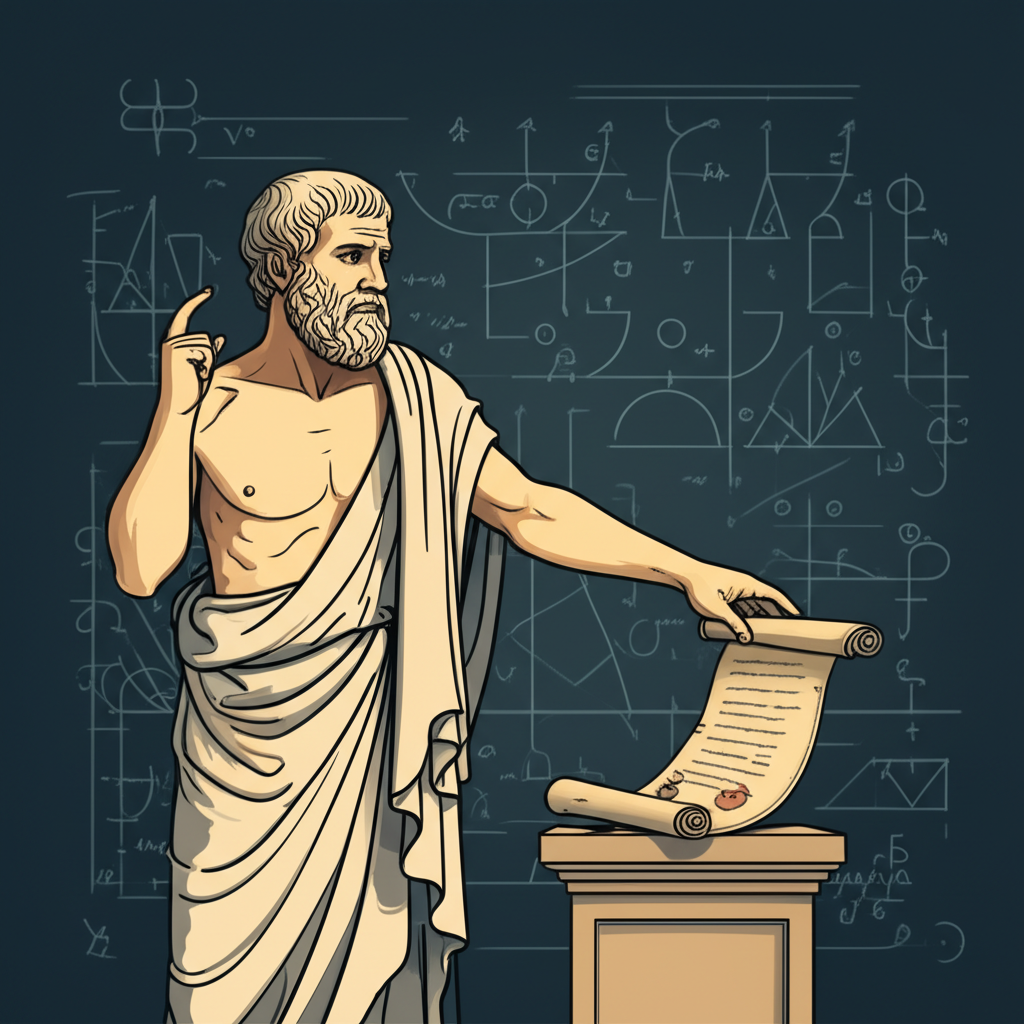 is sketched. The background subtly blends elements of an ancient library with faint outlines of laboratory glassware, symbolizing the fusion of philosophical Logic with empirical Science.)
Why This Matters: The Power of Structured Inquiry
The Logic of Hypothesis and testing extends far beyond the confines of a laboratory. It is a fundamental mode of Reasoning essential for critical thinking in everyday life, problem-solving, and decision-making. By learning to formulate clear hypotheses, deduce testable predictions, and evaluate evidence objectively, we cultivate intellectual rigor. This structured approach allows us to move beyond mere speculation, enabling us to build robust knowledge, challenge assumptions, and continually refine our understanding of ourselves and the complex world we inhabit. It is the enduring legacy of philosophy's quest for truth, applied with precision and purpose.
📹 Related Video: KANT ON: What is Enlightenment?
Video by: The School of Life
💡 Want different videos? Search YouTube for: ""Karl Popper Falsification Principle Explained""
📹 Related Video: What is Philosophy?
Video by: The School of Life
💡 Want different videos? Search YouTube for: ""Inductive vs Deductive Reasoning Philosophy""