

The Architectonics of Truth: Unpacking the Logic of Hypothesis and Testing
The human intellect, ever curious, seeks not merely to observe the world but to comprehend its intricate workings. From the simplest daily decisions to the grandest scientific endeavors, our journey from observation to understanding is fundamentally guided by a process of educated guessing and rigorous verification. This process, often taken for granted, is underpinned by a profound logic—the logic of hypothesis and testing. This article delves into the philosophical roots and practical applications of this indispensable framework, exploring how reasoning transforms mere conjecture into robust knowledge, forming the very bedrock of science and critical thought.
The Quest for Understanding: From Wonder to Worldview
At its core, philosophy begins with wonder. Why do things happen as they do? How can we know what is true? These fundamental questions, posed by the earliest thinkers, laid the groundwork for systematic inquiry. We don't just accept observations; we seek explanations. This innate drive to explain gives rise to a hypothesis—a tentative explanation or proposition that invites further investigation. But a hypothesis alone is insufficient; it must be subjected to scrutiny, tested against reality to ascertain its validity. This interplay between proposing and proving is where the logic of our understanding truly unfolds.
Ancient Echoes of Inquiry: The Great Books and the Birth of Method
The seeds of hypothetical-deductive reasoning were sown long before the advent of modern science. Within the pages of the Great Books of the Western World, we find the earliest philosophical explorations of how we move from uncertainty to conviction.
Plato's Dialectic and the Search for Forms
In Plato's dialogues, particularly in works like the Meno, Socrates famously employs a method of questioning that, while not explicitly "hypothetical-deductive" in the modern sense, deeply embodies the spirit of testing propositions. Through elenctic reasoning, Socrates challenges assumptions, leading his interlocutors to refine or abandon their initial "hypotheses" about virtues like knowledge or justice. This dialectical process is a powerful early example of how initial ideas are subjected to rigorous logical scrutiny.
Aristotle's Syllogism and the Logic of Demonstration
Perhaps the most foundational contribution to the logic of hypothesis and testing from the ancient world comes from Aristotle. In his Posterior Analytics, Aristotle meticulously lays out the principles of deductive reasoning through the syllogism. For Aristotle, true scientific knowledge (episteme) is demonstrative, derived from premises that are "true, primary, immediate, better known than, prior to, and causes of the conclusion." While this might seem to suggest an emphasis on certainty over hypothesis, Aristotle implicitly recognized the need to establish these primary premises, often through inductive observation and the testing of initial propositions against experience. A hypothesis, in an Aristotelian context, could be seen as a proposition awaiting its place within a demonstrative syllogism, needing to be proven or disproven by its logic and consistency with other known truths.
Table 1: Evolution of Inquiry in Ancient Thought
| Philosopher | Key Concept | Relevance to Hypothesis & Testing |
|---|---|---|
| Plato | Dialectic | Challenges assumptions, refines initial ideas through logical questioning. |
| Aristotle | Syllogism | Provides a framework for deductive demonstration; propositions (hypotheses) must fit logical structure and be empirically sound. |
| Both | Reasoning | Emphasize the critical role of structured thought in acquiring knowledge. |
Defining Our Instruments: Logic, Hypothesis, and the Scientific Method
To navigate the landscape of knowledge, we must first define our tools:
- Logic: At its broadest, logic is the systematic study of valid inference. It provides the rules and principles that govern correct reasoning, allowing us to evaluate arguments, draw sound conclusions, and distinguish between valid and fallacious claims. In the context of hypothesis and testing, logic is the framework that ensures our methods of inquiry are coherent and our conclusions justified.
- Hypothesis: A hypothesis is a proposed explanation for a phenomenon. It is a specific, testable statement about the relationship between two or more variables. Crucially, a good hypothesis is falsifiable, meaning it can be proven wrong through observation or experimentation. It’s an educated guess, a provisional truth awaiting judgment.
- Science: Far from a mere collection of facts, science is a dynamic and systematic enterprise that builds and organizes knowledge in the form of testable explanations and predictions about the universe. The scientific method, a cornerstone of modern science, is essentially an elaborate and refined application of the logic of hypothesis and testing.
The Engine of Discovery: Crafting and Testing Hypotheses
The journey from a curious observation to a verified understanding is an iterative dance between induction and deduction, all orchestrated by rigorous logic.
Formulating a Testable Hypothesis
The process often begins with observation and inductive reasoning. We notice patterns, anomalies, or relationships in the world around us. From these specific observations, we generalize to form a tentative explanation—our hypothesis. For instance, observing that plants grow towards sunlight might lead to the hypothesis: "Plants exhibit phototropism, growing in the direction of a light source." A good hypothesis is:
- Specific: Clearly defined variables.
- Testable: Can be investigated through experiment or observation.
- Falsifiable: There must be a possible outcome that disproves it.
- Grounded: Based on existing knowledge or preliminary observations.
The Rigor of Testing: Deductive Reasoning and Experimentation
Once a hypothesis is formulated, the logic shifts to deduction. We ask: "If this hypothesis is true, what specific, observable predictions should follow?" From our plant phototropism hypothesis, we might deduce: "If plants exhibit phototropism, then plants grown with light from only one side will bend towards that side."
The next step is the actual testing—designing an experiment or making controlled observations to see if these predictions hold true. This involves:
- Controlled Experimentation: Manipulating variables and observing the outcome.
- Data Collection: Systematically gathering evidence.
- Analysis: Interpreting the data using statistical and logical methods.
If the experimental results align with the predictions, the hypothesis gains support. If they contradict the predictions, the hypothesis is either refined or rejected. This is the heart of scientific reasoning—an ongoing cycle of proposing, predicting, observing, and refining.
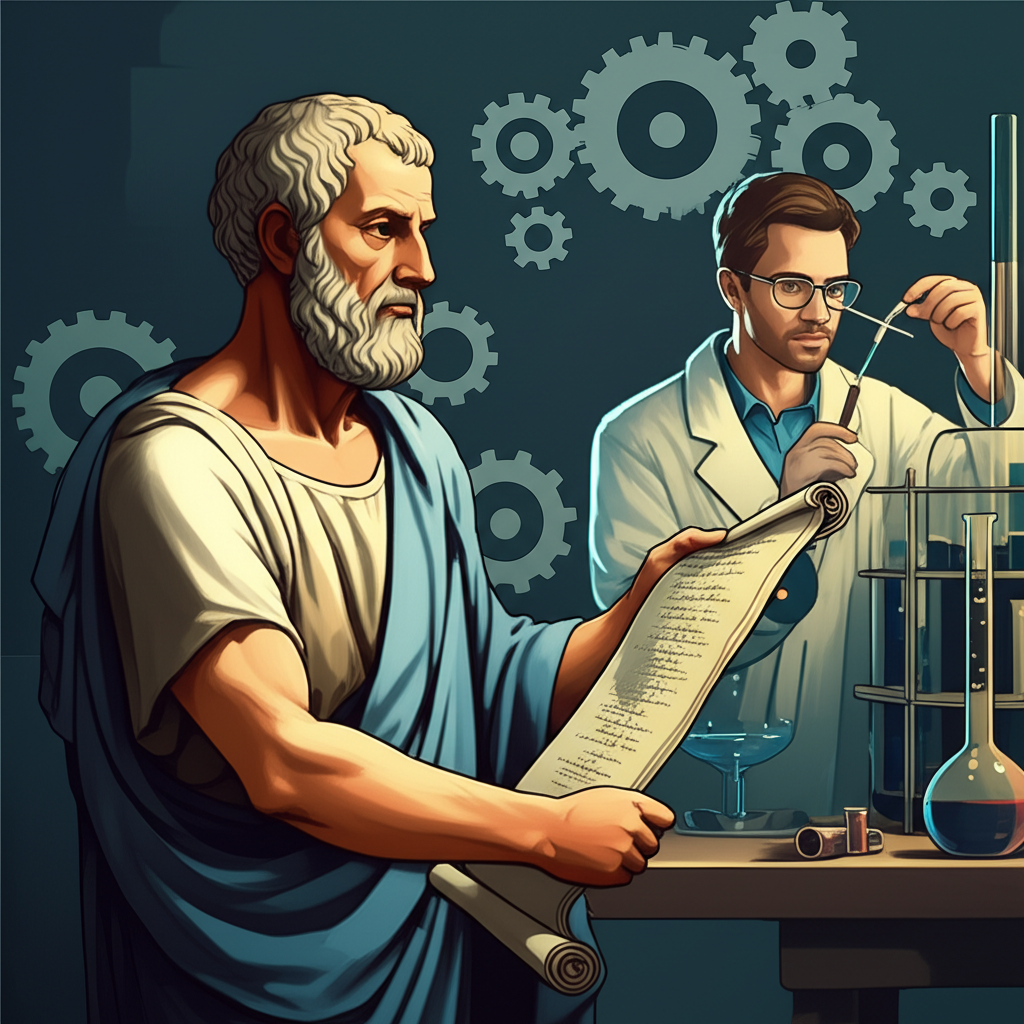
The Philosophical Crucible: Justification and Falsification
The philosophy of science has deeply interrogated the logic of hypothesis and testing. David Hume's problem of induction highlighted the logical leap involved in generalizing from past observations to future predictions. While we can never definitively "prove" a universal hypothesis (as there might always be an unobserved counter-example), modern philosophy, notably through Karl Popper, has emphasized the importance of falsifiability.
For Popper, the strength of a scientific hypothesis lies not in its verifiability, but in its potential to be proven false. A hypothesis that cannot, in principle, be disproven, is not scientific. This perspective shifts the focus from seeking absolute proof to relentlessly attempting to refute our best guesses, strengthening those that withstand the most rigorous challenges. This profound insight underscores the provisional nature of scientific knowledge and the continuous role of logic in refining our understanding.
Beyond the Laboratory: Hypothesis in Everyday Reasoning
The logic of hypothesis and testing isn't confined to the ivory towers of academia or the sterile environments of scientific laboratories. It is a fundamental mode of reasoning we employ constantly:
- Problem-Solving: When your car won't start, you form hypotheses (e.g., "The battery is dead," "It's out of gas") and test them systematically.
- Legal Systems: Lawyers propose hypotheses about what occurred, presenting evidence to support or refute them, subject to the logical scrutiny of the court.
- Personal Decisions: Deciding which career path to take or which investment to make often involves forming hypotheses about future outcomes and 'testing' them against available information and past experiences.
- Critical Thinking: Evaluating news, arguments, or claims requires us to identify underlying hypotheses and assess the evidence presented to support or refute them, demanding a keen sense of logic.
Challenges and Nuances: The Limits of Our Logic
While powerful, the logic of hypothesis and testing is not without its complexities and limitations. Confirmation bias, the human tendency to seek out and interpret evidence that confirms our existing beliefs, can subtly undermine objective testing. Furthermore, the "underdetermination of theories by evidence" suggests that sometimes, multiple different hypotheses could equally explain the same set of observations, making definitive choice difficult. These challenges remind us that the pursuit of knowledge is a continuous, self-correcting process, where vigilance and a commitment to rigorous logic are paramount.
Conclusion: An Enduring Framework for Knowledge
From the dialectical inquiries of ancient Greece to the complex experimental designs of contemporary science, the logic of hypothesis and testing remains an enduring and indispensable framework for knowledge acquisition. It teaches us not to accept assumptions blindly but to question, to propose, to test, and to refine. It is the engine that drives science, the compass for effective reasoning, and the very heart of intellectual progress. By embracing this rigorous approach, we move beyond mere opinion, steadily building a more accurate and profound understanding of ourselves and the universe we inhabit.
YouTube Video Suggestions:
- "Karl Popper Falsification"
- "The Scientific Method: Crash Course Philosophy #15"
📹 Related Video: What is Philosophy?
Video by: The School of Life
💡 Want different videos? Search YouTube for: "The Logic of Hypothesis and Testing philosophy"