

The Logic of Emotion and Reason: An Enduring Philosophical Interplay
The relationship between emotion and reason stands as one of philosophy's most enduring and complex puzzles. Far from being simple antagonists, these fundamental aspects of the human mind engage in a dynamic, often contradictory, yet ultimately co-dependent dance that shapes our perceptions, decisions, and very understanding of reality. This pillar page delves into the historical philosophical approaches to this intricate connection, exploring how thinkers across the ages have grappled with the question of whether logic triumphs over feeling, or if emotion holds a deeper, perhaps even rational, sway over our reasoning. We will navigate the classical dichotomies, examine the radical challenges to reason's supremacy, and consider contemporary perspectives that seek a more integrated understanding of these vital human faculties.
The Classical Dichotomy: Reason's Throne and Emotion's Chains
For much of Western philosophical history, the prevailing view posited a hierarchical relationship: reason was the noble sovereign, meant to guide and control the unruly passions of emotion. This perspective, deeply rooted in the Great Books of the Western World, often framed emotions as potential threats to clear thought and virtuous action.
Plato's Chariot and the Soul's Struggle
Plato, in his Phaedrus, famously illustrates the soul as a charioteer (reason) attempting to control two winged horses: one noble and obedient (representing spirited emotion, like courage), and the other unruly and rebellious (representing appetitive desires). The charioteer's task is to guide the soul towards truth and the Good, implying that true freedom and wisdom come from reason's mastery over the passions. For Plato, the pursuit of knowledge (episteme) through logic was the highest calling, separating us from the mere sensory world of fleeting desires.
Aristotle's Practical Wisdom and the Cultivation of Virtue
While not advocating for the suppression of emotion entirely, Aristotle, in his Nicomachean Ethics, emphasized the role of reason in cultivating virtue. He introduced the concept of phronesis, or practical wisdom, which involves making right decisions in specific situations. This isn't about eradicating emotions but feeling them appropriately – at the right time, towards the right objects, for the right reasons, and in the right manner. Here, reasoning acts as a calibrator, ensuring emotions contribute to a flourishing life rather than detracting from it. The goal is not to be emotionless, but to achieve a harmonious balance where emotions are informed by and responsive to rational assessment.
Descartes' Dualism: The Mind's Dominion Over the Body
René Descartes, a pivotal figure in modern philosophy, solidified the mind-body dualism, further emphasizing the distinct nature of the rational mind from the corporeal body and its associated passions. In his Passions of the Soul, Descartes attempted to understand emotions as movements of the animal spirits, which the rational soul could and should control. For him, clear and distinct ideas, derived through rigorous logic and mathematical reasoning, were the path to knowledge and self-mastery, asserting the intellect's supremacy over the potentially misleading dictates of feeling.
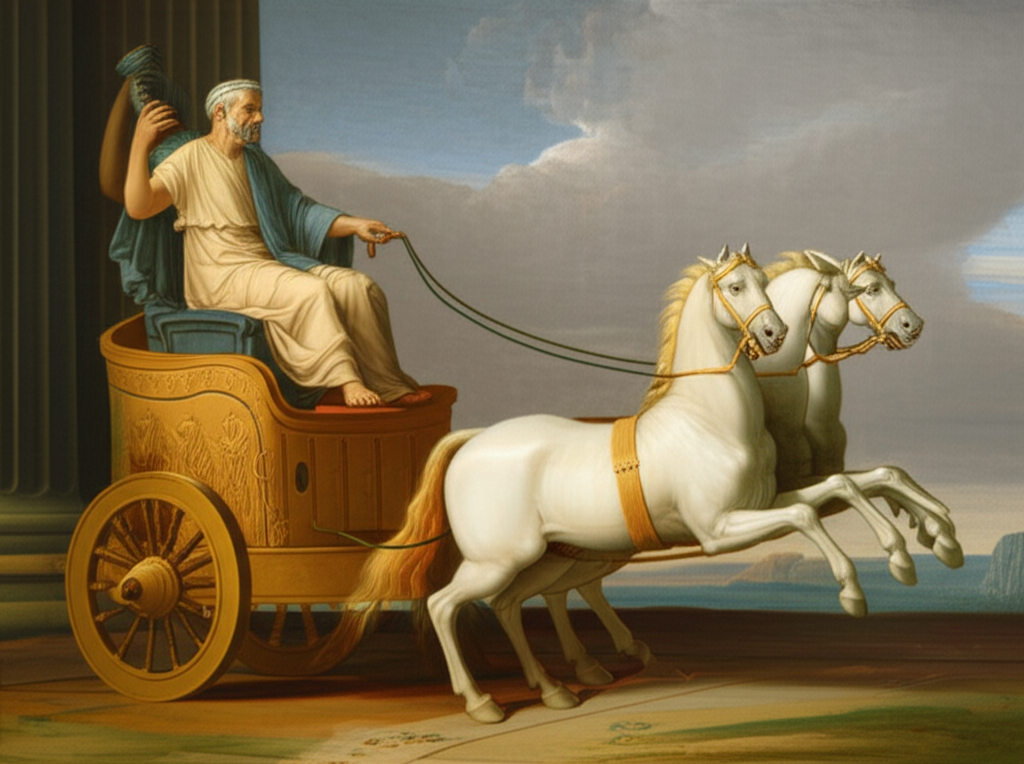 expertly guiding two horses – one white and noble (spirited emotion), the other dark and wild (appetitive desire) – across a celestial path towards a distant, radiant ideal.)
The Challenge to Reason: Emotion's Undeniable Influence
As philosophy progressed, the seemingly clear distinction and hierarchy between emotion and reason began to fray. Thinkers emerged who challenged the notion of reason's absolute sovereignty, arguing for a more fundamental, or at least equally significant, role for emotions in human thought and action.
Hume's Radical Empiricism: Reason as the Slave of Passions
Perhaps the most famous challenge came from David Hume. In his Treatise of Human Nature, Hume provocatively declared that "Reason is, and ought only to be the slave of the passions, and can never pretend to any other office than to serve and obey them." For Hume, our fundamental motivations stem from desires and aversions (passions/emotions). Reasoning, he argued, merely helps us find the most effective means to satisfy those passions; it cannot dictate our ends or values. This radical empiricism suggested that moral judgments, often assumed to be products of pure logic, are in fact rooted in sentiment and feeling.
Spinoza's Monism: Emotions as Natural Necessities
Baruch Spinoza, in his Ethics, offered a different kind of challenge. Rejecting Descartes' dualism, Spinoza viewed emotion not as an external force to be subdued, but as a natural and necessary part of our being, arising from the interaction between our mind and the world. He sought to understand emotions with the same geometric logic he applied to other phenomena, arguing that if we understand the causes of our passions, we can transform passive suffering into active power. For Spinoza, true freedom lay not in suppressing emotions, but in understanding their necessity and thereby transforming them through adequate ideas into a more rational, self-determined state.
The Stoic Approach: Managing, Not Eradicating, Passions
The Stoics, long before Hume or Spinoza, also grappled with emotions. While often misunderstood as advocating for emotionlessness, Stoic philosophy (as seen in figures like Seneca and Epictetus) focused on cultivating virtue and inner tranquility through reasoning. They recognized that certain emotions, particularly destructive ones like excessive fear or anger, were "passions" that arose from faulty judgments. The Stoic goal was not to eliminate all feeling, but to use logic and self-control to reframe one's perceptions, thereby preventing irrational reactions and achieving apatheia – a state of freedom from disturbing passions, allowing for clear and rational action.
Towards Integration: A Modern Synthesis of Mind, Emotion, and Reason
The 20th and 21st centuries have seen a philosophical and scientific movement towards integrating emotion and reason, moving beyond the rigid dichotomies of the past. Contemporary thought often recognizes that these faculties are not only deeply intertwined but mutually constitutive, with each informing and shaping the other.
Kant's Duty and the Moral Landscape
Immanuel Kant, while firmly placing moral agency in the realm of pure practical reason, also implicitly acknowledged the role of human inclinations and feelings. His categorical imperative, based on universalizable logic, demands action from duty rather than mere inclination. However, the very struggle to act from duty often involves overcoming powerful emotional urges, suggesting an awareness of emotion's force even when reason is deemed supreme for moral action. For Kant, the mind strives for autonomy through rational self-governance, even as it navigates the emotional landscape of human experience.
The Logic of Emotion: Are Feelings Rational?
Modern philosophy and cognitive science increasingly argue that emotions are not merely irrational outbursts but often possess their own kind of logic and provide crucial information. Fear, for instance, is a logical response to perceived danger, prompting self-preservation. Empathy, a powerful emotion, is fundamental to moral reasoning and social cohesion. Without emotions, our decision-making can be severely impaired, as evidenced by studies of individuals with damage to emotional centers of the brain who struggle with basic choices despite intact cognitive logic.
Table: Shifting Perspectives on Emotion and Reason
| Philosophical Era/Thinker | Primary View on Emotion | Primary View on Reason | Interplay |
|---|---|---|---|
| Plato | Unruly, needs control | Charioteer, guides | Reason controls emotion for virtue. |
| Aristotle | Can be appropriate/inappropriate | Practical wisdom, calibrates | Reason moderates emotion for flourishing. |
| Descartes | Corporeal, to be mastered | Pure intellect, superior | Reason dominates emotion through will. |
| Hume | Fundamental motivators | Slave to passions | Reason serves emotion's ends. |
| Spinoza | Natural necessities | Understanding, transformation | Reason transforms emotion through knowledge. |
| Stoics | Arise from faulty judgments | Corrects judgments, achieves tranquility | Reason corrects emotion's basis. |
| Kant | Inclinations, can distract | Source of moral duty, autonomy | Reason overcomes emotion for moral action. |
| Contemporary | Informative, integral | Integrated, responsive | Reason and emotion mutually inform each other. |
Practical Implications for the Mind: Cultivating a Harmonious Self
Understanding the intricate dance between logic, emotion, and reasoning has profound implications for how we live our lives, make decisions, and cultivate our inner mind.
- Informed Decision-Making: True wisdom involves not ignoring emotions but understanding their signals and integrating them with rational analysis. Emotions can highlight what truly matters to us, while reason helps us devise the best path forward.
- Ethical Conduct: Empathy and compassion, powerful emotions, are often the bedrock of ethical behavior. Reasoning helps us universalize these feelings into principles, but the initial impetus often springs from our emotional connection to others.
- Mental Well-being: Suppressing emotions can be detrimental. Acknowledging and processing feelings, while applying rational strategies to cope and respond, leads to greater psychological resilience and a more integrated self.
- The Art of Persuasion: Whether in rhetoric or everyday conversation, effective persuasion rarely relies on pure logic alone. It often involves appealing to the audience's emotions in a way that aligns with rational arguments, demonstrating a sophisticated understanding of the human mind.
The journey through the Great Books reveals that the question of emotion versus reason is not a battle to be won by one side, but a relationship to be understood and harmonized. The richness of human experience lies precisely in this dynamic interplay, where our capacity for profound feeling is tempered and guided by the clarity of our logic, and our reasoning is imbued with the depth and purpose that only emotion can provide.
📹 Related Video: PLATO ON: The Allegory of the Cave
Video by: The School of Life
💡 Want different videos? Search YouTube for: ""Plato's Chariot Allegory explained""
📹 Related Video: What is Philosophy?
Video by: The School of Life
💡 Want different videos? Search YouTube for: ""Hume's Philosophy of Emotion and Reason""