

The Logic of Dialectic and Truth
The pursuit of understanding, a hallmark of philosophical inquiry, often leads us down intricate paths of argumentation and analysis. At the heart of this journey lies the profound interplay between Logic, Dialectic, and the elusive grasp of Truth. This article explores how dialectical reasoning, far from being mere debate, is a structured and rigorous method, deeply rooted in logical principles, designed to refine our understanding and guide us closer to genuine truth. It is a process of disciplined inquiry, where the clash of ideas, governed by sound reasoning, serves as a crucible for intellectual advancement.
The Enduring Quest for Truth Through Reason
From the ancient academies of Greece to the modern philosophical seminar, the quest for truth has been paramount. Yet, truth is rarely discovered in isolation or through unchallenged assertion. Instead, philosophers have long recognized the power of collaborative and critical engagement. The method of dialectic, as exemplified by figures like Socrates and Plato in the Great Books of the Western World, provides a robust framework for this engagement, transforming simple conversation into a potent tool for intellectual discovery. It is through the systematic application of logic within a dialectical exchange that we can hope to transcend mere opinion and approach a more profound understanding of reality.
What is Dialectic? More Than Just Argument
At its core, dialectic is a method of philosophical argument that involves a contradiction of ideas and a counter-argument to resolve the contradiction. It is not simply about winning an argument, but about improving an argument, and by extension, our understanding of the subject matter.
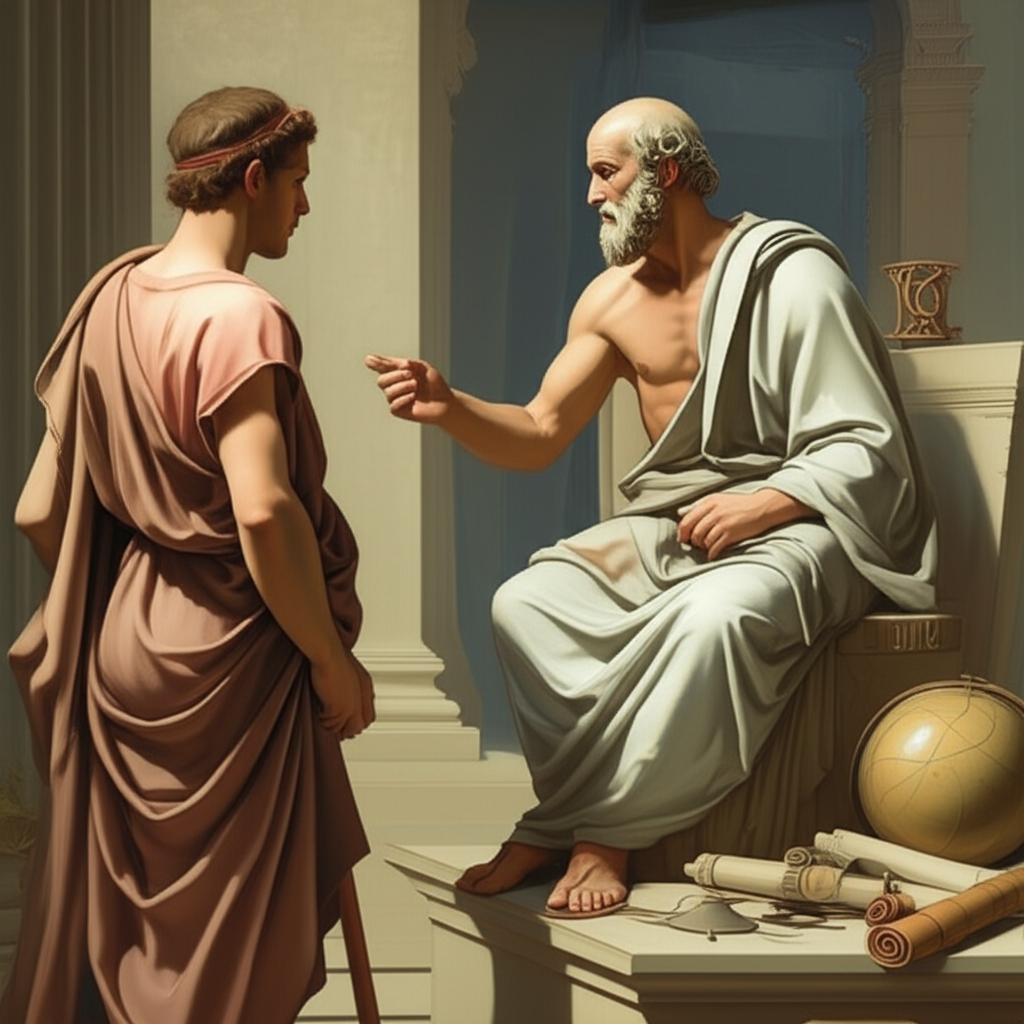
Historically, the Socratic method, as depicted in Plato's dialogues, offers a prime example. Socrates would engage interlocutors in a series of questions, revealing inconsistencies in their beliefs and leading them, often reluctantly, to a more accurate conclusion. This process is characterized by:
- Questioning and Examination: Challenging assumptions and definitions.
- Identification of Contradictions: Exposing flaws in reasoning or beliefs.
- Refinement of Concepts: Moving towards clearer and more precise understandings.
- Collaborative Pursuit: A shared endeavor, even if adversarial in form, aiming for a common goal of knowledge.
Unlike rhetoric, which seeks to persuade, dialectic aims to discover. It is a process of intellectual wrestling, where the ultimate victory is not for one side, but for truth itself.
The Logic of Dialectic: A Framework for Reasoning
The effectiveness of dialectic hinges entirely on its foundation in logic. Without sound logical principles, dialectical exchange devolves into sophistry or unproductive wrangling. Logic provides the rules of engagement, ensuring that the process of reasoning is valid and reliable.
Consider the role of various forms of reasoning within a dialectical framework:
- Deductive Reasoning: Often used to test the implications of a premise. If a general statement (thesis) is true, what specific conclusions must follow? If these conclusions lead to contradiction, the original premise may be flawed.
- Inductive Reasoning: Used to build premises from specific observations, which can then be tested dialectically.
- Abductive Reasoning: Forming the best explanation for a set of observations, which then becomes a hypothesis to be challenged and refined.
Aristotle's Organon, a foundational text in the Great Books, meticulously outlines the principles of formal logic, including the structure of syllogisms and the identification of fallacies. These tools are indispensable for any genuine dialectical inquiry. When engaging in dialectic, participants must adhere to these logical principles to ensure that:
- Arguments are Valid: Conclusions logically follow from their premises.
- Premises are Sound: The factual accuracy and acceptability of the starting points are scrutinized.
- Fallacies are Avoided: Errors in reasoning are identified and corrected.
The famous Hegelian model of "thesis, antithesis, synthesis," while a later development, beautifully encapsulates the logical progression inherent in dialectic: a proposition (thesis) is challenged by its opposite (antithesis), leading to a resolution that incorporates elements of both, forming a new, more comprehensive understanding (synthesis). This synthesis then becomes a new thesis, perpetuating the cycle of intellectual growth.
Dialectic as a Path to Truth
The ultimate aim of grounding dialectic in logic is the pursuit of truth. How does this dynamic process lead us closer to it?
- Clarification of Concepts: Through vigorous questioning and counter-argument, vague or ill-defined concepts are sharpened. What exactly do we mean by "justice," "virtue," or "knowledge"? Dialectic forces us to define our terms with precision.
- Elimination of Error: By exposing contradictions and logical inconsistencies in arguments, dialectic helps us discard false beliefs and identify faulty reasoning. It acts as a filter, allowing only robust and coherent ideas to stand.
- Discovery of Deeper Insights: The synthesis phase, or the resolution of opposing viewpoints, often reveals a more nuanced and comprehensive truth than either initial position held alone. It pushes us beyond simple dichotomies to a richer understanding.
- Testing of Hypotheses: Philosophical propositions, much like scientific ones, benefit from rigorous testing. Dialectic provides a rigorous intellectual environment for such testing, challenging assumptions and exploring their full implications.
The journey towards truth through dialectic is rarely instantaneous. It is an iterative process, a continuous refinement of understanding. Each dialectical engagement, if conducted with intellectual honesty and a commitment to logical principles, chips away at ignorance and prejudice, bringing us closer to a more accurate and profound grasp of reality.
The Enduring Value of Dialectical Inquiry
In an age saturated with information and often polarized debates, the principles of dialectic, anchored in sound logic, are more vital than ever. It teaches us not just what to think, but how to think critically, to question assumptions, and to engage with opposing viewpoints constructively. It is a testament to the power of structured reasoning that allows us to navigate complexity, challenge our own biases, and collectively advance towards a more profound and shared understanding of truth. The legacy of the Great Books of the Western World reminds us that this journey is eternal, and the tools of dialectic are our most reliable companions.
📹 Related Video: SOCRATES ON: The Unexamined Life
Video by: The School of Life
💡 Want different videos? Search YouTube for: ""Socratic Method explained" or "Hegelian Dialectic explained philosophy""