

The Logic of Change in Element: An Enduring Philosophical Inquiry
The concept of change is perhaps one of philosophy's most persistent and perplexing problems. How can something fundamentally alter its nature, yet remain intelligible? What logic underpins the transformation of elements that constitute our world? From the earliest Greek thinkers attempting to understand the physics of reality to Aristotle's systematic analysis, the quest to explain change in the fundamental elements of existence has shaped Western thought, revealing profound insights into the nature of being itself. This article explores the historical development of this inquiry, focusing on how ancient philosophers grappled with the logic governing the mutable world around us.
I. The Ancient Riddle of Flux and Permanence
The philosophical journey into the logic of change begins with the Presocratics, who first sought to identify the primordial element or elements from which all things arise and into which they return.
A. Presocratic Explorations: From Water to Fire
- Thales of Miletus, often considered the first philosopher, proposed that water was the fundamental element. All things, he observed, seemed to derive from or rely on water, suggesting an initial attempt to find a single, underlying substance undergoing various transformations.
- Anaximenes posited air as the primary element, explaining change through processes of rarefaction and condensation—air becoming fire when rarefied, and wind, cloud, water, earth, and stone when condensed. This offered a rudimentary logic for how one element could transform into others.
- Heraclitus of Ephesus famously declared, "Panta rhei" – everything flows. For Heraclitus, change was not merely an attribute of reality but its very essence. Fire, with its constant motion and transformation, served as his primary element, symbolizing the ceaseless flux that defined existence. He saw logic in this constant change, viewing it as a dynamic tension of opposites, a cosmic war that generates all things.
B. Parmenides' Challenge: The Illusion of Change
In stark contrast to Heraclitus, Parmenides of Elea presented a radical challenge to the very notion of change. Through rigorous logic, he argued that change is impossible. His central premise was that "what is, is; what is not, is not." To change would mean for something to become what it is not (non-being), or to cease to be what it is, both of which he deemed inconceivable. Therefore, true being must be eternal, unchanging, and indivisible. This powerful argument, found in his poem On Nature, forced subsequent philosophers to confront the logic of change head-on, compelling them to explain how change could occur without violating Parmenides' compelling reasoning.
C. Empedocles' Synthesis: Elements in Motion
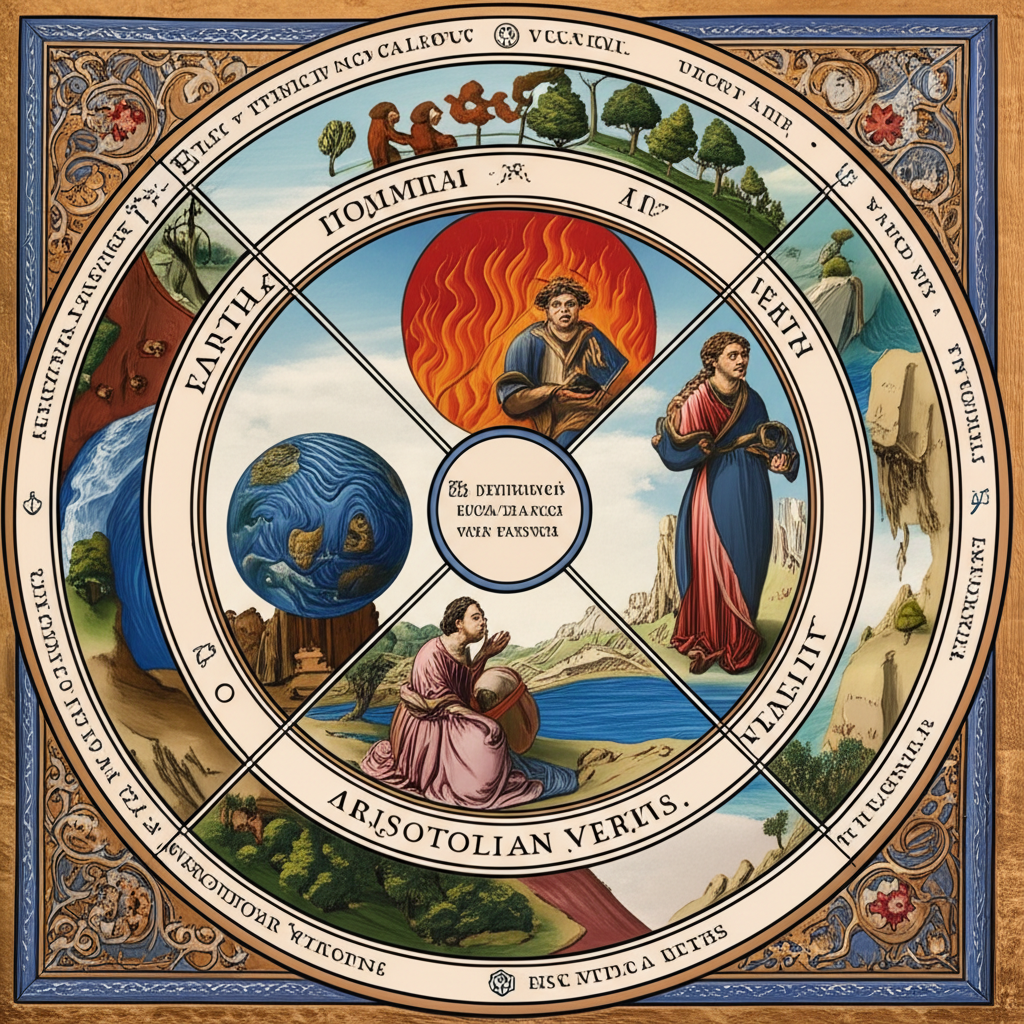
Empedocles of Acragas attempted to reconcile the conflicting views of Heraclitus and Parmenides. He agreed with Parmenides that being itself could not come into existence or pass away, thus preserving the fundamental elements. However, he introduced four eternal, unchangeable roots or elements: Earth, Air, Fire, and Water. Change, for Empedocles, was not the transformation of one element into another, but rather the mixing and separation of these four roots, driven by two opposing forces: Love (attraction) and Strife (repulsion). This provided a logic for change that preserved the integrity of the fundamental elements while accounting for the observable transformations in the world.
II. Aristotle's Systematic Logic of Change
It was Aristotle, drawing extensively from the works compiled in the Great Books of the Western World, who offered the most comprehensive and influential philosophical framework for understanding the logic of change, particularly as it relates to elements. In his Physics and On Generation and Corruption, he directly addresses Parmenides' challenge and provides a nuanced account of how change is not only possible but also intelligible.
A. Potentiality and Actuality: A Framework for Understanding Transformation
Aristotle's genius lay in introducing the concepts of potentiality (δύναμις, dynamis) and actuality (ἐνέργεια, energeia). He argued that for something to change, it must already possess the potential to become what it is changing into. A seed is not yet a tree, but it has the potential to become one. Change, then, is the actualization of a potential. This provides a crucial logic that circumvents Parmenides' dilemma: something does not come from absolute non-being, but from a state of potential being.
B. Substantial vs. Accidental Change: Defining Elemental Shifts
Aristotle further refined the logic of change by distinguishing between different kinds of transformation:
- Accidental Change: This refers to alterations in a substance's non-essential qualities (e.g., a leaf changing color, a person growing taller). The underlying substance remains the same.
- Substantial Change: This is a more profound change where one substance ceases to exist and a new substance comes into being (e.g., a log burning to ash, a living organism dying and decaying). This is where the logic of change in elements becomes paramount.
For Aristotle, when one element transforms into another, it undergoes a substantial change. This is not merely a rearrangement, but a genuine alteration of form.
C. The Inter-convertibility of Elements: Form and Matter in Flux
Aristotle adopted the four-element theory but provided a sophisticated logic for their inter-convertibility. He posited that the four terrestrial elements—Earth, Air, Fire, and Water—are distinguished by combinations of two pairs of primary qualities: hot/cold and wet/dry.
| Element | Primary Qualities |
|---|---|
| Fire | Hot and Dry |
| Air | Hot and Wet |
| Water | Cold and Wet |
| Earth | Cold and Dry |
According to this logic, an element could transform into another by losing one quality and acquiring its opposite. For instance:
- Fire (Hot & Dry) could become Air (Hot & Wet) by losing its dryness and acquiring wetness.
- Water (Cold & Wet) could become Air (Hot & Wet) by losing its coldness and acquiring heat.
This framework offered a coherent logic for the change and transformation observed in the natural world, providing an early form of theoretical physics where elements were not immutable, but dynamically inter-connected through their fundamental qualities.
III. The Enduring Legacy: From Ancient Physics to Modern Philosophy
While modern physics has long moved beyond the classical four elements, the philosophical logic developed by these thinkers remains profoundly relevant. The questions they posed—about the nature of fundamental constituents, the possibility of genuine change, and the underlying principles governing transformations—continue to resonate in contemporary discussions about particle physics, cosmology, and the philosophy of science. The concept of conservation laws in modern physics, for instance, can be seen as a sophisticated descendant of Parmenides' insistence on the persistence of being, albeit applied to quantifiable properties like mass-energy rather than an undifferentiated "being."
Conclusion: The Unfolding Logic of Reality
The quest to understand "The Logic of Change in Element" is a testament to humanity's enduring desire to comprehend the fundamental workings of reality. From the intuitive observations of Thales to the rigorous arguments of Parmenides, and finally to the systematic logic of Aristotle, these foundational inquiries laid the groundwork for both philosophy and natural science. They teach us that even in the midst of constant flux, there is an underlying logic, a pattern of transformation that allows us to make sense of the ever-changing world and its constituent elements. The philosophical tools developed in antiquity continue to offer invaluable perspectives on the most profound questions concerning change and being.
📹 Related Video: ARISTOTLE ON: The Nicomachean Ethics
Video by: The School of Life
💡 Want different videos? Search YouTube for: "Aristotle's Metaphysics and Physics Summary - Great Books of the Western World"
📹 Related Video: ARISTOTLE ON: The Nicomachean Ethics
Video by: The School of Life
💡 Want different videos? Search YouTube for: "Heraclitus vs Parmenides: The Ancient Greek Debate on Change and Reality"