

The Logic of Change in Element: An Ancient Inquiry
The question of how things come to be, pass away, and transform has captivated thinkers since antiquity. This article delves into the philosophical logic underpinning change at the most fundamental elemental level, drawing heavily from the foundational texts compiled in the Great Books of the Western World. We explore how ancient philosophers grappled with the apparent contradiction of a world in constant flux versus the enduring nature of being, ultimately proposing sophisticated models that laid the groundwork for understanding the physics of reality. From the ever-flowing river of Heraclitus to Aristotle's intricate theory of potency and act, we uncover the enduring intellectual quest to rationalize the dynamic nature of our existence.
The Perplexing Problem of Change
Before any coherent logic of change could be formulated, the very phenomenon itself presented a profound philosophical dilemma. Early thinkers observed a world characterized by ceaseless transformation: seasons shifted, living things grew and decayed, and substances altered their properties. Yet, beneath this apparent chaos, there seemed to be an underlying stability.
Heraclitus and the River of Flux
One of the most vivid articulations of constant change comes from Heraclitus, who famously declared, "You cannot step into the same river twice, for new waters are ever flowing in upon you." For Heraclitus, change was the fundamental reality, a perpetual process governed by an inherent logic or Logos – a cosmic reason that maintained the balance of opposing forces. Fire, in its transformative power, often symbolized this ceaseless becoming. The physics of his world was one of dynamic equilibrium, where everything was in flux, yet this flux itself was orderly.
Parmenides and the Unchanging Being
In stark contrast, Parmenides, through his poem "On Nature," argued for the impossibility of true change. His formidable logic posited that "what is, is, and what is not, is not." For something to change, it would have to come from "what is not" (nothing) or become "what is not" (nothing), both of which he deemed impossible. Therefore, all perceived change was an illusion of the senses; reality, or "Being," must be eternal, uncreated, indestructible, and utterly undifferentiated. This presented a significant challenge to any philosophical system attempting to explain the physics of a changing world.
Elements as the Foundation of Change
The tension between Heraclitus's flux and Parmenides's static Being spurred later philosophers to seek a compromise, often found in the concept of fundamental elements. These elements were posited as unchanging, underlying constituents whose rearrangement could account for the observed change in composite substances.
Empedocles's Four Roots
Empedocles proposed that all matter was composed of four eternal and unchangeable "roots" or elements: Earth, Air, Fire, and Water. These elements, he argued, were themselves eternal and indestructible, but they could mix and separate in various proportions under the influence of two cosmic forces: Love (attraction) and Strife (separation). This brilliant synthesis offered a logic for change: substances transform not by becoming something entirely new out of nothing, but by the rearrangement of these fundamental, enduring elements. A tree burns, not because it ceases to be, but because its elements rearrange into ash, smoke, and heat.
Aristotle's Elemental Transformations and Hylomorphism
Aristotle, building upon and refining these ideas, provided the most comprehensive ancient philosophical framework for the logic of change. He, too, recognized four primary terrestrial elements: Earth, Air, Fire, and Water, each characterized by a combination of two primary qualities:
| Element | Primary Qualities |
|---|---|
| Fire | Hot and Dry |
| Air | Hot and Wet |
| Water | Cold and Wet |
| Earth | Cold and Dry |
For Aristotle, change was not merely the mixing and separating of elements, but a more profound process. Through his theory of hylomorphism, he argued that every substance is a composite of matter and form. Matter is the indeterminate substratum, while form gives a thing its specific nature and essence. Change, then, is the acquisition or loss of a form by matter.
The Aristotelian Logic: Potency and Act
Central to Aristotle's logic of change is the distinction between potency (potentiality) and act (actuality). This concept provides a robust explanation for how something can truly change without violating Parmenides's principle of "what is, is."
- Potency: The capacity of something to become something else. A seed has the potency to become a tree. Water has the potency to become steam.
- Act: The realization of that capacity; the actual state of being. The tree is the actualization of the seed's potency. Steam is the actualization of water's potency.
Change, in this Aristotelian logic, is the actualization of a potential. When water heats and turns into steam, it's not disappearing into nothingness and reappearing as something new. Instead, the water (in act) holds the potency to become steam, and that potency is actualized through the addition of heat. The underlying elements or matter persist, but their form changes. This applies even to the transformation of one element into another, which Aristotle believed was possible: water could potentially become air, given the right conditions (e.g., heat transforming cold/wet into hot/wet). This sophisticated logic offered a coherent account of the physics of a dynamic world, allowing for genuine change while preserving the notion of an enduring substratum.
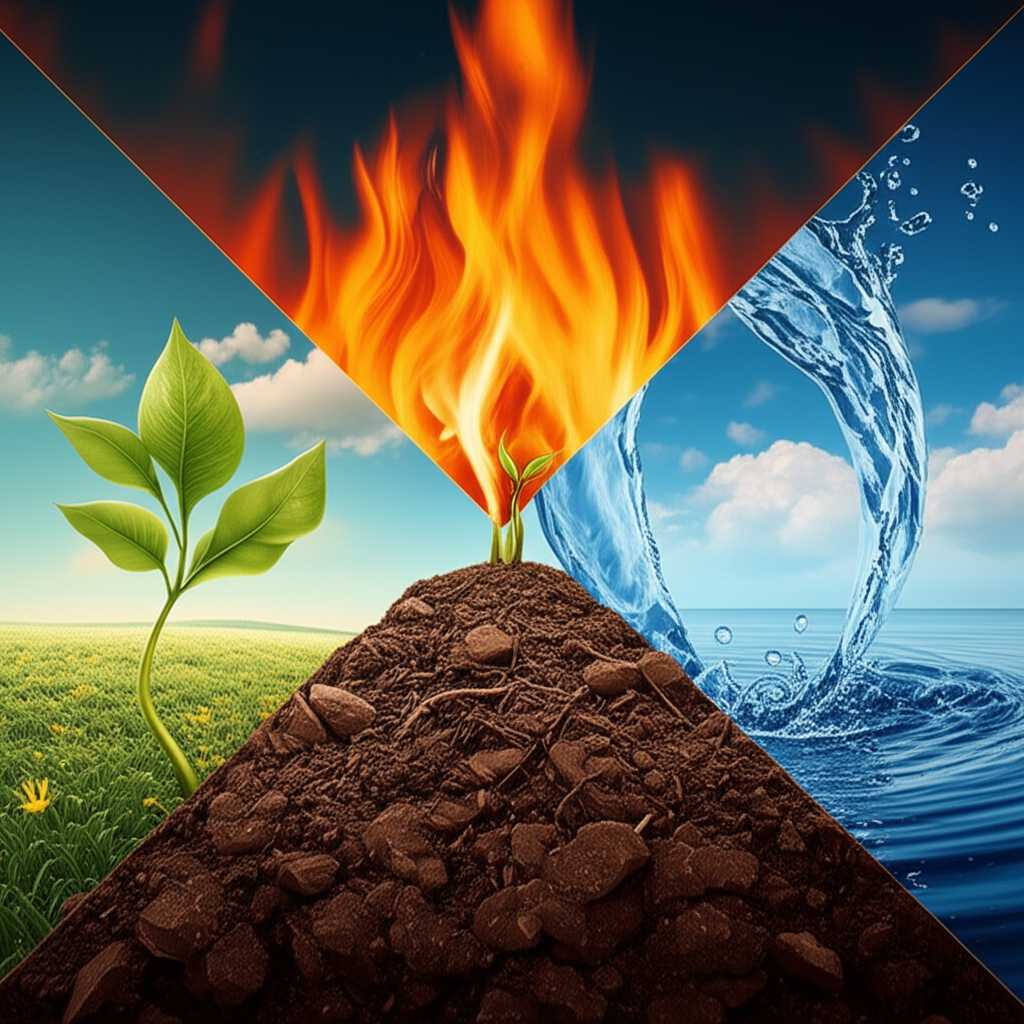 arranged in a philosophical schema, with arrows indicating their interconnections and transformations, perhaps with a central depiction of a human figure contemplating these fundamental forces.)
Enduring Insights into the Physics of Being
The ancient inquiry into the logic of change in elements, as articulated by figures like Empedocles and Aristotle, provided a foundational framework that influenced scientific and philosophical thought for centuries. While modern physics has moved far beyond the four classical elements, the underlying philosophical questions persist: What are the fundamental constituents of reality? How do they interact and transform? And what is the logic governing these transformations? The ancient quest to understand change was, in essence, an early form of natural philosophy – a physics of being – seeking rationality and order within the observable world.
Conclusion: The Enduring Logic of Elemental Transformation
The journey through the logic of change in elements, from the paradoxical claims of Heraclitus and Parmenides to the refined theories of Empedocles and Aristotle, reveals a profound intellectual evolution. It demonstrates how philosophers, grappling with the most fundamental aspects of existence, developed intricate systems to explain the dynamic nature of reality. Their insights, drawn from the wellspring of the Great Books of the Western World, underscore that understanding change is not merely observing it, but discerning the underlying logic and principles that govern the transformations of fundamental elements. This ancient wisdom continues to resonate, reminding us that even in the face of constant flux, there is an enduring order to be discovered.
📹 Related Video: ARISTOTLE ON: The Nicomachean Ethics
Video by: The School of Life
💡 Want different videos? Search YouTube for: "Aristotle Metaphysics Change Potency Act"
📹 Related Video: What is Philosophy?
Video by: The School of Life
💡 Want different videos? Search YouTube for: "Ancient Greek Philosophy Elements"