

The Limitless Nature of Infinity
The concept of infinity, a notion that simultaneously captivates and confounds, represents one of humanity's most profound intellectual pursuits. This article delves into the multifaceted idea of infinity, exploring its intricate presence across mathematics and metaphysics. From the seemingly endless sequence of numbers to the philosophical contemplation of the boundless cosmos or the divine, infinity challenges our perceptions of limits, demanding a fundamental re-evaluation of what we understand as finite. We will navigate the historical and contemporary attempts to grasp this elusive concept, drawing upon the insights of classical thinkers from the Great Books of the Western World who wrestled with its implications for existence, knowledge, and the ultimate nature of reality.
Unpacking the Infinite Idea: A Gateway to the Unbounded
The very mention of infinity evokes a sense of awe, a glimpse into something beyond our immediate comprehension. It is an idea that has fascinated thinkers for millennia, acting as a crucial bridge between the abstract world of numbers and the profound questions of existence. What does it mean for something to be infinite? Is it merely something without end, or does it possess a quality entirely distinct from the finite?
Philosophers and mathematicians alike have grappled with these questions, often arriving at conclusions that are as mind-bending as the concept itself. The journey to understand infinity is not just an academic exercise; it's an exploration into the very fabric of thought, challenging the conventional boundaries of human understanding.
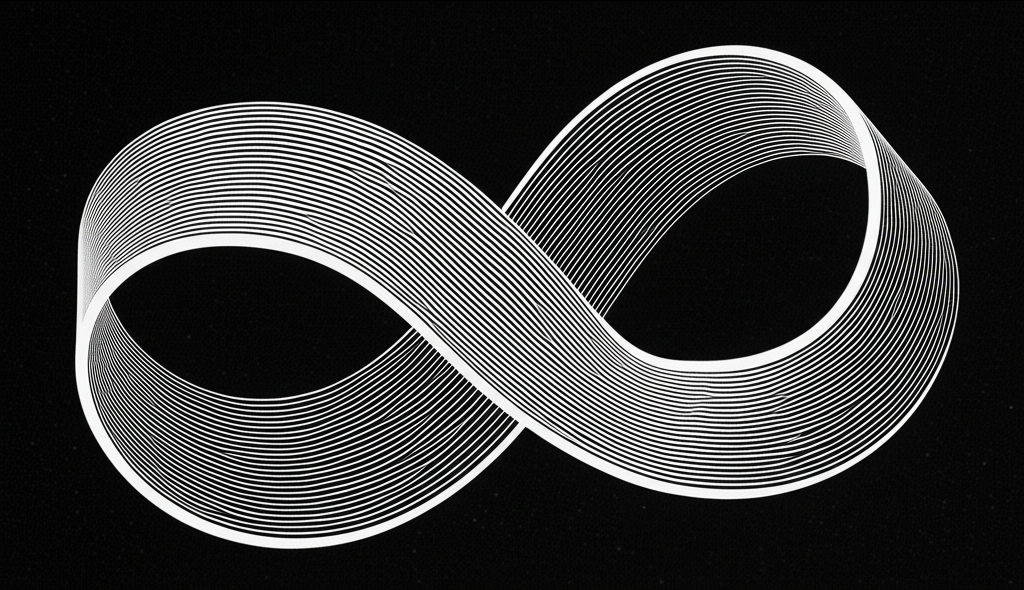 , superimposed over a faint background of ancient Greek philosophical texts and mathematical equations, symbolizing the convergence of philosophy and mathematics in the pursuit of understanding infinity.)
The Mathematical Horizon: Counting Beyond Comprehension
In the realm of mathematics, infinity transitions from a philosophical abstraction to a rigorously defined, albeit still mind-bending, operational concept. Early encounters with infinity in mathematics often involved paradoxes, such as Zeno's famous paradoxes of motion, which highlighted the difficulties in dealing with infinitely divisible quantities. However, it was in the late 19th and early 20th centuries that mathematics truly began to formalize infinity, thanks largely to the groundbreaking work of Georg Cantor.
Cantor's revolutionary insights revealed that not all infinities are created equal. He demonstrated that there are different sizes of infinity, a notion that profoundly altered the landscape of mathematics and our understanding of sets.
Cantor's Hierarchy of Infinities:
- Countable Infinity (ℵ₀ - Aleph-null): This is the
infinityof natural numbers (1, 2, 3, ...). While seemingly endless, these numbers can be put into a one-to-one correspondence with the set of all integers, or even the set of all rational numbers. It's aninfinitythat, in principle, can be "counted" if one had infinite time. - Uncountable Infinity (c - Continuum): This is the
infinityof real numbers, which includes all rational and irrational numbers. Cantor proved that the set of real numbers between 0 and 1 cannot be put into a one-to-one correspondence with the natural numbers. This means there are more real numbers than natural numbers, representing a larger, "uncountable"infinity.
These mathematical developments underscore that infinity is not a singular, undifferentiated concept but rather a landscape of distinct, limitless magnitudes, each with its own unique properties and implications.
Metaphysical Depths: Infinity as a Philosophical Concept
Beyond the precise calculations of mathematics, infinity takes on a more expansive and often more elusive character in metaphysics. Here, infinity is not just about quantity but about quality, potentiality, and the very nature of existence itself. The Great Books of the Western World are replete with philosophical inquiries into infinity, from ancient Greek contemplations of the boundless to medieval scholastic discussions of God's infinite attributes.
-
Aristotle and the Potential Infinite: In his Physics, Aristotle distinguished between potential infinity and actual infinity. For Aristotle, actual infinity—a completed, boundless whole existing all at once—was impossible in the physical world. Instead, he argued for potential infinity, such as the endless process of adding numbers or dividing a line. The universe, for Aristotle, was eternal, but not actually infinite in spatial extent or in the number of events it contained at any given moment. This influential
ideashaped Western thought for centuries, emphasizing processes over static, boundless wholes. -
Aquinas and the Infinite God: Thomas Aquinas, heavily influenced by Aristotle but working within a theological framework, explored
infinityin the context of God. For Aquinas, God is truly and actually infinite, not merely potentially so. God'sinfinityis understood as His absolute perfection, His lack of limits in power, knowledge, and being. This theologicalideaof an infinite God provided a foundational understanding for many subsequent philosophical and religious discussions about the nature of ultimate reality. -
Modern Philosophers and the Infinite Universe: Later philosophers, such as Spinoza and Descartes, also grappled with
infinity. Spinoza posited a single, infinite substance (God or Nature) possessing infinite attributes. Descartes, while acknowledging human finitude, argued that theideaof an infinite God must have an infinite cause, thereby demonstrating God's existence. These thinkers highlight howinfinitybecomes central to understanding fundamental questions about the universe's extent, the nature of time, and the very essence of ultimate reality.
These philosophical engagements reveal infinity not just as a numerical concept, but as a profound idea that shapes our worldview, our understanding of divinity, and our place within the cosmos.
The Enduring Idea: Infinity's Pervasive Influence
The journey through infinity in mathematics and metaphysics reveals a concept that is both rigorously defined and profoundly mysterious. It is an idea that continues to challenge our intellectual capacities, pushing us to think beyond the confines of our immediate experience. Whether contemplating the endless sequence of prime numbers or the boundless nature of the divine, infinity remains a touchstone for human curiosity and intellectual endeavor.
The intricate dance between mathematical precision and philosophical contemplation is nowhere more evident than in the study of infinity. Each discipline enriches the other, with mathematical breakthroughs often sparking new philosophical questions, and metaphysical inquiries providing the impetus for deeper mathematical exploration. This continuous interplay ensures that infinity will remain a fertile ground for discovery for generations to come.
Conclusion: A Limitless Inquiry
The "Limitless Nature of Infinity" is more than just a grand statement; it is a testament to the enduring power of an idea that transcends mere quantity. From the countable sets to the uncountable continuum, from Aristotle's potentiality to Aquinas's divine actuality, infinity serves as a constant reminder of the vastness of existence and the boundless capacity of human thought. It is a concept that humbles us, yet simultaneously inspires us to reach further, to question deeper, and to embrace the profound mysteries that lie beyond the finite. The exploration of infinity is, in essence, an unending journey into the very heart of knowledge and being.
YouTube Video Suggestions:
-
📹 Related Video: KANT ON: What is Enlightenment?
Video by: The School of Life
💡 Want different videos? Search YouTube for: ""Georg Cantor infinity theory explained""
-
📹 Related Video: ARISTOTLE ON: The Nicomachean Ethics
Video by: The School of Life
💡 Want different videos? Search YouTube for: ""Philosophy of Infinity Aristotle Aquinas""