

The Limitless Nature of Infinity
Summary: The concept of infinity stands as one of the most profound and perplexing ideas in human thought, challenging the very boundaries of our comprehension. From the esoteric realms of mathematics, where it denotes quantities without end and sets of astonishing magnitude, to the expansive domains of metaphysics, grappling with the nature of existence, God, and the cosmos, infinity has captivated thinkers across millennia. This article explores the multifaceted dimensions of infinity, examining its historical development, its rigorous mathematical definitions, its philosophical implications, and the enduring power of this Idea to reshape our understanding of reality, drawing insights from the enduring wisdom of the Great Books of the Western World.
Unveiling the Infinite: A Journey into Boundless Thought
The human mind, accustomed to finite measures and tangible limits, often recoils from the sheer magnitude of infinity. Yet, this seemingly elusive concept is not merely an abstract mathematical construct; it is a fundamental Idea that permeates our deepest inquiries into the nature of reality, consciousness, and the universe itself. To contemplate infinity is to confront the edges of our understanding, to question what it means for something to be truly limitless. It is a concept that simultaneously humbles and elevates the human intellect, pushing us beyond the confines of the observable and the quantifiable.
Infinity in Mathematics: The Architecture of the Unbounded
Perhaps nowhere is infinity more rigorously defined and explored than in the realm of mathematics. Here, it is not simply "a very large number," but a distinct conceptual entity with its own intricate rules and properties. The journey into mathematical infinity took a significant turn with the work of Georg Cantor in the 19th century, who demonstrated that there are, in fact, different sizes of infinity.
- Potential Infinity: Historically, many ancient Greek thinkers, notably Aristotle, grappled with the concept of potential infinity – a process that can be continued indefinitely, like counting natural numbers (1, 2, 3...). It is always growing but never truly complete.
- Actual Infinity: Cantor's groundbreaking work introduced the notion of actual infinity, suggesting that infinite sets can exist as completed totalities. He proved that the set of real numbers is "larger" than the set of natural numbers, giving rise to the transfinite numbers (ℵ₀, ℵ₁, etc.). This revelation was nothing short of revolutionary, demonstrating that the mathematical universe harbored complexities far beyond intuitive grasp.
The implications of these mathematical discoveries extend beyond mere number theory, influencing fields from logic to theoretical physics, where models of the universe often invoke infinite dimensions or quantities.
The Metaphysical Horizon: Infinity Beyond Numbers
Beyond its mathematical precision, infinity assumes a profoundly different character within metaphysics. Here, it touches upon questions of ultimate reality, the nature of being, and the divine. Philosophers have long pondered the infinite in relation to:
- God: For many theological and philosophical traditions, God is often defined as an infinite being – infinite in power, knowledge, and presence. This Idea of an infinite deity underpins much of Western religious thought, as explored by figures like Thomas Aquinas in the Summa Theologica, a cornerstone text within the Great Books of the Western World.
- The Cosmos: Is the universe spatially infinite? Temporally infinite? These questions, debated since antiquity, continue to drive modern cosmology. The concept of an infinite universe challenges our anthropocentric biases, forcing us to consider existence on scales that defy direct experience.
- The Mind: Some philosophers, from Descartes to Hegel, have explored the notion of an infinite mind or consciousness, whether human or divine. The capacity for abstract thought, for conceiving of endless possibilities, points to an intrinsic connection between human reason and the infinite.
The metaphysics of infinity asks not just "how much?" but "what kind?" – delving into the qualitative aspects of boundlessness and eternity.
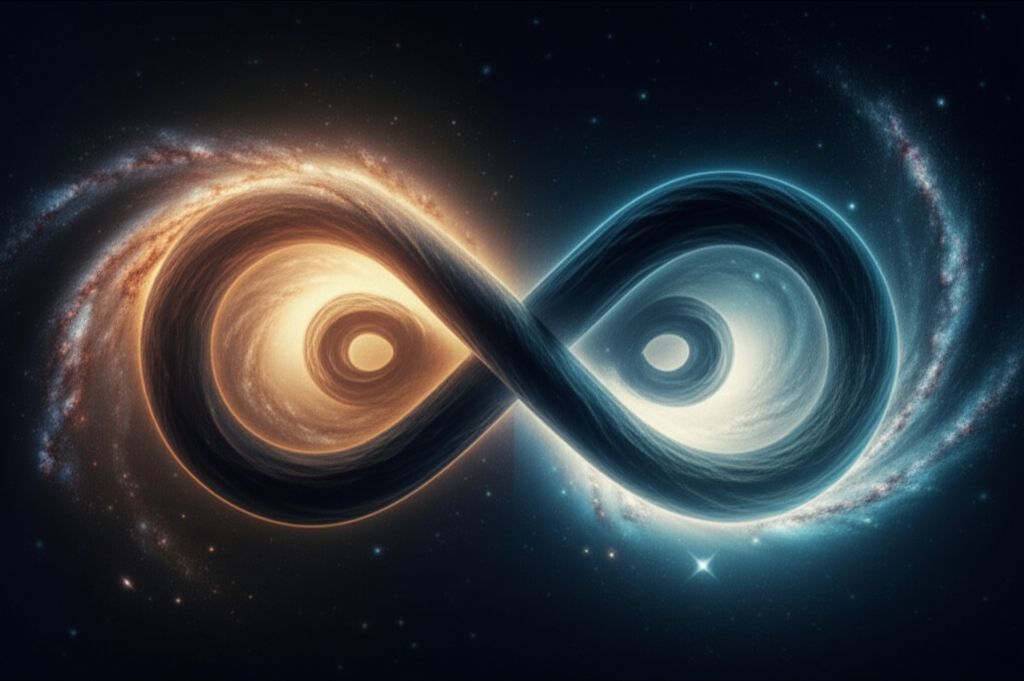 , with subtle mathematical equations faintly visible in the background, suggesting the convergence of science and philosophy.)
Historical Echoes: Infinity in the Great Books
The contemplation of infinity is a thread woven throughout the intellectual tapestry of the Great Books of the Western World.
- Ancient Greece: While wary of actual infinity, thinkers like Plato and Aristotle grappled with potential infinity and the concept of the apeiron (the unlimited or indefinite). Aristotle, in his Physics, meticulously argued against actual infinity in the physical world, asserting that infinity exists only in potentiality.
- Medieval Thought: Christian philosophers, influenced by Neoplatonism, reconciled classical ideas with the concept of an infinite God. Augustine, in Confessions, explored the eternal and boundless nature of God's existence and creation.
- Early Modern Philosophy: Descartes, Spinoza, and Leibniz each engaged with infinity in their systems. Descartes invoked an infinite God as a guarantor of clear and distinct ideas, while Spinoza posited a single, infinite substance (God or Nature) as the sole reality. Leibniz explored the infinite divisibility of matter and the concept of infinitesimals, bridging mathematics and metaphysics.
These historical engagements demonstrate that the Idea of infinity is not static; it evolves with human understanding, reflecting the philosophical and scientific paradigms of each era.
The Idea of Infinity: A Human Construct or Universal Truth?
One of the most profound questions surrounding infinity is whether it is a human construct—a product of our imaginative and mathematical faculties—or if it represents an inherent, objective truth about the universe. Is infinity something we invent, or something we discover?
The very act of conceiving the infinite suggests a unique capacity of the human mind. Yet, the consistency and predictive power of mathematical theories involving infinity point towards a deeper, perhaps universal, reality. This philosophical tension lies at the heart of many debates in the metaphysics of mathematics and the philosophy of mind. Whether a mere Idea or an objective feature of reality, infinity undeniably expands our intellectual horizons, compelling us to consider possibilities beyond the finite and the immediate. It challenges our assumptions about limits, encouraging a more profound engagement with the boundless mysteries that define existence.
Conclusion: Embracing the Limitless
The limitless nature of infinity continues to be a fertile ground for philosophical inquiry and scientific exploration. From the rigorous proofs of mathematics to the speculative depths of metaphysics, the Idea of infinity challenges our cognitive boundaries and invites us into a deeper appreciation of the universe's inherent complexity. As we continue to draw wisdom from the Great Books of the Western World and push the frontiers of modern thought, infinity remains a beacon, guiding us towards a more expansive and nuanced understanding of reality itself.
YouTube Video Suggestions:
-
📹 Related Video: PLATO ON: The Allegory of the Cave
Video by: The School of Life
💡 Want different videos? Search YouTube for: ""Cantor's Diagonalization Argument Explained Simply""
2. ## 📹 Related Video: ARISTOTLE ON: The Nicomachean Ethics
Video by: The School of Life
💡 Want different videos? Search YouTube for: ""Aristotle on the Infinite and Potentiality""