

Infinity, a concept that simultaneously defines the boundless and challenges our very capacity for comprehension, stands as a cornerstone in both mathematics and metaphysics. It is not merely a number without end but a profound idea that has shaped philosophical inquiry from antiquity to the present day, inviting us to contemplate the truly limitless. Through the ages, thinkers have grappled with its implications, transforming our understanding of reality, knowledge, and the very nature of existence.
The Unfathomable Concept: An Initial Glimpse
The notion of infinity has always held a peculiar fascination, stretching the limits of human reason. From the earliest philosophical texts, one finds attempts to articulate what it means for something to be without end, without limit, or without boundary. It is an idea that resists easy definition, often manifesting as a paradox that reveals the inherent constraints of finite thought attempting to grasp the infinite. This struggle is evident in the Great Books of the Western World, where philosophers, theologians, and scientists alike have wrestled with its implications, each epoch adding new layers to its complex tapestry.
From Potential to Actual: Infinity in Mathematics
While initially a philosophical construct, infinity found its most rigorous formalization within the realm of mathematics. Ancient Greek thinkers, notably Aristotle, distinguished between the potential infinite—a process that can always be extended but never completed—and the actual infinite—a completed totality of infinitely many things, which he largely denied in the physical world. For centuries, this Aristotelian view held sway.
However, the 19th century witnessed a revolutionary shift with the work of Georg Cantor. Cantor's groundbreaking set theory introduced the concept of transfinite numbers, demonstrating that there are not just one, but infinitely many different "sizes" of infinity. This was a profound leap, moving beyond the mere idea of endlessness to a structured, quantifiable hierarchy of infinities.
- Countable Infinities: Infinities that can be put into a one-to-one correspondence with the natural numbers (e.g., the set of all integers, or rational numbers).
- Uncountable Infinities: Infinities that are "larger" than the set of natural numbers (e.g., the set of all real numbers, or points on a line segment).
Cantor's work, initially met with skepticism and even hostility, provided a robust mathematical framework for understanding the actual infinite, forever changing the landscape of mathematics and, by extension, metaphysics.
The Metaphysical Horizon: Infinity as a Philosophical Idea
Beyond the precision of mathematical formulation, infinity retains its profound metaphysical significance. For many philosophical and theological traditions, infinity is not just a quantity but an attribute of ultimate reality, often associated with the divine.
- Theological Infinity: In Abrahamic traditions, God is often described as infinite in power, knowledge, and goodness. This concept of an absolutely infinite being, as explored by figures like St. Augustine and St. Thomas Aquinas in the Great Books, posits an ultimate reality that transcends all limitations and provides a foundation for existence itself. This idea of an infinite God offers solace and meaning, suggesting a boundless source from which all finite things derive.
- Cosmological Infinity: Philosophers have long debated whether the universe itself is infinite in space or time. From the Stoics to modern cosmologists, this question touches upon the limits of our perception and the ultimate nature of the cosmos. Is the universe a boundless expanse, or does it have an edge, and if so, what lies beyond? These questions probe the very fabric of existence.
- Epistemological Infinity: Even our capacity for knowledge can be considered in terms of infinity. Is there an infinite amount of knowledge to be gained, or are there fundamental limits to what we can know? This idea challenges the notion of complete understanding and suggests a perpetual journey of inquiry.
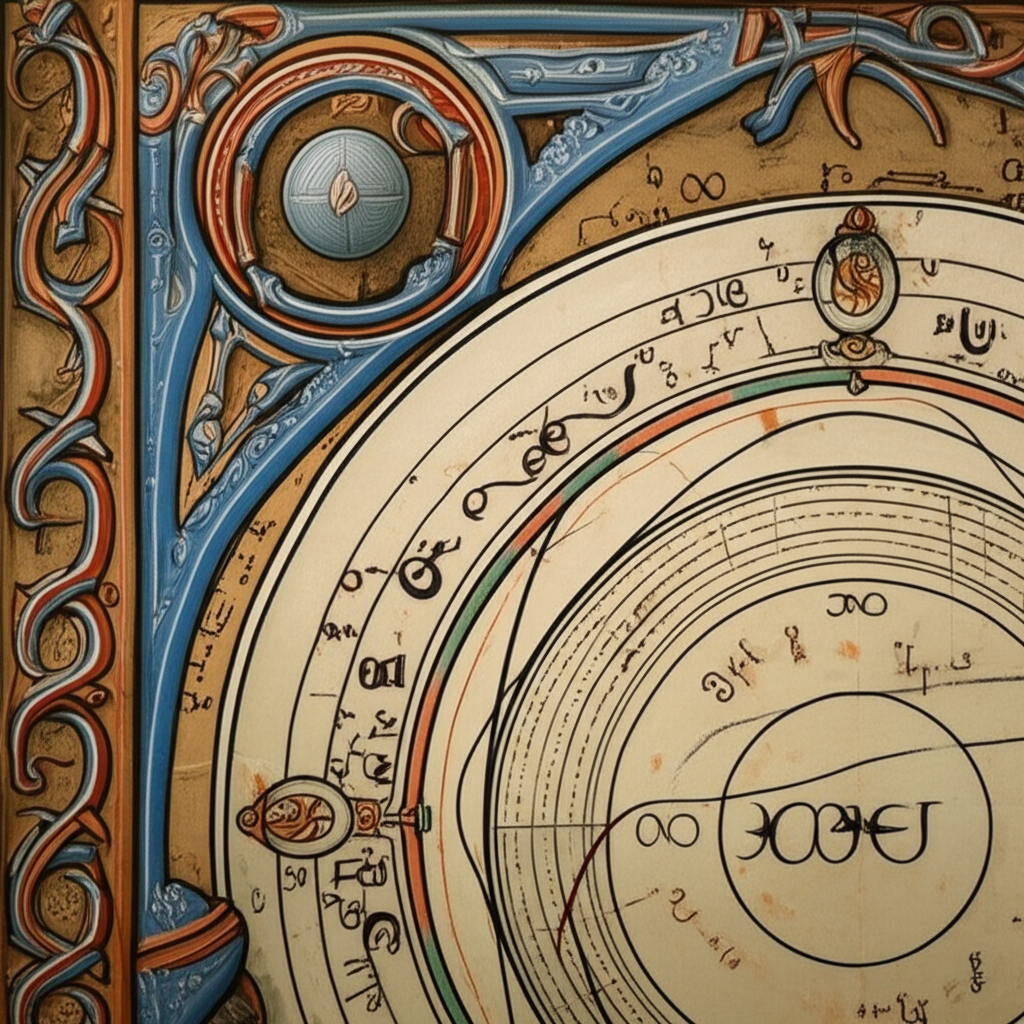 subtly interwoven into the design, symbolizing the ancient roots and contemporary understanding of infinity.)
Ancient Wisdom and Modern Paradoxes: A Journey Through Thought
The journey through the idea of infinity reveals a rich tapestry of thought, where ancient wisdom often foreshadows modern dilemmas.
Key Philosophical Approaches to Infinity:
- Aristotelian Potential Infinite: The understanding that infinity exists only as a process that can always be extended, never as a completed whole. This prevented Zeno's paradoxes from implying actual motion was impossible.
- Theological Actual Infinite: The concept of God as an infinite being, perfect and complete in every attribute, as explored by Augustine and Aquinas, grounding all reality in an ultimate, boundless source.
- Cartesian/Spinozistic Infinite Substance: The notion of an infinite, self-sufficient substance (God or Nature) as the ultimate reality, from which all finite modes or attributes emanate.
- Kantian Antinomies: Immanuel Kant identified antinomies of pure reason, where arguments for and against the finitude or infinitude of the world in space and time could both be logically constructed, demonstrating the limits of reason when applied beyond experience.
- Cantorian Transfinite Numbers: The mathematical formalization of different "sizes" of actual infinities, revolutionizing our understanding through set theory and providing tools to differentiate between seemingly equal infinities.
Each of these perspectives, whether ancient or modern, mathematical or metaphysical, contributes to our evolving comprehension of this most elusive idea.
Embracing the Limitless: The Enduring Allure of Infinity
The limitless nature of infinity remains one of philosophy's most compelling subjects. It challenges our intuitions, expands our mental horizons, and forces us to confront the boundaries—or lack thereof—of our universe and our understanding. Whether approached through the rigorous proofs of mathematics, the profound inquiries of metaphysics, or the historical unfolding of a powerful idea, infinity continues to inspire awe and critical thought. It reminds us that some concepts are not merely understood but are to be perpetually contemplated, pushing the very edge of human thought into the boundless unknown.
📹 Related Video: What is Philosophy?
Video by: The School of Life
💡 Want different videos? Search YouTube for: ""The Philosophy of Infinity: A Journey Through Endless Ideas""
📹 Related Video: PLATO ON: The Allegory of the Cave
Video by: The School of Life
💡 Want different videos? Search YouTube for: ""Cantor's Paradoxes and the Sizes of Infinity Explained""