

The Limitless Nature of Infinity: An Enduring Philosophical Frontier
The concept of Infinity stands as one of humanity's most profound and perplexing ideas, a boundless frontier that challenges the very limits of our comprehension. Far from being a mere mathematical abstraction, infinity permeates our understanding of existence, time, and the cosmos, serving as a cornerstone for deep metaphysical inquiry. This article delves into the multifaceted nature of infinity, exploring its evolution from ancient philosophical quandaries to its modern mathematical formalizations, ultimately revealing its ceaseless power to expand our intellectual horizons.
Grappling with the Infinite: A Human Predicament
From the earliest stirrings of philosophical thought, the notion of something without end, without bounds, has captivated and confounded the human mind. How can we, finite beings, truly grasp the infinite? Is it merely the absence of an end, or does it possess a positive, substantive reality of its own? These questions lie at the heart of what makes Infinity such a compelling idea – a concept that transcends simple definition, demanding a re-evaluation of our intuitive sense of scale and possibility.
Historical Echoes: Infinity in the Great Books
The journey to understand Infinity is a long and winding one, deeply etched into the annals of Western thought. Within the pages of the Great Books of the Western World, we find thinkers wrestling with this elusive concept across millennia:
- Ancient Greece: Philosophers like Aristotle distinguished between potential infinity (a process that can go on forever, like counting) and actual infinity (a completed set of infinitely many things, which he largely rejected as incoherent in the physical world). For the Greeks, the finite was often associated with perfection and order, while the infinite hinted at the chaotic and indeterminate.
- Medieval Thought: Theistic philosophers grappled with the idea of an infinite God, reconciling this metaphysical reality with the seemingly finite universe. Thinkers like Thomas Aquinas explored the infinite attributes of God, further solidifying infinity's place in theological discourse.
- Early Modern Era: The advent of calculus by Leibniz and Newton introduced new mathematical tools for dealing with infinite processes, limits, and infinitesimals, revolutionizing our ability to describe continuous change.
- 19th and 20th Centuries: The most radical shift came with Georg Cantor's groundbreaking work on set theory, which demonstrated that there are not just one, but different sizes of actual infinities – a revelation that profoundly reshaped Mathematics and its metaphysical implications.
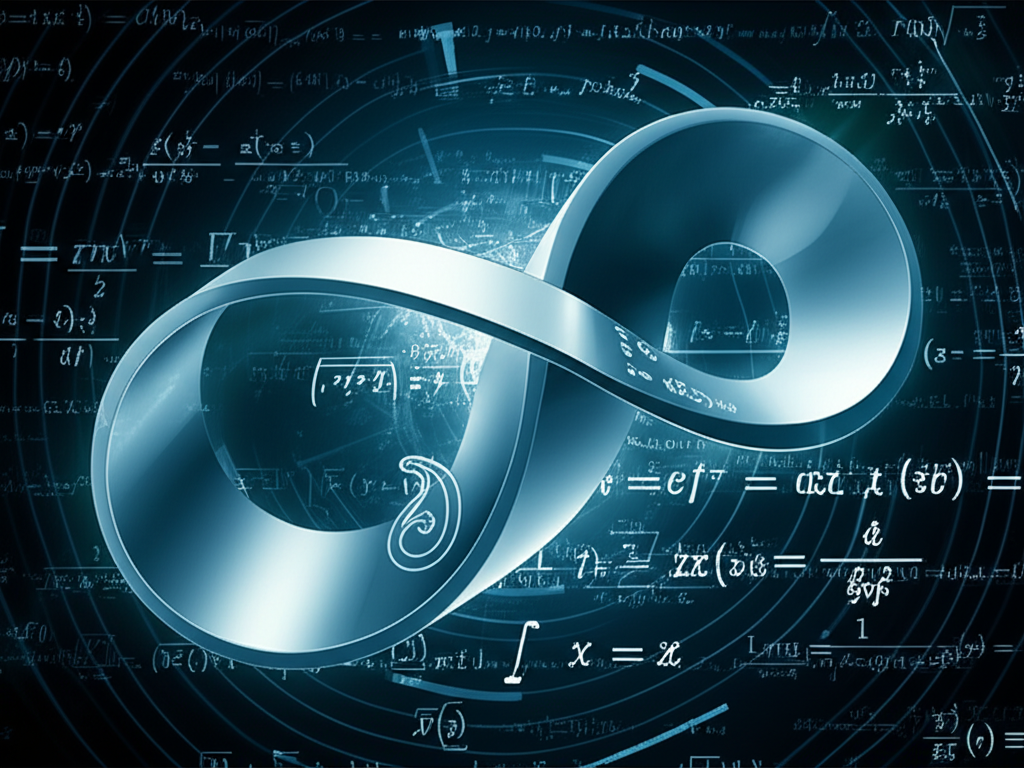 subtly woven into its surface, suggesting endlessness and self-referential complexity against a deep, cosmic background.)
Mathematics: Unveiling the Unfathomable Depths
While intuition often recoils from the infinite, Mathematics has provided the most rigorous framework for exploring its structure. It's here that the "limitless nature" becomes not just a poetic phrase, but a subject of precise analysis.
Key Mathematical Concepts of Infinity:
| Concept | Description | Philosophical Implication |
|---|---|---|
| Countable Infinity | The size of infinite sets whose elements can be put into one-to-one correspondence with the natural numbers (e.g., integers, rational numbers). | Challenges the notion that "infinite" means "immeasurably larger than." |
| Uncountable Infinity | The size of infinite sets whose elements cannot be put into one-to-one correspondence with the natural numbers (e.g., real numbers, points on a line). | Reveals a hierarchy within infinity itself, suggesting different "degrees" of limitlessness. |
| Limits | The value that a function or sequence "approaches" as an input or index approaches some value (often infinity). | Provides a way to analyze infinite processes without necessarily reaching an "end." |
| Transfinite Numbers | Cantor's system for extending the natural numbers to "count" the sizes of infinite sets (cardinal numbers) and infinite ordinals. | Formalizes the idea of actual infinities, moving beyond mere potentiality. |
These mathematical insights reveal that infinity is not a monolithic void, but a landscape with intricate structures and varying magnitudes. The very act of doing Mathematics often involves confronting and manipulating infinite processes, from calculus to set theory, constantly pushing the boundaries of what is conceivable.
Metaphysics: The Infinite Horizon of Existence
Beyond numbers and sets, Infinity resonates deeply within metaphysics, shaping our understanding of reality, time, and space. The idea of infinity here isn't just about quantity, but about fundamental qualities of existence.
- Cosmological Infinity: Is the universe spatially infinite? Does it contain an infinite number of stars, galaxies, or parallel universes? The answer profoundly impacts our place within the cosmos. An infinite universe suggests endless possibilities and a challenge to any notion of a central, unique observer.
- Temporal Infinity: Does time stretch infinitely into the past and future? The implications for causality, purpose, and the very beginning (or lack thereof) of existence are immense. The metaphysical weight of an eternal present or an endless succession of events is a core philosophical dilemma.
- The Infinite Divine: For many philosophical and theological traditions, God is often conceived as an infinite being – infinitely powerful, knowing, and good. This attribution of infinity grants divinity its ultimate nature, distinguishing it from all finite creation.
- Potential vs. Actual Infinity in Reality: The ancient debate between potential and actual infinity still holds metaphysical sway. Does the world truly contain actually infinite things (e.g., an infinite number of points on a line segment), or are these merely conceptual tools for describing finite, but infinitely divisible, realities?
Infinity as an Enduring Idea
The "limitless nature of Infinity" is not just a description of its magnitude, but a testament to its enduring power as an idea. It is a concept that forces us to confront the limits of our own understanding, to stretch our minds beyond the familiar and finite. Whether pondered by ancient sages, formalized by mathematicians, or invoked by cosmologists, Infinity remains a potent symbol of the unknown, the boundless, and the perpetually unfolding mystery of existence. It is an idea that, by its very nature, invites endless exploration, ensuring its place at the forefront of philosophical inquiry for generations to come.
YouTube Video Suggestions:
-
📹 Related Video: KANT ON: What is Enlightenment?
Video by: The School of Life
💡 Want different videos? Search YouTube for: ""Georg Cantor and the Different Sizes of Infinity Explained""
-
📹 Related Video: PLATO ON: The Allegory of the Cave
Video by: The School of Life
💡 Want different videos? Search YouTube for: ""What is Infinity? A Philosophical and Mathematical Exploration""