

The Unyielding Tapestry: Exploring the Law of Cause and Effect
By Grace Ellis
An Immutable Principle: What is the Law of Cause and Effect?
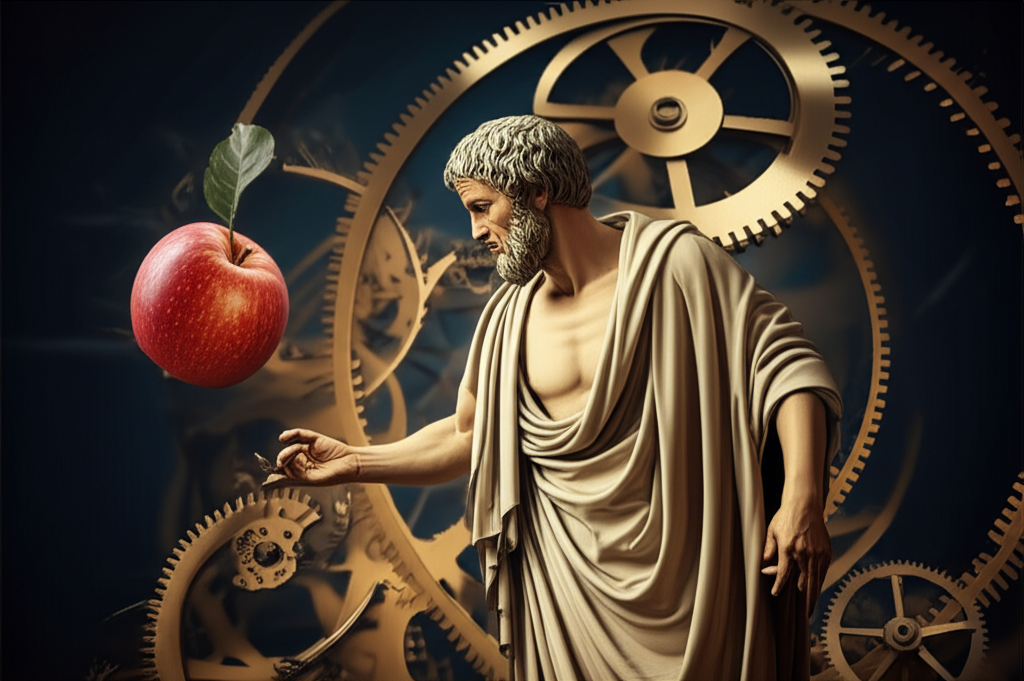
At the very bedrock of our understanding of the universe lies a concept so fundamental, so pervasive, that it often goes unquestioned: the Law of Cause and Effect. Simply put, this principle posits that every effect, every event, every outcome, has a preceding cause. Nothing simply happens; rather, everything is the inevitable result of something else. It is the invisible thread that weaves through the fabric of existence, connecting moments, actions, and consequences in an unbroken chain. From the falling apple to the rise and fall of civilizations, this Law underpins our ability to predict, to learn, and to make sense of the world around us. Without it, the universe would be an unpredictable chaos, and logic would cease to have any meaning.
Tracing the Roots: A Brief History in Western Thought
The concept of causality has been a central preoccupation for philosophers throughout history, shaping the very trajectory of Western thought. The "Great Books of the Western World" are replete with inquiries into this profound relationship.
-
Aristotle's Four Causes: One of the earliest and most comprehensive frameworks for understanding causality comes from Aristotle. In his Physics and Metaphysics, he identified four distinct types of causes:
- Material Cause: That out of which something is made (e.g., the bronze of a statue).
- Formal Cause: The form or essence of a thing (e.g., the shape of the statue).
- Efficient Cause: The primary agent or source of the change or rest (e.g., the sculptor who makes the statue).
- Final Cause: The purpose or end for which a thing exists (e.g., the reason for creating the statue).
Aristotle's work laid a foundational understanding, emphasizing that to truly know something, one must understand its causes.
-
Hume's Skeptical Inquiry: Centuries later, David Hume, an influential Scottish philosopher, challenged the very notion of necessary connection between cause and effect. In A Treatise of Human Nature and An Enquiry Concerning Human Understanding, Hume argued that we never observe a necessary connection, only constant conjunction. We see event A consistently followed by event B, and through habit, our minds infer a causal link. This radical skepticism highlighted that our belief in causality is more a product of psychological expectation than empirical observation or pure logic.
-
Kant's Synthetic A Priori: Immanuel Kant, responding to Hume, famously argued that causality is not merely a habit of mind, nor is it something we derive purely from experience. Instead, in his Critique of Pure Reason, Kant proposed that causality is a fundamental category of understanding, a "synthetic a priori" judgment. It is a necessary precondition for our experience of the world, something our minds impose on phenomena to make sense of them. Without the principle of causality, experience itself would be impossible.
The Logic of Existence: Why Does it Matter?
The Law of Cause and Effect is not merely an academic curiosity; it is the very framework upon which our understanding of reality, science, and even morality is built.
- Scientific Inquiry: Science fundamentally relies on the ability to identify causes and predict effects. Experiments are designed to isolate variables to determine precise causal relationships. Without this principle, scientific discovery would be impossible, and technological advancement would halt.
- Rational Thought and Logic: Our ability to reason, to plan, and to make informed decisions is predicated on the assumption that actions have consequences. If effects were random, there would be no basis for logic or rational planning.
- Moral Responsibility: The concept of accountability, blame, and praise is deeply intertwined with causality. We hold individuals responsible for their actions because we believe their actions are the cause of certain effects.
- Understanding the Universe: From the Big Bang to the evolution of life, the grand narratives of the cosmos are told through the lens of cause and effect. It provides a coherent, albeit complex, story of how everything came to be.
Practical Applications: From Metaphysics to Mundane
The Law of Cause and Effect manifests in countless ways, from the grand philosophical questions to the simplest daily observations:
- Engineering: Bridges stand because engineers understand the causes of stress and the effects of materials.
- Medicine: Doctors prescribe treatments based on understanding the causes of disease and the effects of medication.
- Law: Legal systems are built on establishing causality to assign responsibility and administer justice.
- Personal Growth: Understanding that our habits (causes) lead to our life outcomes (effects) empowers personal development.
Navigating the Nuances: Challenges and Interpretations
While universally accepted in many forms, the Law of Cause and Effect is not without its complexities and challenges:
- Complexity of Causation: In many real-world scenarios, there isn't a single cause for an effect but a complex web of contributing factors. Identifying the primary cause can be incredibly difficult.
- Probabilistic Causality: In quantum mechanics, causality often appears probabilistic rather than deterministic, challenging our classical intuitions.
- The "First Cause" Problem: If every effect has a cause, what caused the very first event? This leads to metaphysical questions about an uncaused cause, often invoked in theological arguments.
- Correlation vs. Causation: A common logical fallacy is to assume that because two events are correlated, one must be the cause of the other. Often, a third, unseen factor is the true cause.
Conclusion: The Enduring Law
The Law of Cause and Effect remains an indispensable principle for understanding our universe. Whether viewed as an inherent feature of reality, a necessary construct of the human mind, or a pragmatic tool for prediction, its influence on philosophy, science, and everyday logic is undeniable. As we continue to probe the mysteries of existence, the intricate dance between cause and effect will undoubtedly remain at the heart of our inquiry, a fundamental Law guiding our quest for knowledge.
📹 Related Video: What is Philosophy?
Video by: The School of Life
💡 Want different videos? Search YouTube for: ""The Problem of Causality in Philosophy Explained""
📹 Related Video: ARISTOTLE ON: The Nicomachean Ethics
Video by: The School of Life
💡 Want different videos? Search YouTube for: ""Aristotle's Four Causes Explained Simply""