

The Inexorable Dance: Exploring the Law of Cause and Effect
The Law of Cause and Effect stands as one of the most fundamental and pervasive principles of human understanding, a bedrock upon which much of our perception of reality, scientific inquiry, and even moral logic is built. At its core, this principle asserts that every event, every change, every phenomenon, is the direct result of a preceding cause. Nothing simply "happens"; rather, everything is woven into an intricate web of antecedents and consequences. This isn't merely a scientific observation but a profound philosophical insight that has shaped thought for millennia, suggesting an inherent order and predictability to the universe, even if that order is incredibly complex.
The Ancient Roots of a Universal Principle
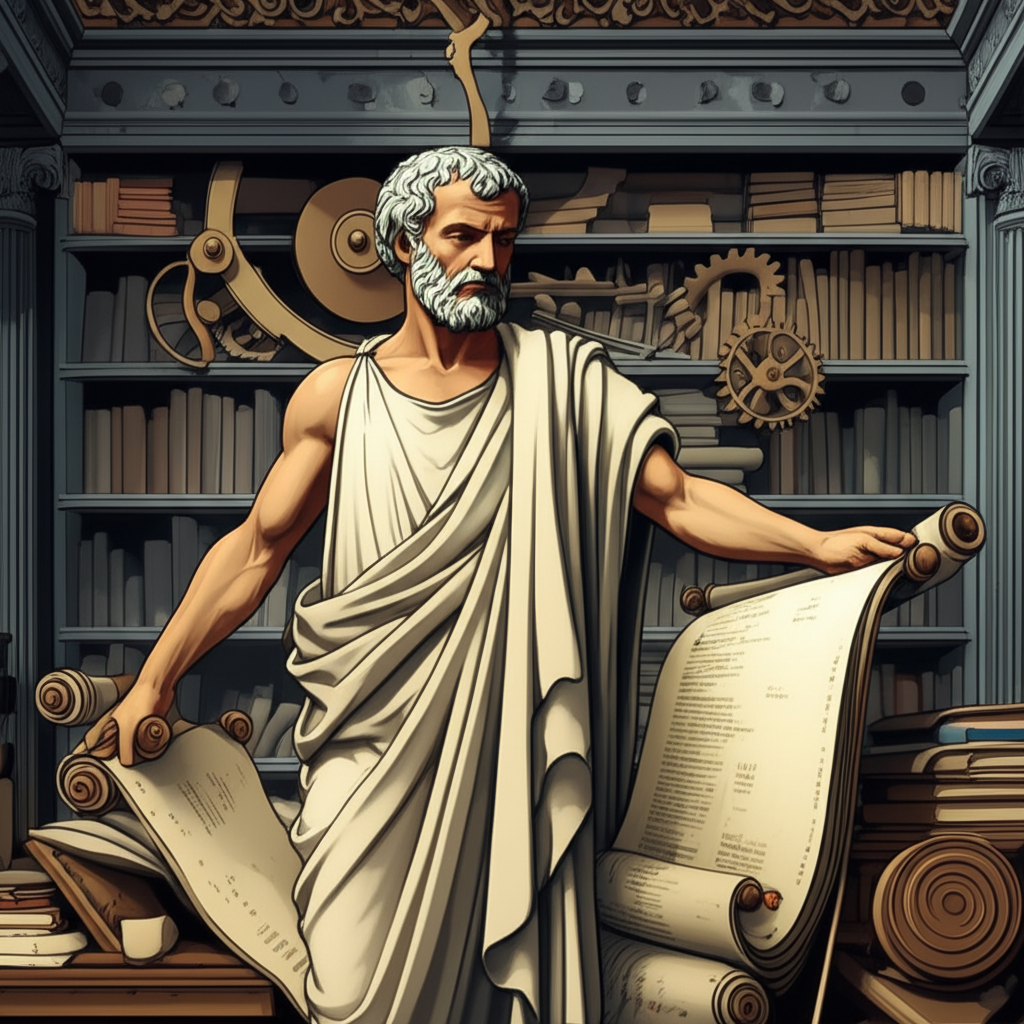
The concept of cause and effect is far from a modern invention. From the earliest philosophical inquiries, thinkers grappled with the nature of change and the origins of phenomena. In the Great Books of the Western World, we find Aristotle, in works like Physics and Metaphysics, meticulously outlining his famous four causes:
- Material Cause: What something is made of (e.g., the bronze of a statue).
- Formal Cause: The form or essence of a thing (e.g., the shape of the statue).
- Efficient Cause: The primary source of the change or rest (e.g., the sculptor who makes the statue).
- Final Cause: The purpose or end for which something exists (e.g., the statue’s purpose to beautify a temple).
Aristotle's detailed schema highlights the ancient recognition that understanding something fully requires grasping its origins and purposes. This systematic approach laid much of the groundwork for subsequent Western thought on causality, establishing it as a crucial principle for comprehending both the natural world and human action. The idea that effects are intelligible through their causes became an indispensable tool for rational inquiry.
The Indispensable Logic of Connection
To speak of the Law of Cause and Effect is to speak of an inherent logic that underpins our very experience. When we observe a billiard ball striking another, we expect the second ball to move. This expectation isn't merely learned behavior; it taps into a deeper cognitive framework that seeks out causal connections. The principle of causality allows us to:
- Predict Future Events: If we understand the causes, we can anticipate the effects. This is fundamental to all scientific endeavors, from predicting planetary orbits to forecasting weather patterns.
- Explain Past Occurrences: When faced with an effect, we naturally seek its cause, allowing us to reconstruct events and understand their origins. Historians, detectives, and even children asking "why?" are all engaging with this aspect of the law.
- Attribute Responsibility: In ethics and law, the concept of cause is paramount. We hold individuals responsible for actions that cause harm or benefit, forming the basis of justice and moral accountability.
However, the nature of this connection has also been a source of profound philosophical debate. David Hume, another giant from the Great Books tradition, famously challenged the notion of necessary connection between cause and effect. He argued that we only observe constant conjunction – one event following another – but never the invisible "power" or "force" that binds them. For Hume, our belief in causality is more a product of habit and expectation than a direct perception of an inherent link. Despite this skepticism, the practical utility and intuitive appeal of the Law of Cause and Effect have ensured its enduring status as a guiding principle.
Navigating Complexity: Beyond Simple Links
While the fundamental principle remains, the application of the Law of Cause and Effect in the real world is rarely simple. We often encounter:
- Multiple Causes: A single effect can be the result of several interacting causes. For example, a global economic recession is not due to one factor but a confluence of many.
- Probabilistic Causality: In many fields, particularly quantum physics and social sciences, causality is often expressed in terms of probabilities rather than absolute certainties. A cause might increase the likelihood of an effect without guaranteeing it.
- Feedback Loops: Effects can, in turn, become causes, creating complex systems where distinctions blur and initial causes are hard to isolate. Climate change, for instance, involves numerous interconnected feedback loops.
Despite these complexities, the underlying logic that every effect has a cause remains a powerful heuristic. It compels us to dig deeper, to analyze more thoroughly, and to resist the temptation of attributing events to pure randomness or inexplicable forces. It is a constant invitation to understand the intricate machinery of existence.
Conclusion: The Unseen Architect of Reality
The Law of Cause and Effect is more than just a scientific tenet; it is a profound philosophical principle that shapes our worldview. It suggests that the universe is not chaotic but ordered, not arbitrary but intelligible. While philosophers have debated the precise nature of the causal link and the limits of our knowledge of it, the practical and theoretical utility of this law remains undeniable. It is the unseen architect that structures our reality, guiding our inquiries, informing our decisions, and underpinning our very sense of logic in a world of constant change.
YouTube: "David Hume causality explained"
YouTube: "Aristotle's Four Causes philosophy"
📹 Related Video: What is Philosophy?
Video by: The School of Life
💡 Want different videos? Search YouTube for: "The Law of Cause and Effect philosophy"