

The Unseen Threads: Unpacking the Law of Cause and Effect
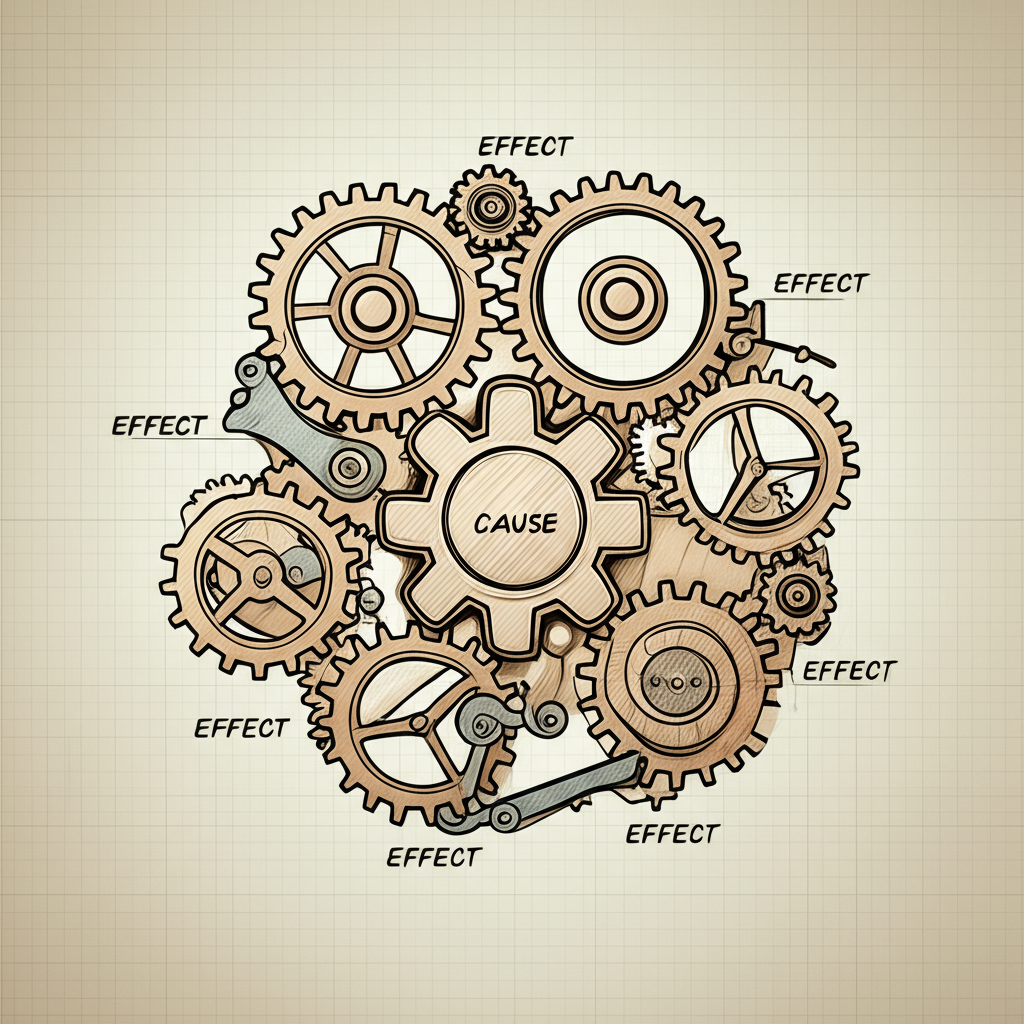
The Law of Cause and Effect stands as a bedrock principle of human understanding, a fundamental logic that shapes our perception of reality. At its core, it asserts that every event or state of affairs (the effect) is the inevitable consequence of a preceding event or set of conditions (the cause). This isn't merely an observation but a foundational assumption that underpins scientific inquiry, rational thought, and our very ability to navigate the world. To comprehend this Law is to grasp the intricate, often invisible, connections that weave through existence, revealing a universe governed by order rather than arbitrary chaos.
The Inexorable Principle: What is Causality?
At its most direct, the Law of Cause and Effect posits that nothing simply happens. Every phenomenon, every change, every outcome can be traced back to an originating factor. This principle is not just about sequences in time, but about necessary connections. If A is the cause, then B, the effect, will follow, given the right conditions. This relationship is often seen as universal, applying across all domains, from the falling of an apple to the intricate workings of human societies. It's the very logic we employ to make sense of our experiences, to predict future events, and to learn from the past.
Historical Echoes of Causality: From Ancient Greece to Modern Thought
The contemplation of cause and effect has been a central preoccupation for philosophers throughout history, forming a significant portion of the "Great Books of the Western World."
Aristotle's Fourfold Inquiry
Perhaps the most comprehensive early articulation of causality comes from Aristotle. In his Physics and Metaphysics, he delineated four distinct types of causes, not as separate events, but as different ways of understanding why something is the way it is:
- Material Cause: That out of which something is made (e.g., the bronze of a statue).
- Formal Cause: The essence or form, the definition of what a thing is (e.g., the shape of the statue).
- Efficient Cause: The primary source of the change or rest, that which produces the effect (e.g., the sculptor who makes the statue). This is closest to our modern understanding of "cause."
- Final Cause: The end, the purpose for which a thing exists or is done (e.g., the purpose of the statue – to honor a hero).
Aristotle's framework provided a robust logic for understanding the world, moving beyond simple sequential events to a deeper exploration of inherent properties and purposes.
Hume's Skeptical Challenge
Centuries later, David Hume, in his A Treatise of Human Nature and An Enquiry Concerning Human Understanding, presented a profound challenge to the certainty of the causal Law. Hume observed that while we see constant conjunctions (one event consistently following another), we never perceive the necessary connection between them. We infer causality based on habit and expectation, not on an observable, inherent link. This observation shook the foundations of empirical logic, suggesting that our belief in causality might be more a psychological principle than an objective truth about the world.
Kant's Transcendental Response
Immanuel Kant, deeply influenced by Hume, sought to rescue the Law of Cause and Effect from pure skepticism. In his Critique of Pure Reason, Kant argued that causality is not something we derive solely from experience, but rather an a priori category of understanding, a fundamental structure of the human mind. We don't just observe the world causally; we must perceive it causally for any coherent experience to be possible. For Kant, causality is a universal and necessary principle that the mind imposes on phenomena, making it a foundational Law for all possible experience.
The Enduring Relevance of the Causal Principle
The Law of Cause and Effect, whether viewed as an objective reality, a fundamental mental category, or a reliable heuristic, remains indispensable.
- Scientific Inquiry: Every scientific experiment is built on the premise that specific interventions (causes) will lead to predictable outcomes (effects). The search for scientific laws is, in essence, the search for robust causal relationships.
- Moral Responsibility: Our understanding of ethics and justice often hinges on attributing actions (causes) to individuals and holding them accountable for their consequences (effects).
- Everyday Logic: From planning our day to understanding historical events, we constantly apply causal reasoning. If I study (cause), I will likely pass the exam (effect). If there's smoke (effect), there must be fire (cause).
The ongoing philosophical debates about free will versus determinism, for instance, are deeply intertwined with the implications of a universally applied causal Law. If every event is causally determined, what space remains for genuine choice? This question continues to push the boundaries of our understanding of this profound principle.
Exploring Further:
- YouTube: "Aristotle's Four Causes Explained"
- YouTube: "Hume and Kant on Causality"
📹 Related Video: What is Philosophy?
Video by: The School of Life
💡 Want different videos? Search YouTube for: "The Law of Cause and Effect philosophy"