

The Interplay of Desire and Will in Choice
Summary: Human choice is a complex tapestry woven from the threads of desire and will. While desire often represents the immediate pull of our appetites, emotions, and inclinations, will embodies our capacity for rational deliberation, self-control, and conscious intent. This article explores how these two fundamental faculties, extensively examined by the great thinkers of Western philosophy, engage in a perpetual dance within the mind of man, shaping not only individual decisions but also the very essence of character and moral action. Understanding their interplay is key to comprehending human agency and the pursuit of a well-lived life.
The Eternal Dance: Desire and Will in the Human Mind
From the moment we awaken until we rest, our lives are a continuous stream of choices. Some are trivial, others monumental, but all are influenced by the intricate relationship between what we want and what we choose to do. This profound dynamic, central to understanding the human mind, has captivated philosophers for millennia, finding rich exploration within the pages of the Great Books of the Western World.
Desire's Primal Call: The Engine of Existence
Desire is often the initiating spark, the raw energy that propels man into action. It encompasses everything from basic biological needs—hunger, thirst, comfort—to more complex longings for love, recognition, knowledge, or power. Philosophers like Plato, in his Republic, identified different types of desires residing in the appetitive part of the soul, distinct from reason. Aristotle, in his Nicomachean Ethics, acknowledged the role of appetites and passions as natural parts of human experience, though needing guidance. Even earlier, thinkers like Epicurus implicitly dealt with desire in his pursuit of pleasure and avoidance of pain as the ultimate good. Thomas Hobbes, in Leviathan, posited that human actions are fundamentally driven by a perpetual and restless desire for power after power, ending only in death.
Desire, in its purest form, is neither good nor bad; it simply is. It gives life its vibrancy, its impetus, its direction. However, unchecked or irrational desires can lead to impulsiveness, addiction, and actions detrimental to oneself or society.
The Guiding Hand: Will as the Architect of Self
If desire is the engine, will is the steering mechanism, the conscious navigator. The will is the faculty that allows man to deliberate, to choose, to assent or dissent, and to act purposefully. It is the locus of our autonomy and self-determination. For Augustine, in his Confessions, the will was central to human freedom and the struggle against sin, a faculty capable of choosing good or evil, though often needing divine grace. Thomas Aquinas, building on Aristotle, saw the will as a "rational appetite"—a desire guided by reason.
The Enlightenment brought a sharper focus on the will's power. René Descartes, in his Meditations, considered the will to be infinite, our capacity to affirm or deny, to pursue or avoid, and saw it as the source of both human freedom and error when not guided by clear and distinct perceptions of the intellect. Immanuel Kant, in his Groundwork of the Metaphysics of Morals, elevated the "good will" to the highest moral principle, arguing that true moral action stems not from inclination (desire) but from duty, from the will's adherence to universal moral laws. The will empowers man to transcend immediate gratification, to commit to long-term goals, and to act in accordance with deeply held values, even when it is difficult.
The Arena of Choice: Where Desire Meets Will
The human mind is the stage where desire and will perform their intricate drama. Every choice, from what to eat for breakfast to how to live one's life, involves some degree of interaction between these two forces.
Conflict and Harmony: The Dynamics of Decision
Often, desire and will are at odds. We might desire to stay in bed, but our will compels us to rise for work. We might desire a sugary treat, but our will, guided by health goals, chooses an apple. This internal conflict is a hallmark of the human condition, a testament to our capacity for self-governance.
However, desire and will can also work in harmony. When we desire to learn, and our will commits us to study, the synergy is powerful. When we desire to help others, and our will translates that intention into action, we experience moral fulfillment.
| Feature | Desire | Will |
|---|---|---|
| Nature | Appetitive, emotional, instinctual | Rational, deliberative, intentional |
| Source | Body, senses, passions, external stimuli | Intellect, reason, moral principles |
| Orientation | Immediate gratification, pleasure, avoidance | Long-term goals, duty, values, self-control |
| Expression | Wanting, craving, longing | Choosing, deciding, assenting, acting |
| Philosophers | Plato (appetite), Aristotle (passions), Hobbes | Augustine, Descartes, Kant, Aquinas |
Shaping the Man: The Mind's Crucible
The ongoing interaction between desire and will profoundly shapes the mind and character of man. A life dominated solely by unchecked desire leads to impulsiveness and potential self-destruction. A life devoid of desire, if even possible, would be lifeless and without motivation. The mature man learns to integrate these forces, using will not to eradicate desire, but to guide and refine it, aligning his actions with his deepest values and rational understanding. This process of self-mastery is central to ethical living and personal growth.
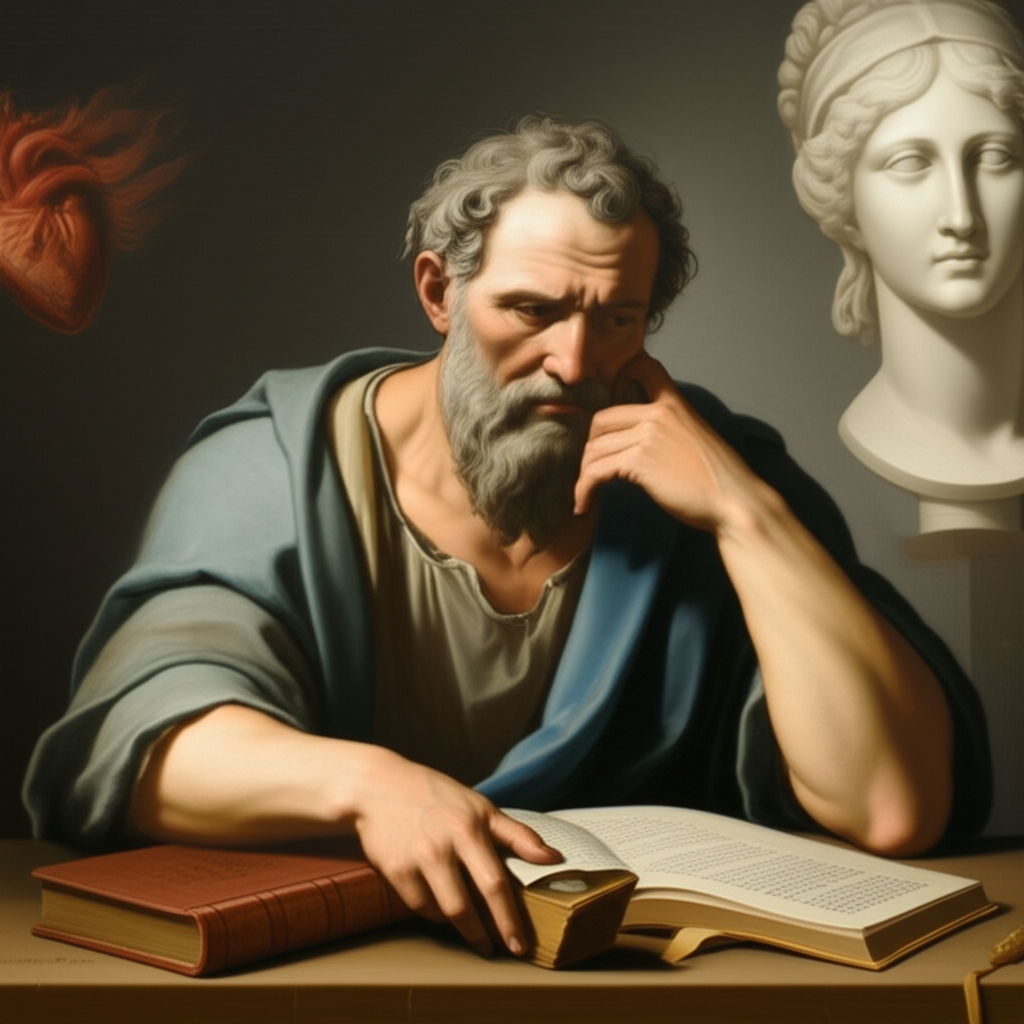 on the other, symbolizing the tension and eventual harmony between passion and reason within the human mind. The figure's gaze is inward, reflecting deep thought.)
Echoes Through Time: Great Thinkers on the Interplay
The Great Books of the Western World offer invaluable insights into the enduring philosophical debate surrounding desire and will:
- Plato's Charioteer: Reason's Dominion: In The Republic, Plato famously likened the soul to a charioteer (reason/will) guiding two winged horses: one noble (spiritedness) and one unruly (appetite/desire). The charioteer's task is to control and direct the horses, ensuring the soul moves towards truth and virtue, rather than being dragged by base desires.
- Aristotle's Virtue: Habit and Rational Choice: Aristotle emphasized phronesis, practical wisdom, as the capacity to deliberate well about what is good for man. For him, virtuous action requires not just right desire but also the will to choose the mean between extremes, developed through habituation. The continent man uses will to overcome bad desires, while the virtuous man has trained his desires to align with reason.
- Augustine's Inner Strife: The Will's Redemption: Augustine's Confessions is a poignant account of his personal struggle against carnal desire and the weakness of his will. He famously prayed, "Grant me chastity and continence, but not yet!" highlighting the internal conflict. His journey illustrates the will's pivotal role in turning towards God and achieving spiritual freedom.
- Descartes's Infinite Will: Judgment and Error: Descartes saw the will as an infinite faculty, boundless in its capacity for affirmation or denial. Human error, he argued, arises when the will assents to ideas that are not clear and distinct perceptions of the intellect, thus allowing desire or prejudice to sway judgment.
- Kant's Good Will: Duty Over Inclination: Kant made a radical distinction between acting from desire (inclination) and acting from duty. For him, a truly moral action stems from a "good will"—one that chooses to act in accordance with universal moral law, regardless of personal desire or expected outcome. The moral worth of an action lies in the maxim (principle) by which it is willed.
Navigating the Inner Landscape: Practical Implications
Understanding the interplay of desire and will is not merely an academic exercise. It has profound practical implications for how we live our lives:
- Self-Awareness: Recognizing the sources and nature of our desires, and the strength or weakness of our will, is the first step towards self-mastery.
- Ethical Decision-Making: Consciously engaging our will to choose actions aligned with our moral principles, even when desires pull us elsewhere, builds character and integrity.
- Goal Achievement: Long-term success in any endeavor—be it academic, professional, or personal—requires the will to persevere, to overcome obstacles, and to delay gratification, often in the face of immediate desires.
- Personal Growth: The cultivation of a strong, rational will allows man to transcend his primal impulses and strive for higher ideals, shaping himself into the person he aspires to be.
Conclusion: The Ongoing Symphony of Choice
The dialogue between desire and will is a continuous symphony within the human mind. It is the dynamic tension that defines our choices, shapes our character, and ultimately determines the trajectory of our lives. By engaging with the profound insights offered by the Great Books of the Western World, we gain a deeper appreciation for this fundamental interplay, empowering us to become more conscious architects of our own destiny and more thoughtful participants in the ongoing human drama.
YouTube:
-
📹 Related Video: PLATO ON: The Allegory of the Cave
Video by: The School of Life
💡 Want different videos? Search YouTube for: "Plato's Chariot Allegory explained"
-
📹 Related Video: KANT ON: What is Enlightenment?
Video by: The School of Life
💡 Want different videos? Search YouTube for: "Kant's Categorical Imperative explained"