

The Infinite Dance of Numbers: Unpacking Mathematical Series
Friends, let's embark on a journey into one of the most beguiling realms where mathematics and philosophy intertwine: the concept of infinity as it manifests in mathematical series. At first glance, a series is simply a sum of numbers, often following a particular rule. But delve a little deeper, and we find ourselves wrestling with the very nature of quantity, the limits of logic, and the mind-bending notion that an infinite number of terms can, paradoxically, add up to a finite value, or conversely, explode into an incomprehensible enormity. This article aims to pull back the curtain on this fascinating corner of thought, offering a direct summary of how these sequences challenge and expand our understanding of the universe.
The Allure of Endless Sums
Imagine a line segment. Now, imagine dividing it in half, then dividing the remaining half in half again, and so on, infinitely. This simple mental exercise introduces us to the essence of a mathematical series: an ordered sequence of numbers, called terms, which are to be added together. The profound question, however, arises when this sequence is infinite. Can we sum an infinite number of parts?
- What is a Mathematical Series?
At its core, a series is represented as $a_1 + a_2 + a_3 + \dots$, where each $a_n$ is a term derived from some rule. For example, the series $1/2 + 1/4 + 1/8 + \dots$ is a geometric series where each term is half of the previous one. - Initial Intuition vs. Mathematical Reality: Our everyday logic might suggest that adding an infinite number of positive quantities, no matter how small, must result in an infinite sum. Yet, mathematics reveals a more nuanced truth. Some infinite series converge to a finite sum, while others diverge towards infinity. This distinction is where the real philosophical meat lies.
Zeno's Paradoxes and the Dawn of Infinite Thought
The struggle with infinity is not a modern one. Ancient Greek philosophers, whose ideas are so richly preserved in the Great Books of the Western World, grappled with these very concepts, albeit without the formal tools of calculus. Zeno of Elea, for instance, famously proposed paradoxes that highlighted the perplexing nature of infinity when applied to motion and quantity. How can Achilles, swift as he is, ever catch the tortoise if he must first cover half the distance, then half of the remaining distance, and so on, infinitely?
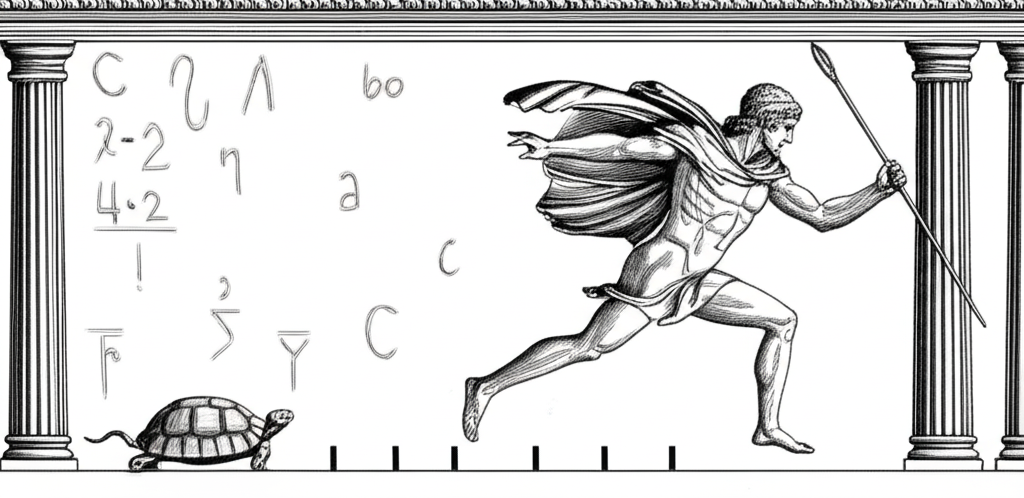
These paradoxes, while seemingly irresolvable through common sense logic, find their elegant solutions within the framework of modern mathematics. The concept of a convergent series allows us to understand how an infinite sequence of steps can indeed lead to a finite, traversable distance. It’s a testament to the power of mathematics to provide clarity where pure philosophical intuition might falter.
Converging Worlds: When Infinity Becomes Finite
The most astonishing aspect of mathematical series is the idea of convergence. A series converges if the sum of its infinite terms approaches a specific, finite value. It's like an asymptote in algebra, where a curve gets ever closer to a line but never quite touches it—yet, in series, we reach that sum.
Consider our earlier example: $1/2 + 1/4 + 1/8 + 1/16 + \dots$
As we add more terms, the sum gets closer and closer to 1.
- $1/2 = 0.5$
- $1/2 + 1/4 = 0.75$
- $1/2 + 1/4 + 1/8 = 0.875$
- $1/2 + 1/4 + 1/8 + 1/16 = 0.9375$
And so on. This series, despite having an infinite number of terms, converges perfectly to 1.
The philosophical implication here is profound: an infinite process can yield a finite, quantifiable result. This challenges our intuitive understanding of quantity and the very definition of "completeness." How can something "complete" be built from infinite parts? Logic, guided by mathematics, shows us the way.
Key Characteristics of Convergent Series:
- Terms Approach Zero: For a series to converge, its individual terms must eventually get arbitrarily close to zero. If they don't, the sum will surely grow unbounded.
- Existence of a Limit: The sequence of partial sums (the sum of the first N terms) must approach a specific finite number as N approaches infinity.
- Finite Sum: Despite the infinite number of terms, the total quantity accumulated is finite.
Diverging Paths: The Unbounded Nature of Infinity
Not all infinite series are so well-behaved. Many, in fact, diverge. This means that as you add more and more terms, the sum simply grows without bound, heading towards infinity.
A classic example is the Harmonic Series: $1 + 1/2 + 1/3 + 1/4 + 1/5 + \dots$
One might initially think that since the terms are getting smaller and smaller, it too must converge. Each term does approach zero. However, the sum of the harmonic series grows infinitely. It grows very slowly, but it grows nonetheless.
- $1 = 1$
- $1 + 1/2 = 1.5$
- $1 + 1/2 + 1/3 \approx 1.83$
- $1 + 1/2 + 1/3 + 1/4 \approx 2.08$
This series highlights the unbounded nature of infinity as a quantity. It reminds us that our intuition, even when seemingly supported by the diminishing size of individual terms, must be rigorously tested by logic and mathematical proof. The infinity of the sum here is a true, uncontainable infinity.
The Philosophical Echoes of Mathematical Infinity
The study of mathematical series is more than just an academic exercise; it's a profound lens through which we can examine the nature of infinity itself. It asks us to reconsider what we mean by "part" and "whole," "finite" and "infinite," and how quantity can behave in ways that defy our initial understanding.
- Infinity in Different Guises: Mathematics provides concrete models for understanding infinity not just as an abstract concept, but as something that can be precisely defined and manipulated. Whether it's the infinity of points on a line, the infinity of time, or the infinity of possibilities, the principles gleaned from series offer a framework for contemplation.
- Logic as the Guiding Star: The rigor required to prove convergence or divergence emphasizes the crucial role of logic. It’s logic that allows us to move beyond mere intuition and establish definitive truths about these infinite sums.
- Mathematics as a Language of the Beyond: Ultimately, the mathematics of series serves as a powerful language, allowing us to articulate, explore, and even tame aspects of infinity that would otherwise remain elusive to pure philosophical discourse. It’s a bridge connecting the tangible world of numbers to the vast, conceptual universe of endlessness.
To truly appreciate the depth of this subject is to acknowledge the sheer elegance with which mathematics confronts and clarifies the most profound philosophical questions. It teaches us that infinity is not just "very, very big," but a concept with diverse behaviors, demanding precision and a willingness to challenge our most basic assumptions about quantity and existence.
YouTube Video Suggestions:
-
📹 Related Video: ARISTOTLE ON: The Nicomachean Ethics
Video by: The School of Life
💡 Want different videos? Search YouTube for: ""Why do some infinite series converge?" - look for videos that explain convergence with clear animations or visual aids."
-
📹 Related Video: KANT ON: What is Enlightenment?
Video by: The School of Life
💡 Want different videos? Search YouTube for: ""Zeno's Paradoxes explained mathematical solutions" - search for explanations that connect Zeno's ideas to modern calculus and series."