

The Infinity of Mathematical Series: A Philosophical Inquiry into Unbounded Quantity
Summary: The concept of infinity in mathematics, particularly within the realm of series, presents one of the most profound philosophical challenges to our understanding of quantity and existence. Far from being a mere abstract construct, the study of infinite mathematical series forces us to confront the very limits of human logic and intuition, revealing how an unending succession of terms can paradoxically converge upon a finite, definable value. This exploration delves into the historical and philosophical implications of infinite series, bridging the gap between rigorous mathematical demonstration and our intuitive grasp of the boundless.
The human mind, accustomed to the finite and the tangible, often recoils from the notion of infinity. Yet, mathematics, that most rigorous of disciplines, not only embraces infinity but quantifies it, dissects it, and, perhaps most astonishingly, sums it. The realm of infinite mathematical series stands as a testament to this audacious intellectual pursuit, pushing the boundaries of what we perceive as possible and challenging our fundamental assumptions about quantity.
The Ancient Quarrel with Infinity
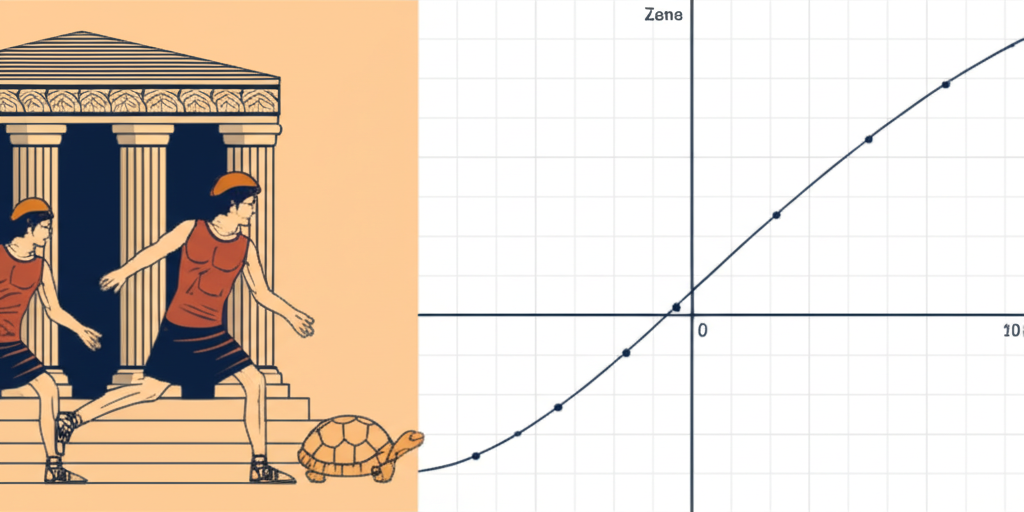
For centuries, philosophers, as chronicled in the Great Books of the Western World, grappled with the elusive nature of infinity. The Eleatics, with Zeno's famous paradoxes, demonstrated the inherent difficulties in conceiving of motion or division as infinitely continuous. Aristotle, in his Physics, distinguished between potential infinity—the capacity to always add more, without end—and actual infinity—a completed, unbounded whole. He largely rejected the latter for the physical world, finding it a logical impossibility that defied the principles of quantity and completion.
However, mathematics found a way to bridge this ancient chasm. Consider the simple geometric series: 1/2 + 1/4 + 1/8 + 1/16 + ... This sequence of terms continues infinitely. Intuitively, one might think that adding an infinite number of positive values must result in an infinite quantity. Yet, the logic of mathematics reveals a different truth: this series converges precisely to 1. Each successive term halves the remaining distance to 1, but never quite reaches it through any finite number of steps. The sum, however, is 1.
Series and the Unfolding of Infinite Quantity
A mathematical series is essentially the sum of the terms of a sequence. When that sequence has an infinite number of terms, we enter the domain of infinite series. The profound philosophical question arises: how can an unending process yield a definite, finite outcome? This is where the concept of a limit becomes crucial, a cornerstone of calculus developed by Newton and Leibniz.
Key Characteristics of Convergent Infinite Series:
- Infinite Terms: The series contains an unending number of terms.
- Finite Sum (Convergence): Despite the infinite terms, the sum approaches a specific, finite quantity.
- Limit: The value the series approaches as the number of terms goes to infinity.
- Logical Derivation: The convergence is not arbitrary but rigorously proven through mathematical logic.
| Series Example | Sum/Limit | Philosophical Implication |
|---|---|---|
| 1/2 + 1/4 + 1/8 + ... | 1 | An infinite number of parts can constitute a finite whole. |
| 1 + 1/2 + 1/3 + 1/4 + ... | Diverges | Not all infinite series converge; some truly tend towards infinity. |
| 1 - 1/2 + 1/3 - 1/4 + ... | ln(2) | Alternating series can also converge to unexpected values. |
The harmonic series (1 + 1/2 + 1/3 + ...) stands as a counter-example, demonstrating that not all infinite series converge. Its sum tends towards infinity, reminding us that while mathematics can tame some infinities, others remain boundless in their quantity.
From Potential to Actual Infinity: A Philosophical Leap
The development of modern mathematics, particularly Georg Cantor's work on set theory in the late 19th century, challenged the Aristotelian aversion to actual infinity. Cantor demonstrated that there are different sizes of infinity, distinguishing between countable and uncountable infinities. While infinite series primarily deal with countable infinities (each term can be numbered), their convergence to a specific quantity forces us to accept that an actual infinity of processes can result in a completed, finite state. This conceptual leap, enabled by rigorous logic, has profoundly impacted how we understand the nature of numbers, space, and time.
The Philosophical Resonance of Infinite Series
The study of infinite mathematical series is more than just an exercise in calculation; it's a profound philosophical inquiry. It compels us to re-evaluate our intuitive grasp of quantity, forcing us to accept that the whole can be derived from an unending succession of parts. It demonstrates the power of logic to describe phenomena that defy common sense, expanding our understanding of what is coherent and consistent within the universe of abstract thought.
The infinity embedded in these series challenges our human-centric perception of completion and boundedness. It suggests that reality, or at least its mathematical description, might be far more nuanced and paradoxically simple than our everyday experience suggests. The convergence of an infinite series is a powerful metaphor for how seemingly endless processes can lead to definite, comprehensible states, offering insights not just into mathematics but into the very structure of existence.
YouTube:
- "Zeno's Paradoxes and the Concept of Infinity"
- "What is an Infinite Series? (And why do some converge?)"
📹 Related Video: What is Philosophy?
Video by: The School of Life
💡 Want different videos? Search YouTube for: "The Infinity of Mathematical Series philosophy"