

The Endless Horizon: Philosophical Reflections on the Infinity of Mathematical Series
The concept of infinity stands as one of humanity's most profound and perplexing intellectual challenges. While often perceived as a purely abstract notion, its rigorous exploration within mathematics, particularly through the study of infinite series, offers a unique lens through which to examine fundamental philosophical questions about quantity, existence, and the very nature of logic. This article delves into how mathematical series not only quantify the boundless but also illuminate the intricate relationship between the concrete world of numbers and the abstract realm of philosophical thought, bridging the gap between calculation and contemplation.
The Enduring Fascination with the Infinite
From ancient myths of eternal cycles to modern cosmological theories of an expanding universe, the human mind has consistently grappled with the notion of infinity. It is a concept that simultaneously excites and confounds, pushing the boundaries of our comprehension. While intuition often struggles to grasp what it means for something to be truly infinite, mathematics provides a precise, formal language to articulate and investigate this elusive idea. Among its most compelling tools for this exploration are infinite mathematical series: sequences of numbers added together, where the number of terms is limitless. These series force us to confront not just the idea of an unending process but also the astonishing possibility that an endless sum can, paradoxically, converge to a finite quantity.
Converging Dreams and Diverging Realities: The Logic of Limitless Sums
An infinite series is simply the sum of an infinite sequence of numbers. What makes them philosophically rich is their behavior: some series converge, meaning their sum approaches a specific finite value, while others diverge, meaning their sum grows without bound or oscillates indefinitely.
Consider the classic example:
- 1/2 + 1/4 + 1/8 + 1/16 + ...
Each term is half the previous one. Intuitively, one might think that adding an infinite number of terms must result in an infinite sum. However, the logic of limits, foundational to calculus, reveals that this series converges precisely to 1. Imagine walking halfway to a wall, then half the remaining distance, then half of that, and so on. You take an infinite number of steps, yet you never quite reach or exceed the wall. This elegant mathematical demonstration provides a concrete example of how infinity can be contained within finite bounds, challenging our everyday understanding of quantity.
Conversely, other series diverge:
- 1 + 1 + 1 + 1 + ... (Clearly diverges to infinity)
- 1 + 2 + 3 + 4 + ... (Also diverges to infinity)
- 1 + 1/2 + 1/3 + 1/4 + ... (The harmonic series, a subtle example that diverges, albeit very slowly, to infinity)
The distinction between convergence and divergence is not merely a mathematical technicality; it's a profound philosophical statement about the nature of accumulation and the properties of infinity.
Zeno's Paradoxes and the Triumph of Quantity
The philosophical implications of infinite series resonate deeply with ancient inquiries, particularly Zeno of Elea's paradoxes, famously discussed in the Great Books of the Western World. Zeno, by dividing motion or quantity into an infinite number of smaller segments, sought to demonstrate the impossibility of motion or the incoherence of infinity itself.
One of his most famous paradoxes, Achilles and the Tortoise, posits that if the tortoise has a head start, Achilles can never overtake it, because each time Achilles reaches where the tortoise was, the tortoise has moved a little further. This creates an infinite sequence of ever-smaller distances Achilles must cover. Zeno's logic leads to an apparent impasse, challenging the very notion of motion and the divisibility of space and time.
However, the mathematical understanding of converging infinite series offers a powerful counter-argument. The total distance Achilles must cover to overtake the tortoise, and the total time it takes, can be represented as a converging infinite series. While the number of steps is infinite, the sum of the distances (or times) is finite. This mathematical framework allows us to reconcile the infinite divisibility of space and time with the finite reality of movement, providing a rigorous answer to an ancient philosophical puzzle concerning quantity and infinity.
Beyond the Numbers: Infinity's Philosophical Footprint
The study of infinite series extends beyond mere calculation; it forces us to re-evaluate our fundamental assumptions about reality. Philosophers, from Aristotle's distinction between potential and actual infinity (explored in his Physics and Metaphysics) to Kant's antinomies of pure reason, have grappled with how infinity can exist, if at all, in the empirical world.
Aristotle argued that only potential infinity exists – the possibility of always adding more or dividing further – but not actual infinity, a completed, limitless quantity. Mathematical series, particularly converging ones, seem to present a challenge to this, suggesting that an "actually infinite" process (an infinite sum) can indeed yield a finite, tangible result. This pushes us to consider whether mathematics reveals truths about reality that transcend our intuitive grasp, or if it merely provides a consistent system for describing phenomena.
The elegance and consistency of mathematics in handling infinity through series speaks to its unique role as a bridge between the abstract and the concrete. It is a language that allows us to articulate and explore concepts that would otherwise remain ineffable, pushing the boundaries of human logic and understanding.
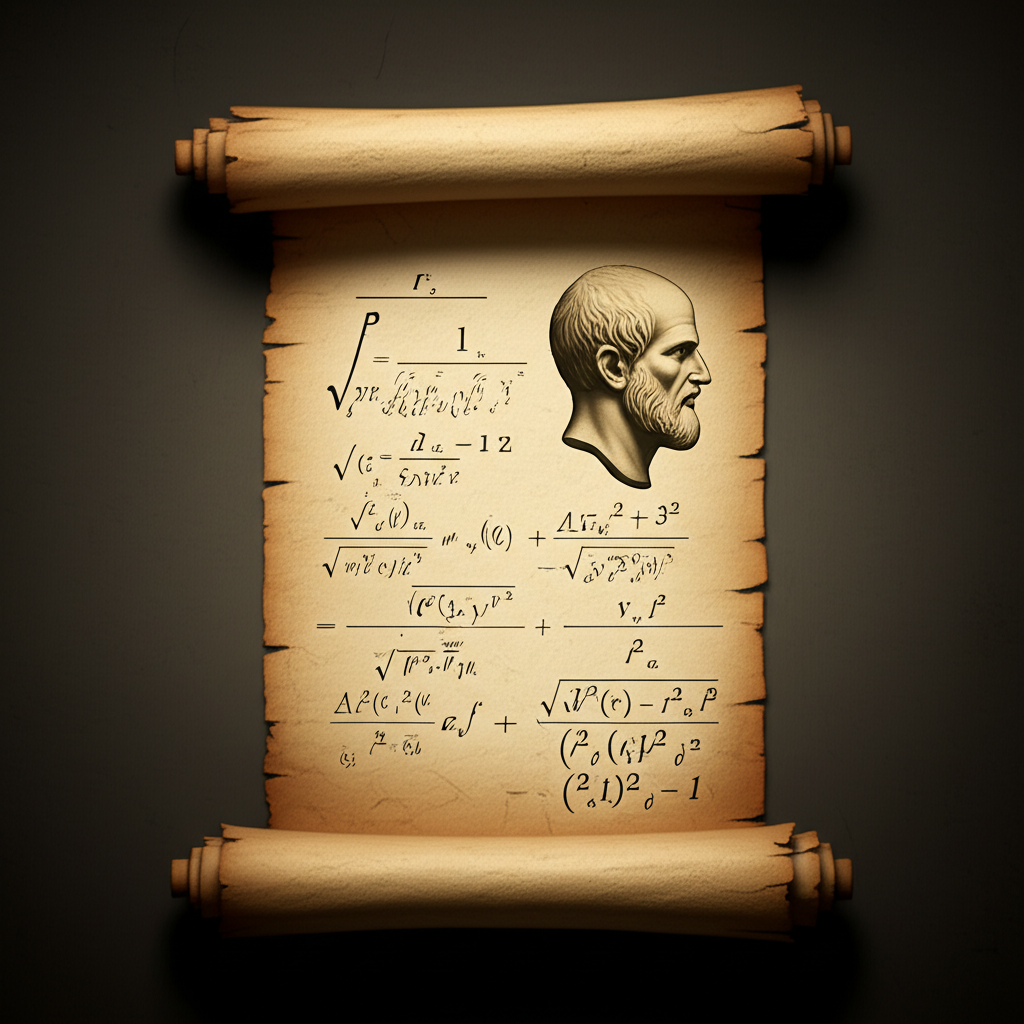 in thoughtful contemplation. In the background, a faint cosmic spiral galaxy suggests the vastness of the universe, linking the microscopic detail of mathematical logic to the macroscopic scale of infinity.)
The Great Books' Whisper: Ancient Echoes in Modern Math
The Great Books of the Western World are replete with philosophical inquiries into number, quantity, and the infinite. Plato, in works like the Republic and Timaeus, saw mathematics as a pathway to understanding the eternal Forms, a realm of perfect and unchanging truths that transcended the physical world. For him, the inherent logic and consistency of mathematical principles, including those hinting at infinity, pointed towards a deeper reality.
Later thinkers, such as Descartes and Leibniz, also engaged deeply with mathematics as a model for philosophical reasoning. Leibniz's development of calculus, which provides the framework for understanding limits and infinite series, was deeply intertwined with his metaphysical investigations into the nature of the universe and the infinite attributes of God. For these philosophers, mathematics was not just a tool for calculation but a profound method for uncovering the rational structure of the cosmos and the limits of human knowledge regarding infinity.
The journey through the infinity of mathematical series is more than a numerical exercise; it is a profound philosophical expedition. It compels us to question our assumptions about quantity, to marvel at the power of logic, and to confront the boundless nature of infinity itself. In doing so, mathematics stands not merely as a science of numbers but as an indispensable partner in the perennial philosophical quest for understanding existence.
📹 Related Video: What is Philosophy?
Video by: The School of Life
💡 Want different videos? Search YouTube for: "Zeno's Paradoxes and the Philosophy of Infinity Explained"
📹 Related Video: PLATO ON: The Allegory of the Cave
Video by: The School of Life
💡 Want different videos? Search YouTube for: "What is Infinity? A Philosophical and Mathematical Exploration"