

The Enduring Blueprint: How Constitutions Safeguard Against Tyranny
In the grand tapestry of human governance, the specter of tyranny has loomed large, a constant threat to individual liberty and societal well-being. From ancient city-states to modern nations, the concentration of unchecked power invariably leads to oppression. This is where the Constitution emerges not merely as a legal document, but as a profound philosophical statement and a practical instrument designed to prevent tyranny. It is the carefully crafted framework that defines the legitimate bounds of government power, enshrines the fundamental rights of its citizens, and establishes a system of Liberty that can withstand the ambitions of those who would seek to dominate. Without such a foundational charter, the delicate balance between order and freedom is irrevocably lost, leaving the door open for arbitrary rule and the suppression of the human spirit.
The Philosophical Foundations of Limiting Power
The idea that power needs to be contained is as old as philosophy itself. Thinkers across millennia have grappled with the inherent dangers of unchecked authority, recognizing that even the most well-intentioned rulers can be corrupted by absolute power.
From Ancient Greece: The Search for Justice and Stable Governance
Long before modern constitutionalism, ancient philosophers recognized the cyclical nature of governments and the descent into tyranny.
- Plato's Republic: While envisioning an ideal state led by philosopher-kings, Plato also meticulously detailed the degradation of political systems, from aristocracy to timocracy, oligarchy, democracy, and finally, tyranny. His work serves as a stark warning against the corruption of power and the erosion of justice when the state serves personal ambition rather than the common good. The very search for a just society implies a structure that resists such decay.
- Aristotle's Politics: Aristotle, in his empirical study of various constitutions, classified governments by the number of rulers and their aims. He distinguished between "correct" forms (monarchy, aristocracy, polity) that serve the common interest, and "deviant" forms (tyranny, oligarchy, democracy – in his negative sense of mob rule) that serve only the rulers' self-interest. His preference for a "polity," a mixed constitution blending elements of oligarchy and democracy, was an early articulation of the idea that a balanced government, incorporating different societal elements, is crucial for stability and for preventing the slide into oppressive rule. He emphasized the rule of law as paramount, stating that "the law is reason unaffected by desire."
The Dawn of Modern Constitutional Thought: Social Contracts and Natural Rights
The Enlightenment era brought forth a radical shift, emphasizing individual rights and the consent of the governed as the bedrock of legitimate government.
- Thomas Hobbes's Leviathan: Though often associated with absolute sovereignty, Hobbes's work laid the groundwork for social contract theory. He argued that individuals surrender some Liberty to a sovereign power to escape the "state of nature," which he famously described as "solitary, poor, nasty, brutish, and short." While his solution leaned towards a powerful ruler, the underlying premise—that government derives its legitimacy from a compact—is a precursor to constitutional thought.
- John Locke's Two Treatises of Government: Locke is arguably the most influential figure in modern constitutional theory. He posited that individuals possess inherent natural rights—to life, Liberty, and property—that pre-exist government. The purpose of government, then, is to protect these rights, and its authority is legitimate only with the consent of the governed. If a government acts against the trust placed in it by the people, violating their natural rights, the people have a right to resist and establish a new government. This concept of limited government and the right to revolution forms the philosophical backbone of many modern constitutions.
- Jean-Jacques Rousseau's The Social Contract: Rousseau explored the idea of popular sovereignty and the "general will." While his ideas could be interpreted in ways that lead to a "tyranny of the majority," his emphasis on the people as the ultimate source of legitimate authority profoundly influenced the democratic aspirations embedded within constitutional frameworks.
The Constitution as a Shield: Mechanisms Against Tyranny
A constitution is not merely a philosophical treatise; it is a practical blueprint for structuring power to resist its abuse. It establishes concrete mechanisms designed to prevent the concentration of authority that leads to tyranny.
Separation of Powers and Checks and Balances
One of the most ingenious and effective strategies against tyranny is the division of governmental power into distinct branches, each with its own responsibilities and the ability to limit the others.
- Baron de Montesquieu's The Spirit of the Laws: Montesquieu, studying the English system, articulated the principle of the separation of powers. He argued that combining legislative, executive, and judicial powers in the same hands, whether an individual or a body, would inevitably lead to tyranny. His insights profoundly influenced the framers of the United States Constitution.
The three primary branches of government are:
- Legislative Branch: Makes laws (e.g., Congress, Parliament).
- Executive Branch: Implements and enforces laws (e.g., President, Prime Minister).
- Judicial Branch: Interprets laws and administers justice (e.g., Supreme Court, judiciary).
These branches are not entirely independent; they are interconnected through a system of checks and balances, ensuring no single branch becomes too powerful.
Table: Checks and Balances in a Constitutional System
| Branch Exercising Power | Check Exercised By | Example of Check |
|---|---|---|
| Legislative | Executive | Vetoes legislation |
| Judicial | Declares laws unconstitutional | |
| Executive | Legislative | Impeachment, overriding vetoes, approving appointments |
| Judicial | Declares executive actions unconstitutional | |
| Judicial | Legislative | Proposing constitutional amendments, approving judicial appointments |
| Executive | Appoints judges, grants pardons |
Rule of Law and Limited Government
Beyond the structural division of power, a constitution fundamentally establishes the principle of the rule of law. This means:
- No one is above the law: Even those in power are subject to the same legal standards as ordinary citizens. This contrasts sharply with tyrannical regimes where the ruler is the law.
- Predictability and Fairness: Laws are applied consistently and transparently, providing stability and protecting individuals from arbitrary decisions.
- Limited Government: The constitution explicitly enumerates and restricts the powers of the government. It defines what the government can do, and by implication, what it cannot do, thereby safeguarding the sphere of individual Liberty.
Protection of Individual Rights and Liberties
A cornerstone of any constitution designed to prevent tyranny is the explicit articulation and protection of individual rights. These are not privileges granted by the government, but inherent rights that the government is obligated to respect and uphold.
- Bills of Rights: Many constitutions include a Bill of Rights (like the first ten amendments to the U.S. Constitution), guaranteeing freedoms such as speech, religion, assembly, and due process. These provisions act as direct barriers against government overreach and ensure a sphere of autonomy for citizens, preventing the state from dictating every aspect of their lives.
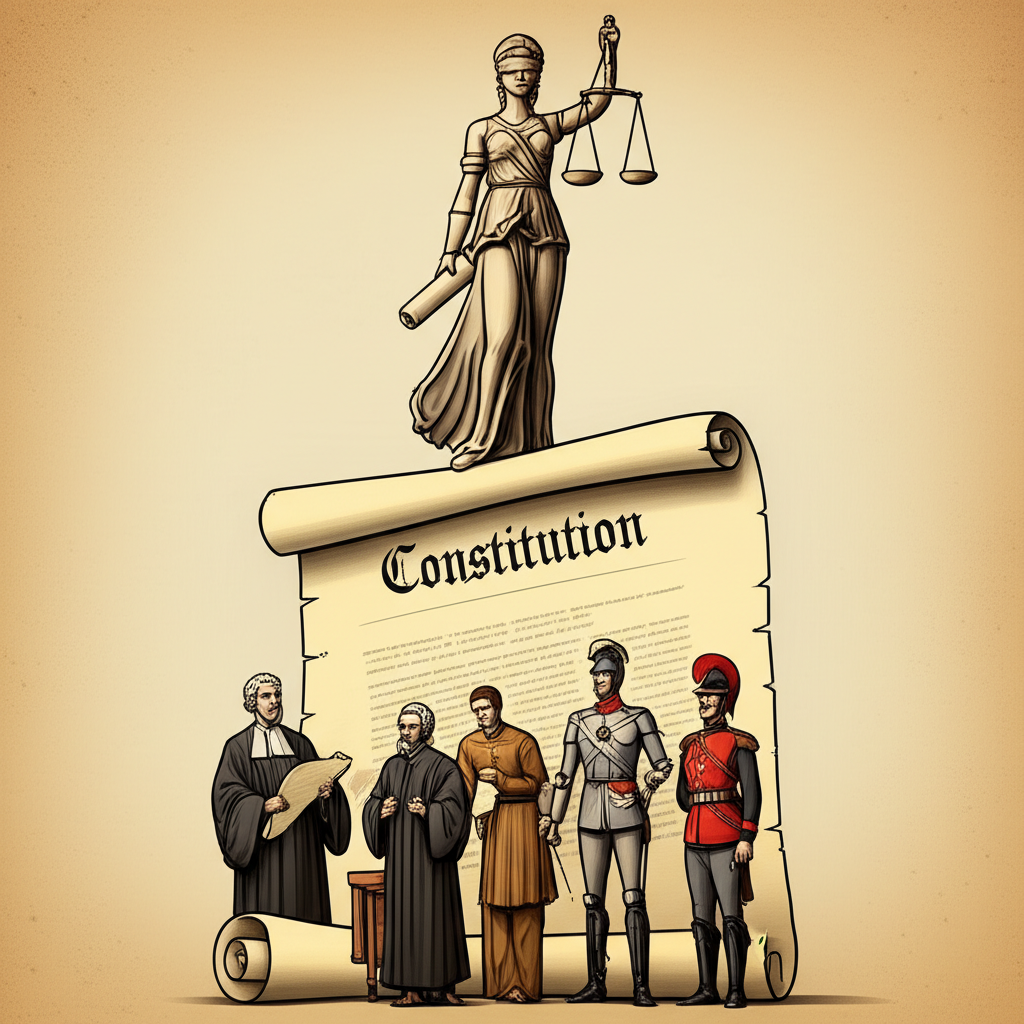
The American Experiment: A Testament to Constitutionalism
The drafting and ratification of the United States Constitution stands as a monumental example of applying philosophical principles to construct a government explicitly designed to resist tyranny.
- The Federalist Papers: Authored by James Madison, Alexander Hamilton, and John Jay, these essays argued for the ratification of the Constitution.
- Federalist No. 10: Madison famously addressed the danger of "factions" (groups pursuing self-interest over the common good) and argued that a large republic, with diverse interests, would make it harder for any single faction to gain absolute power.
- Federalist No. 51: Madison articulated the genius of the system of checks and balances, stating, "Ambition must be made to counteract ambition." This acknowledges the fallibility of human nature and designs a system where the self-interest of one branch or faction serves to limit the potential overreach of another.
- The Bill of Rights: Added shortly after ratification, these amendments directly addressed concerns that the original Constitution did not sufficiently protect individual Liberty. They represent a direct philosophical lineage from Locke, enshrining fundamental rights as non-negotiable limits on governmental power.
The Ongoing Vigilance: A Constitution's True Strength
A constitution, no matter how perfectly drafted, is not a self-executing guarantee against tyranny. Its strength and longevity depend on the continuous engagement and vigilance of its citizens.
- Active Citizenship: Understanding one's rights and responsibilities, participating in democratic processes, and holding leaders accountable are vital. An informed and engaged populace is the ultimate check on power.
- Judicial Independence: An impartial judiciary willing to uphold the constitution, even against popular sentiment or governmental pressure, is crucial.
- Education: A society that values philosophical inquiry and civic education is better equipped to recognize and resist the subtle encroachments of authoritarianism. The erosion of constitutional principles often begins incrementally, making constant awareness essential.
YouTube: "Montesquieu Separation of Powers explained"
YouTube: "John Locke Natural Rights Philosophy"
Conclusion: The Enduring Importance of the Constitutional Compact
The Constitution stands as humanity's most sophisticated and enduring attempt to reconcile the need for order with the yearning for Liberty. It is a testament to the philosophical insight that power, left unchecked, inevitably corrupts and leads to tyranny. By carefully defining the legitimate scope of government, dividing its powers, and explicitly protecting individual rights, a constitution serves as the essential blueprint for a free society. Yet, its pages are not merely static words; they are a living compact, requiring continuous understanding, defense, and interpretation by each generation. To neglect our constitutional principles is to invite the very tyranny they were so painstakingly designed to prevent, reminding us that the preservation of Liberty is a perpetual and profound philosophical endeavor.
📹 Related Video: What is Philosophy?
Video by: The School of Life
💡 Want different videos? Search YouTube for: "The Importance of Constitution in Preventing Tyranny philosophy"