

The Unyielding Bulwark: How Constitutions Safeguard Against Tyranny
In the grand tapestry of human governance, few threads are as vital as the concept of a Constitution. It is not merely a document, a collection of laws, but rather the very soul of a society's commitment to ordered liberty. Without such a foundational framework, the delicate balance of power inevitably tilts, threatening to plunge communities into the abyss of tyranny. This pillar page delves into the profound philosophical and practical importance of a constitution in preventing the unchecked exercise of government power, ensuring that the pursuit of liberty remains paramount, and drawing upon the timeless wisdom found within the Great Books of the Western World.
The Perennial Fear of Power Unchecked
From the earliest city-states to the most complex modern nations, humanity has grappled with a fundamental dilemma: how to empower a government to maintain order and provide for the common good without simultaneously creating a monster capable of devouring the very people it is meant to serve. History, replete with examples of benevolent rule descending into despotism, underscores this persistent challenge. The fear of tyranny is not a modern invention; it is an ancient, deeply ingrained apprehension that has spurred thinkers for millennia to devise mechanisms of control and accountability.
A Brief Overview of the Threat
The insidious nature of tyranny lies in its ability to erode freedoms incrementally, often under the guise of security or efficiency, until individual agency is all but extinguished. It represents the ultimate perversion of governance, where power becomes an end in itself, rather than a means to secure justice and well-being for all.
The Philosophical Quest for Order
Philosophers, from Plato to Locke, have meticulously dissected the forms of government, seeking to understand not only their strengths but also their inherent weaknesses and tendencies towards corruption. Their inquiries consistently highlight the necessity of external constraints on power, recognizing that human nature, left unchecked, can lead to the most severe forms of oppression.
Defining the Pillars: Constitution, Tyranny, Government, and Liberty
To fully appreciate the constitution's role, we must first establish a clear understanding of the core concepts at play.
What is a Constitution? More Than Just Paper
At its heart, a Constitution is a system of fundamental principles according to which a state or other organization is governed. It defines the structure of the government, delineates the powers and responsibilities of its various branches, and, critically, establishes the rights and duties of its citizens. It is a social contract, an agreement between the governed and the governors, setting limits on authority and ensuring accountability. It is, in essence, the supreme law of the land, above any individual or faction.
The Shadow of Tyranny: Absolute Power Corrupting Absolutely
Tyranny describes a form of government where absolute power is vested in a single individual or a small group, exercised arbitrarily and oppressively, often without regard for law or the rights of the governed. As Lord Acton famously warned, "Power tends to corrupt, and absolute power corrupts absolutely." Tyranny thrives in the absence of checks, balances, and a clear, enforceable framework of rights. It is characterized by the suppression of dissent, the arbitrary application of force, and the systematic denial of individual freedoms.
Government's Dual Nature: Protector and Potential Oppressor
Government is the system or group of people governing an organized community, generally a state. Its primary functions include maintaining order, providing public services, and defending the populace. However, the very power required for these functions also carries the potential for abuse. A government, left unrestrained, can easily transition from protector to oppressor, using its monopoly on legitimate force to subjugate its citizens rather than serve them.
Liberty: The Enduring Pursuit
Liberty refers to the state of being free within society from oppressive restrictions imposed by authority on one's way of life, behavior, or political views. It is not merely the absence of coercion but the presence of conditions that allow individuals to flourish, to exercise their rights, and to participate meaningfully in their communities. The protection of liberty is the ultimate goal of any just constitutional order.
From Ancient Wisdom to Modern Safeguards: A Historical Perspective
The idea of limiting governmental power is deeply rooted in Western philosophical thought, evolving through centuries of contemplation and political experimentation.
-
Plato's Republic and the Cycle of Decay: In his seminal work, The Republic, Plato explored various forms of government, from aristocracy to democracy, and warned of their inherent tendencies to degenerate. He saw tyranny as the worst form of government, arising from excessive freedom in democracy, where unrestrained desires lead to a strongman seizing power. His analysis underscores the need for a stable, ordered system to prevent such a descent.
-
Aristotle's Politics: The Rule of Law, Not Men: Aristotle, in Politics, meticulously categorized constitutions and emphasized the crucial distinction between the "rule of law" and the "rule of men." He argued that a just government operates under fixed laws, applied equally to all, rather than the arbitrary will of a ruler. This principle is fundamental to constitutionalism.
-
Locke and the Social Contract: Government by Consent: John Locke's Two Treatises of Government laid the groundwork for modern constitutional thought. He posited that government derives its legitimacy from the consent of the governed and that individuals possess inherent natural rights (life, liberty, and property) that government cannot legitimately infringe upon. The constitution, in this view, is the embodiment of this social contract, limiting government to protect these rights.
-
Montesquieu and the Separation of Powers: Dividing to Conquer Tyranny: Building on Locke, Baron de Montesquieu, in The Spirit of the Laws, articulated the vital principle of the separation of powers. He argued that to prevent tyranny, governmental authority must be divided into distinct branches—legislative, executive, and judicial—each with its own functions and checks on the others. This division prevents the concentration of power in any single entity.
-
The American Experiment: A Practical Application: The framers of the United States Constitution, deeply influenced by these Enlightenment thinkers, meticulously crafted a document designed explicitly to prevent tyranny. Their work, informed by the debates encapsulated in The Federalist Papers, established a republic founded on limited government, federalism, and a robust system of checks and balances, all aimed at securing liberty.
The Constitution as an Anti-Tyranny Mechanism
A well-crafted constitution is not merely a statement of ideals; it is a practical tool, a complex machine designed to resist the forces of oppression.
Establishing the Rule of Law: Above All Individuals
The most fundamental safeguard is the principle of the rule of law. This dictates that everyone, from the highest official to the ordinary citizen, is subject to the same laws, fairly and consistently applied. A constitution enshrines this, making it clear that no one is above the law, thus preventing arbitrary rule.
Checks and Balances: A System of Mutual Constraint
Inspired by Montesquieu, constitutional systems often employ checks and balances. This mechanism distributes governmental power among different branches, each possessing the ability to limit or scrutinize the actions of the others.
| Governmental Branch | Primary Function | Checks on Other Branches |
|---|---|---|
| Legislative | Makes Laws | Impeaches Executive/Judicial, Approves Appointments/Treaties, Controls Funding |
| Executive | Enforces Laws | Vetoes Legislation, Appoints Judges, Commands Military |
| Judicial | Interprets Laws | Declares Laws/Actions Unconstitutional, Presides over Impeachments |
This intricate dance of power ensures that no single branch can become too dominant, thereby acting as a powerful deterrent against tyranny.
Protecting Individual Rights: The Unalienable Core of Liberty
A robust constitution explicitly enumerates and protects the fundamental rights and freedoms of individuals. These might include freedom of speech, religion, assembly, the right to due process, and protection from arbitrary arrest. These enshrined rights act as inviolable boundaries that the government cannot cross, securing the very essence of liberty.
Limited Government: Defining the Boundaries of Power
A constitution defines the scope and limits of governmental authority. It specifies what the government can do, and by implication, what it cannot do. This principle of limited government prevents the state from overreaching into areas of private life or from accumulating excessive power.
Mechanisms for Amendment and Adaptation: A Living Document
While a constitution provides stability, it also requires mechanisms for amendment and adaptation. A rigid document that cannot evolve with societal changes risks becoming obsolete or being circumvented. Provisions for amendment ensure that the constitution remains a living document, capable of addressing new challenges without sacrificing its core principles, thus preventing revolutionary upheaval that could lead to new forms of tyranny.
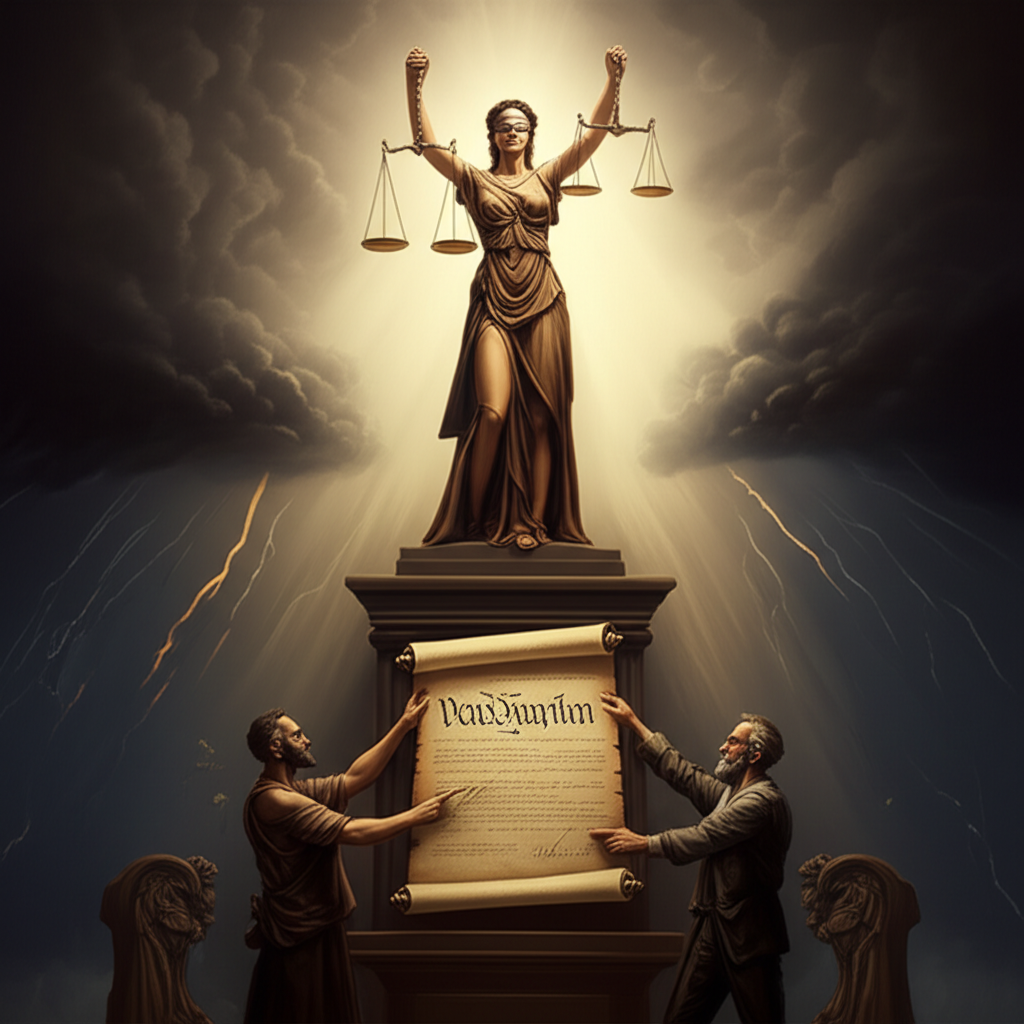
The Perils of Constitutional Erosion: When the Bulwark Cracks
Even the most thoughtfully designed constitution is not impervious to attack. The erosion of constitutional principles can lead to a gradual slide into authoritarianism, often without a dramatic revolutionary moment.
- Historical Examples of Constitutional Failure: The Weimar Republic in Germany, with its constitutional flaws and the rise of demagoguery, serves as a stark warning. Despite a democratic constitution, economic instability and political extremism allowed for the legal ascent of a totalitarian regime, demonstrating that a constitution alone is insufficient without constant vigilance.
- The Gradual Slide: How Tyranny Can Emerge Subtly: Tyranny rarely arrives with a sudden coup. More often, it emerges through a series of small, incremental steps: the weakening of independent institutions, the politicization of the judiciary, the suppression of free press, the expansion of executive power, and the normalization of surveillance. Each step, seemingly minor, chips away at the constitutional bulwark until it eventually crumbles.
Maintaining the Constitutional Republic: Vigilance as the Price of Liberty
The enduring success of a constitutional framework depends not just on its initial design but on the sustained commitment of its citizens and institutions.
- Civic Education and Engagement: An informed citizenry is the ultimate guardian of the constitution. Understanding its principles, rights, and responsibilities empowers individuals to hold their leaders accountable and resist incursions on liberty.
- Judicial Independence: An impartial and independent judiciary is crucial for interpreting the constitution and ensuring that all governmental actions adhere to its dictates. Without it, the rule of law becomes an empty promise.
- The Role of an Informed Citizenry:
- Voting responsibly and engaging in political discourse.
- Demanding transparency and accountability from elected officials.
- Protecting freedom of the press and independent media.
- Actively defending civil liberties and human rights.
Conclusion: The Enduring Mandate of Constitutional Governance
The importance of a Constitution in preventing tyranny cannot be overstated. It is the blueprint for ordered liberty, the contract that binds government to its people, and the bulwark against the arbitrary exercise of power. From the philosophical inquiries of ancient Greece to the revolutionary experiments of the Enlightenment, the consensus remains clear: without a robust, respected, and defended constitutional framework, the path to oppression becomes dangerously short. Our duty, as beneficiaries of this profound intellectual legacy, is to perpetually engage with, understand, and uphold these foundational principles, ensuring that the flame of liberty continues to burn brightly.
📹 Related Video: What is Philosophy?
Video by: The School of Life
💡 Want different videos? Search YouTube for: ""John Locke Social Contract Philosophy Explained""
📹 Related Video: KANT ON: What is Enlightenment?
Video by: The School of Life
💡 Want different videos? Search YouTube for: ""Montesquieu Separation of Powers Explained""