

The Enduring Enigma: Exploring the Immortality of the Soul
The question of the Immortality of the Soul stands as one of humanity's most profound and persistent inquiries, threading its way through the annals of philosophy and the core tenets of Religion. This article delves into the rich tapestry of thought surrounding the Soul's potential eternal nature, examining arguments from ancient Greece to the Enlightenment, drawing heavily from the foundational texts compiled in the Great Books of the Western World. We will explore the Metaphysics underpinning these ideas, considering how different thinkers have grappled with the distinction between body and mind, the essence of consciousness, and the ultimate destiny of human existence. From Plato's world of Forms to Descartes' radical dualism, the journey into the Soul's Immortality is not merely an academic exercise but a fundamental quest for meaning and understanding.
The Philosophical Genesis: Plato and the Eternal Soul
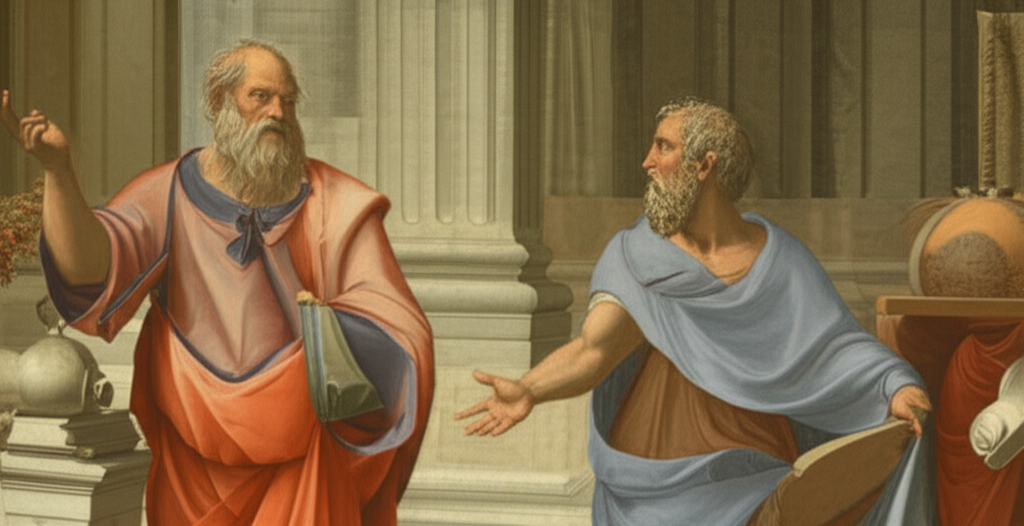
Our exploration inevitably begins with ancient Greece, where the concept of the Soul as a distinct, potentially immortal entity gained significant philosophical traction. Plato, whose dialogues form a cornerstone of Western thought, presented compelling arguments for the Soul's Immortality.
In works like the Phaedo, Plato posits that the Soul is simple, indivisible, and akin to the eternal Forms, making it inherently indestructible. His arguments include:
- The Argument from Opposites: Life arises from death, and death from life, suggesting a cycle where souls must exist in some state before and after bodily life.
- The Argument from Recollection (Anamnesis): Our ability to grasp perfect concepts (like equality or beauty) that are not fully present in the physical world implies that our Soul must have encountered these Forms in a prior existence.
- The Argument from Simplicity: The Soul, being non-composite and immaterial, cannot be broken down or corrupted, unlike the body. It is therefore naturally immortal.
- The Argument from the Form of Life: The Soul is the principle of life; it cannot admit its opposite, death.
Plato's vision of the Soul as a charioteer guiding two horses (reason, spirit, appetite) in the Phaedrus further illustrates its complex nature and its yearning for the divine, underscoring its potential for an existence beyond the material realm. This perspective laid the groundwork for centuries of Metaphysics concerning consciousness and identity.
Aristotle's Nuance: The Soul as Form
While deeply influenced by Plato, Aristotle offered a more nuanced and biologically grounded view of the Soul in his treatise De Anima. For Aristotle, the Soul is not merely imprisoned within the body but is rather the "form" of the body, the principle that organizes and animates matter.
Aristotle's Classification of Souls:
| Type of Soul | Primary Function(s) | Organism Example | Potential for Immortality? |
|---|---|---|---|
| Nutritive Soul | Growth, reproduction, nourishment | Plants | No (dies with the body) |
| Sensitive Soul | Sensation, locomotion, desire (in addition to nutritive) | Animals | No (dies with the body) |
| Rational Soul | Thought, reason, understanding (in addition to others) | Humans | Debatable (intellect only) |
Aristotle struggled with the Immortality of the individual Soul, suggesting that while the "active intellect" might be separable and eternal, it's less clear if this active intellect retains individual personality or memory. His focus on the Soul's function within a living organism presented a significant departure from Plato's more transcendent view, challenging later thinkers to reconcile the two.
The Christian Synthesis: Augustine and Aquinas
With the rise of Christianity, the philosophical discourse on the Immortality of the Soul became inextricably linked with theological doctrines of creation, salvation, and the afterlife.
-
Saint Augustine of Hippo: Drawing heavily on Neoplatonism, Augustine firmly asserted the Soul's Immortality as a divine creation. For Augustine, the Soul is an immaterial substance, distinct from the body, created directly by God. Its eternal nature is essential for divine justice and the ultimate destiny of individuals in heaven or hell. The Soul's capacity for reason and introspection, as explored in Confessions, serves as evidence of its non-materiality and its connection to eternal truths.
-
Saint Thomas Aquinas: Synthesizing Aristotelian philosophy with Christian theology in his Summa Theologica, Aquinas argued for the Soul's Immortality by focusing on its intellectual faculties. He contended that the human Soul (the "substantive form" of the body) has operations (understanding, willing) that do not depend on bodily organs. Since thinking is an immaterial act, the Soul itself must be immaterial and thus incorruptible and immortal. This intellectual capacity points to a destiny beyond the physical, reinforcing the teachings of Religion.
The Enlightenment and Cartesian Dualism
The modern era brought new perspectives, most notably René Descartes' radical dualism. In his Meditations on First Philosophy, Descartes argued for a clear and distinct separation between the mind (the Soul) and the body.
Key Tenets of Cartesian Dualism:
- Res Cogitans (Thinking Substance): The mind/soul is an unextended, thinking substance, whose essence is thought.
- Res Extensa (Extended Substance): The body is an extended, non-thinking substance, whose essence is extension in space.
- Distinctness: Because the mind can be conceived independently of the body, and vice-versa, they must be distinct substances.
- Immortality: Since the mind is not composed of parts and does not occupy space, it cannot be destroyed by the dissolution of the body, thus supporting its Immortality.
Descartes' clear distinction provided a powerful Metaphysics for understanding the Soul as an immortal entity, though it also introduced the enduring "mind-body problem" – how these two distinct substances interact.
Enduring Questions and Modern Perspectives
The debate surrounding the Immortality of the Soul continues to evolve. While classical arguments from indivisibility, consciousness, and divine purpose remain central, modern philosophy and science offer new challenges and insights. Materialist perspectives, for instance, argue that consciousness is merely an emergent property of complex brain activity, ceasing with brain death. Yet, the human yearning for transcendence, the profound implications for ethics, and the search for ultimate meaning ensure that the question of the Soul's Immortality remains a vibrant field of inquiry.
Ultimately, the contemplation of the Soul's Immortality forces us to confront our deepest convictions about existence, identity, and the very nature of reality. It is a journey that transcends mere belief, inviting rigorous philosophical investigation and a profound appreciation for the intellectual heritage bequeathed to us by the Great Books of the Western World.
📹 Related Video: PLATO ON: The Allegory of the Cave
Video by: The School of Life
💡 Want different videos? Search YouTube for: "Plato's Phaedo Immortality of the Soul arguments"
📹 Related Video: ARISTOTLE ON: The Nicomachean Ethics
Video by: The School of Life
💡 Want different videos? Search YouTube for: "Descartes Meditations Mind Body Dualism"