

The Enduring Question: Unraveling the Immortality of the Soul
The concept of the Immortality of the Soul stands as one of humanity's most persistent and profound philosophical inquiries. It delves into the very core of our existence, questioning whether our consciousness, our essence, transcends the physical limitations of the body and the finality of death. This article explores the historical arguments, metaphysical underpinnings, and religious interpretations that have shaped our understanding of the soul's potential eternal journey, drawing insights from the rich tapestry of thought found within the Great Books of the Western World.
The Soul's Journey: A Quest for Eternal Significance
From ancient times, thinkers have grappled with the idea that something within us—a soul—might be distinct from our corporeal form and possess an enduring nature. This fascination isn't merely academic; it speaks to our deepest hopes and fears, offering solace in the face of mortality or prompting profound ethical considerations for how we live.
What is the Soul? A Philosophical Primer
Before delving into its immortality, we must first define what philosophers have meant by "soul." Historically, it has been conceived in various ways:
- The animating principle: The life-force that distinguishes the living from the non-living.
- The seat of consciousness: The locus of thought, emotion, and will.
- The individual essence: That which makes a person uniquely themselves, often associated with personal identity.
- A non-physical substance: Distinct from the body, capable of independent existence.
It is primarily this last definition that underpins discussions of the immortality of the soul.
Metaphysical Foundations: Arguments for an Indestructible Essence
The most rigorous arguments for the soul's immortality often emerge from metaphysical inquiry, exploring the fundamental nature of reality and existence. Ancient Greek philosophy, particularly the work of Plato, laid much of the groundwork for these discussions.
Plato's Enduring Legacy: Recollection, Simplicity, and Forms
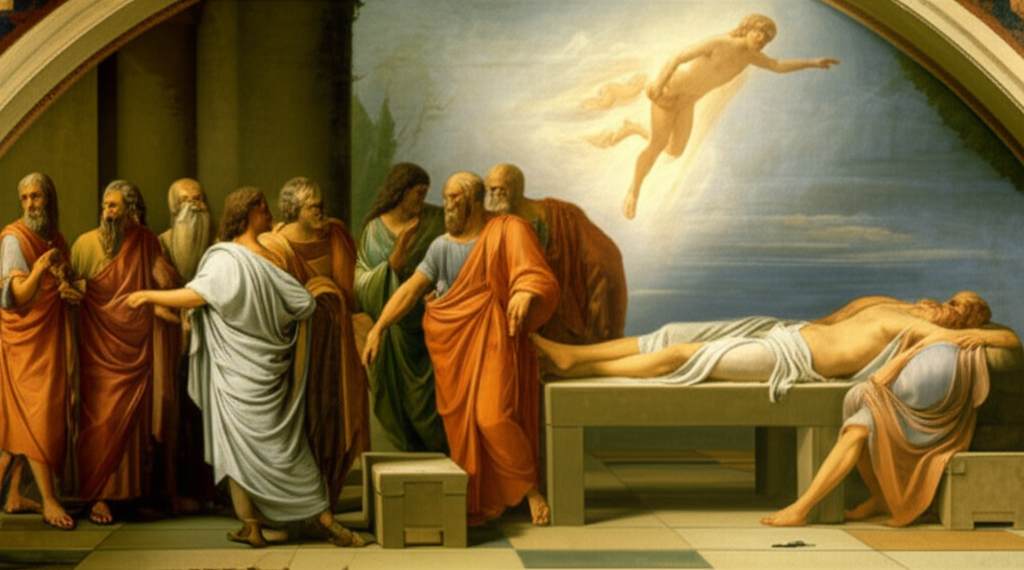
In his dialogues, particularly the Phaedo, Plato presents several powerful arguments for the soul's immortality. Drawing from the Great Books of the Western World, we find his core ideas:
- The Argument from Recollection (Anamnesis): Plato suggests that our ability to grasp universal concepts (like perfect equality or beauty) that we never directly experience in the imperfect physical world implies that our soul must have encountered these Forms in a prior existence. Learning, then, is not acquiring new knowledge but recollecting what the soul already knows.
- The Argument from Opposites: Life comes from death, and death from life. Just as sleep precedes waking, Plato argues that death must precede a form of awakening for the soul. This cyclical nature of existence suggests the soul's continuous journey.
- The Argument from Simplicity (Indestructibility): The soul, being non-composite and simple, cannot be broken down or dissolved like physical objects. Therefore, it is naturally indestructible. Furthermore, the soul is akin to the eternal and unchanging Forms, while the body is ephemeral and changeable.
- The Argument from the Form of Life: The soul is inherently that which brings life. Just as fire cannot admit coldness, the soul cannot admit death. Its very essence is life, and thus it must be immortal.
Plato's arguments underscore a fundamental distinction between the eternal, intelligible realm of Forms and the transient, sensible world of matter, placing the soul firmly in the former.
From Aristotle to Descartes: Refining the Soul's Nature
While Aristotle, also a central figure in the Great Books of the Western World, offered a more integrated view of the soul as the "form" of the body (its animating principle), his concept of the nous (intellect or mind) as potentially separable and immortal provided another avenue for discussion.
Centuries later, René Descartes radically redefined the soul as a distinct, non-physical substance—res cogitans (thinking thing)—entirely separate from the physical body, res extensa (extended thing). This dualism, arguing that the mind (soul) can exist independently of the body, became a cornerstone of modern philosophical thought on immortality.
Table 1: Key Philosophical Perspectives on the Soul's Immortality
| Philosopher | Core Idea/Argument | Implications for Immortality |
|---|---|---|
| Plato | Soul is simple, akin to Forms; Recollection, Opposites | Inherently immortal, pre-exists and post-exists the body |
| Aristotle | Soul is the form of the body; Nous as potential exception | Vegetative/Sensitive souls perish; Rational soul (nous) may be separable/immortal |
| Descartes | Mind (soul) is a distinct, non-extended thinking substance | Soul is inherently immortal, independent of the body |
| Leibniz | Monads (simple, indivisible substances) are the basis of reality | Each monad (including the soul) is indestructible and eternal |
Religion and the Promise of Eternal Life
Beyond philosophical reasoning, the belief in the immortality of the soul is a foundational tenet for countless religious traditions worldwide. For many, this belief provides meaning, moral guidance, and hope for an existence beyond the earthly realm.
Abrahamic Traditions: Resurrection and Eternal Judgment
In Judaism, Christianity, and Islam, the soul is often seen as divinely created, and its persistence beyond death is a central doctrine.
- Christianity: The concept of the immortality of the soul is intertwined with the resurrection of the body and eternal life, promising a future existence with God in heaven or separation in hell, based on earthly deeds. The soul is often viewed as the true self, destined for judgment.
- Islam: Emphasizes the soul's journey from a temporary earthly life to an eternal afterlife, where individuals face accountability for their actions. The soul is seen as returning to its Creator.
- Judaism: While classical Judaism focuses more on the sanctity of life in this world, belief in an afterlife, often involving the resurrection of the dead and the immortality of the soul (or a portion of it), has developed significantly through its history.
Eastern Philosophies: Cycles of Reincarnation and Liberation
Eastern religious and philosophical traditions offer different, yet equally profound, perspectives on the soul's enduring nature.
- Hinduism: The concept of Atman (the individual soul) is central, believed to be eternal and part of Brahman (the ultimate reality). The soul undergoes samsara (the cycle of rebirth or reincarnation) until it achieves moksha (liberation) through spiritual realization.
- Buddhism: While Buddhism generally rejects the idea of a permanent, unchanging individual soul (anatta), it nonetheless posits a continuity of consciousness or a stream of existence that undergoes rebirth, driven by karma, until nirvana is achieved. This isn't the immortality of a fixed entity but the endless flow of becoming.
These diverse religious narratives highlight a pervasive human intuition: that our existence is not extinguished with the last breath, but continues in some form, be it through personal immortality or a transmigration of essence.
Contemporary Debates and Enduring Questions
Despite centuries of philosophical and religious inquiry, the immortality of the soul remains a vigorously debated topic. Modern science, particularly neuroscience, often challenges dualistic views, suggesting that consciousness is an emergent property of the brain, making the idea of a disembodied soul difficult to reconcile with empirical evidence.
However, the profound implications of the question continue to resonate. What does it mean for human dignity, morality, and our understanding of the universe if our essence is truly eternal? The journey to comprehend the immortality of the soul is far from over, inviting each generation to ponder its mysteries anew.
Further Exploration
📹 Related Video: PLATO ON: The Allegory of the Cave
Video by: The School of Life
💡 Want different videos? Search YouTube for: "Plato Phaedo Immortality of the Soul explained"
📹 Related Video: What is Philosophy?
Video by: The School of Life
💡 Want different videos? Search YouTube for: "Descartes Mind-Body Dualism Philosophy"