

The Enduring Question: Exploring the Immortality of the Soul
The concept of the immortality of the soul stands as one of philosophy's most profound and persistent inquiries, transcending cultures, eras, and belief systems. From the ancient Greeks who posited eternal forms to modern discussions on consciousness, this topic delves deep into our understanding of existence, identity, and the very fabric of reality. This article explores the rich tapestry of arguments and perspectives surrounding the soul's persistence beyond physical death, navigating the intricate pathways of metaphysics and religion to uncover why this question continues to captivate the human spirit.
Unpacking the Soul: A Philosophical Journey
At the heart of the debate lies the fundamental question: What exactly is the soul? Before we can contemplate its immortality, we must grapple with its definition. Historically, the soul has been conceived in myriad ways: as the animating principle of life, the seat of consciousness, the essence of personal identity, or even a divine spark.
Defining the Indefinable: Early Conceptions
The soul (Greek: psyche, Latin: anima) has been a subject of intense scrutiny since antiquity.
- Ancient Egyptians: Believed in multiple components of the soul (e.g., Ba and Ka) that continued to exist in the afterlife.
- Pre-Socratic Philosophers: Often viewed the soul as a material substance (e.g., air, fire) or as an organizational principle.
- Plato: Presented the soul as an immaterial, eternal entity, distinct from the body, capable of existing independently.
- Aristotle: Saw the soul as the "form" of the body, its animating principle, inseparable from the body in most respects, though he hinted at a separable, immortal intellect (nous).
These early distinctions laid the groundwork for centuries of metaphysical inquiry into the nature of being and consciousness.
Ancient Echoes: Greek Philosophy and the Immortal Soul
The Golden Age of Greek philosophy provided some of the most enduring arguments for the soul's immortality, profoundly influencing Western thought.
Plato's Enduring Arguments
Plato, a central figure in the Great Books of the Western World, masterfully articulated several arguments for the soul's immortality, primarily in his dialogue Phaedo.
- The Argument from Opposites (Cyclical Argument): Plato posited that everything comes from its opposite. Just as sleep comes from waking and waking from sleep, life must come from death, and death from life. Therefore, souls must exist in an afterlife to return to life.
- The Theory of Recollection (Anamnesis): We possess knowledge of eternal Forms (e.g., perfect equality, beauty) that we could not have acquired through sensory experience in this life. This suggests our souls must have encountered these Forms in a prior, discarnate existence.
- The Argument from Simplicity: The soul, being immaterial and simple, cannot be broken down into parts. Only composite things can decay or be destroyed. Therefore, the soul is indestructible.
- The Argument from the Forms (Affinity Argument): The soul is akin to the eternal, unchanging Forms, while the body is akin to the changeable, sensible world. Things that are like the Forms are eternal; therefore, the soul is eternal.
Plato's vision painted a compelling picture of the soul as an eternal traveler, temporarily housed in a mortal body, destined for a journey beyond earthly confines.
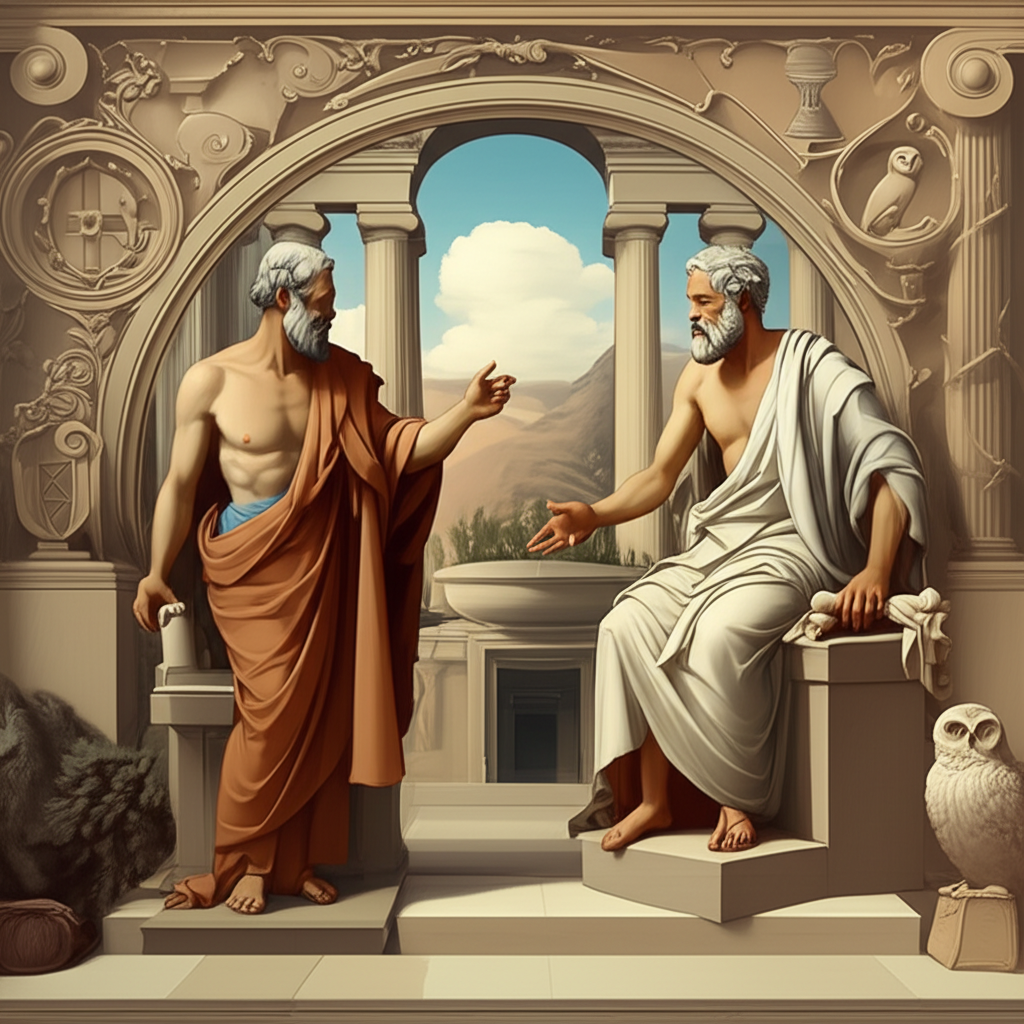
Aristotle's Nuanced Perspective
Aristotle, while differing from his teacher Plato, also explored the nature of the soul in De Anima. He viewed the soul as the entelechy or "first actuality" of a natural body having life. For Aristotle, the soul is the form of the body, and the body is the matter of the soul.
- Vegetative Soul: Responsible for nutrition, growth, and reproduction (plants, animals, humans).
- Sensitive Soul: Responsible for sensation, desire, and locomotion (animals, humans).
- Rational Soul: Unique to humans, responsible for thought and reason.
While Aristotle generally saw the soul as inseparable from the body, he made an exception for the rational soul (nous), particularly the "active intellect." This aspect, he suggested, might be separable and immortal, entering the body from without and persisting after death. This particular point remains a subject of considerable scholarly debate.
Theological Foundations: Religion and Eternal Life
Beyond philosophical speculation, the concept of the immortality of the soul is a cornerstone of many major world religions, offering solace, purpose, and a framework for moral conduct.
Diverse Religious Perspectives
| Religion | Conception of Soul | View on Immortality | Key Concepts |
|---|---|---|---|
| Christianity | Created by God, unique to each individual | Immortal; faces judgment, destined for heaven, hell, or purgatory; resurrection of body. | Resurrection, Heaven, Hell, Judgment, Grace |
| Islam | Ruh (spirit/soul) breathed into human by Allah | Immortal; faces judgment, destined for Jannah (paradise) or Jahannam (hell). | Akhirah (Afterlife), Judgment Day, Jannah, Jahannam |
| Judaism | Nefesh, Ruach, Neshamah (different levels/aspects) | Generally immortal; focus more on this life, but belief in Olam Ha-Ba (world to come) and resurrection. | Olam Ha-Ba, Gehenna (purification), Resurrection |
| Hinduism | Atman (individual soul) is part of Brahman (universal spirit) | Immortal; undergoes samsara (cycle of rebirth) until moksha (liberation). | Karma, Reincarnation, Moksha, Dharma |
| Buddhism | Anatta (no-self/no-soul) doctrine | Rejects a permanent, unchanging soul; emphasizes rebirth of consciousness/karma. | Anatta, Rebirth, Karma, Nirvana |
For many, religious faith provides the ultimate assurance of the soul's continuation, often linking it to divine justice, moral accountability, and the promise of eternal communion.
Modern Dissections: From Descartes to Contemporary Thought
The Enlightenment brought new ways of thinking about the mind and body, leading to further philosophical explorations and challenges to traditional views on the soul and its immortality.
Cartesian Dualism and its Legacy
René Descartes, another pivotal figure in the Great Books, famously proposed substance dualism: the idea that the mind (or soul) and body are two distinct kinds of substance.
- Mind (Soul): An unextended, thinking substance (res cogitans). Its essence is thought.
- Body: An extended, non-thinking substance (res extensa). Its essence is extension in space.
Descartes argued that because the mind is not extended, it cannot be divided or destroyed like a physical body, thus implying its immortality. This radical separation, however, created the enduring "mind-body problem": how do these two fundamentally different substances interact?
Challenges and Alternatives
The Cartesian model, while influential, faced significant critiques.
- Materialism: Denies the existence of a non-physical soul, asserting that all mental phenomena are ultimately reducible to physical processes in the brain. Consciousness, on this view, is an emergent property of complex neural networks, perishing with the brain.
- Emergentism: Suggests that consciousness emerges from complex physical systems but is not reducible to them in a simple way. Whether this emergent property could exist independently of its physical substrate is a key question.
- Identity Theory: Posits that mental states are identical to brain states.
- Functionalism: Defines mental states by their functional role rather than their intrinsic properties, opening the door for minds in non-biological systems (e.g., AI).
These modern perspectives, often rooted in scientific advancements in neuroscience and psychology, pose significant challenges to traditional notions of the soul as an independently existing, immortal entity. The debate often hinges on whether consciousness is purely a product of the brain or if it points to something beyond the physical.
The Enduring Debate: Arguments For and Against Immortality
The question of the soul's immortality is not easily settled, with compelling arguments on both sides.
Key Arguments for the Immortality of the Soul
- The Argument from Desire: Humans universally desire eternal life and perfect happiness. If this desire is natural, it implies that its fulfillment is possible, suggesting an immortal soul capable of achieving it.
- The Moral Argument: For justice to prevail, there must be an afterlife where good is rewarded and evil punished, implying the soul's persistence to receive this judgment.
- The Argument from Consciousness/Personal Identity: How can our subjective experience of self, our memories, and our unique identity be merely brain chemistry? Some argue that consciousness points to a non-physical essence.
- The Argument from the Simplicity of the Soul (Revisited): If the soul is a simple, indivisible entity (as Plato and some others argued), it cannot be broken down or cease to exist in parts.
Key Arguments Against the Immortality of the Soul
- The Argument from Physical Dependence: All evidence suggests that consciousness, memory, and personality are utterly dependent on the brain. Damage to the brain (e.g., injury, disease) directly affects these mental faculties, implying they cease when the brain dies.
- The Problem of Interaction (Dualism's Flaw): If the soul is non-physical, how can it interact with the physical body? If no interaction, how can it influence our actions or be influenced by our senses?
- The Problem of Origin: When does a soul originate? At conception, birth, or some other point? If it's created, why can't it be uncreated?
- Lack of Empirical Evidence: There is no scientific, verifiable evidence for the existence of a non-physical soul or its survival after death. Near-death experiences, while compelling to some, lack universal scientific consensus.
The Ramifications: Why Does It Matter?
The belief or disbelief in the immortality of the soul has profound implications for how we live our lives, our ethical frameworks, and our understanding of meaning and purpose.
- Moral and Ethical Conduct: Belief in an afterlife with judgment can be a powerful motivator for ethical behavior. If there is no immortality, does it diminish the urgency of moral action, or does it heighten the value of this single life?
- Meaning and Purpose: For many, the idea of an immortal soul imbues life with transcendent purpose, connecting individual existence to a larger cosmic or divine plan. Without it, individuals might seek meaning solely in earthly achievements, relationships, and experiences.
- Facing Mortality: The hope of immortality offers solace in the face of death, transforming it from an absolute end into a transition. Without this hope, death can appear as an ultimate annihilation, prompting different responses to grief and the finite nature of existence.
The debate over the immortality of the soul is not merely an abstract philosophical exercise; it touches upon the deepest human anxieties and aspirations, shaping our worldview and influencing our choices in profound ways. Whether through the lens of ancient metaphysics, religious dogma, or modern scientific inquiry, the question of what lies beyond continues to define our intellectual and spiritual quest.
YouTube Video Suggestions:
-
📹 Related Video: PLATO ON: The Allegory of the Cave
Video by: The School of Life
💡 Want different videos? Search YouTube for: ""Plato Phaedo Immortality Soul Explained""
2. ## 📹 Related Video: What is Philosophy?
Video by: The School of Life
💡 Want different videos? Search YouTube for: ""Descartes Dualism Mind Body Problem Crash Course Philosophy""