

The Imagination as a Source of Art
The very essence of human creativity, particularly in the realm of art, is inextricably linked to the faculty of imagination. It is not merely a passive receptacle for sensory input, nor solely a tool for recalling past experiences. Rather, imagination is a dynamic, constructive force of the mind that allows us to conceive of realities beyond the immediate, to synthesize disparate elements into novel forms, and ultimately, to bring forth art from the depths of our inner world. This active capacity transforms raw perception and memory into the structured beauty and profound meaning we find in every artistic endeavor, from the simplest sketch to the most complex symphony.
Unlocking the Creative Spark: Imagination as Poiesis
At its core, art is an act of creation, a poiesis in the truest sense. While the physical act of painting, sculpting, or composing is tangible, the genesis of these acts resides in the imaginative faculty. It is here that the artist first conceives of forms, colors, sounds, or narratives that do not yet exist in the external world. This isn't simply about dreaming; it's about a focused, intentional construction within the mind.
Consider the architect, who first imagines a structure, walking through its imagined spaces long before the first stone is laid. Or the poet, who imagines the perfect metaphor to convey an emotion, bringing together seemingly unrelated concepts to forge a new understanding. This productive imagination, a concept explored by philosophers from Kant to Coleridge, is what elevates art beyond mere craft. It is the ability to:
- Synthesize: Combine existing ideas or perceptions in novel ways.
- Envision: Form mental images of things not present or even possible in reality.
- Project: Extend known principles into unknown or hypothetical scenarios.
- Transform: Reinterpret and reshape reality according to an inner vision.
Without this initial, internal act of creation, the external manifestation of art would be impossible. The mind, through imagination, lays the groundwork for all subsequent artistic endeavors.
Beyond Imitation: The Transformative Power of Imagination in Art
Throughout philosophical history, particularly within the "Great Books of the Western World," discussions often revolve around art as imitation (mimesis). While art certainly draws inspiration from the world around us, the imagination ensures it is never a mere photocopy. An artist doesn't just replicate; they interpret, select, exaggerate, and rearrange, imbuing their work with personal meaning and a unique perspective.
The transformative power of imagination is evident in how artists take the mundane and make it extraordinary, or how they explore abstract concepts through concrete forms. It’s the difference between a photograph of a sunset and a painting of one; the latter is infused with the artist's emotional response and imaginative interpretation of light, color, and mood.
Memory and Imagination: Forging New Realities
The relationship between memory and imagination is particularly profound for the artist. Memory provides the raw material – a vast reservoir of experiences, observations, emotions, and knowledge. However, it is imagination that sifts through this archive, reconfigures its elements, and breathes new life into them.
- An artist doesn't just recall a face; they imagine the character behind it, the life etched in its lines, and then translate that into a portrait.
- A composer doesn't just remember a melody; they imagine its development, its harmony, its orchestral texture, building a complete soundscape from a simple theme.
This interplay allows for the creation of new realities within the artwork, realities that resonate with universal truths even as they originate from a deeply personal imaginative process. The artist remembers the world but imagines a new one, or a new way of seeing the old one.
The Interplay of Mind and Medium
The journey from an imagined concept to a finished artwork is a complex interplay between the artist's mind and their chosen medium. The imagination provides the initial vision, but the medium imposes its own constraints and possibilities. The sculptor imagines a form within a block of marble, but the material's grain and density guide their hands. The writer imagines a narrative, but the structure of language shapes its unfolding.
This dialogue between the internal imaginative vision and the external resistance of the medium is crucial. It refines the initial idea, forcing the artist to solve problems, make choices, and ultimately, to manifest their internal world in a tangible form that can be shared. The mind's imaginative leap is thus grounded by the practicalities of execution, leading to a richer, more robust artistic expression.
Imagination as a Bridge: Connecting Artist and Audience
Perhaps one of the most remarkable aspects of art born from imagination is its ability to ignite imagination in others. A great work of art doesn't just present a finished product; it invites the viewer or listener to participate in its creation, to complete its meaning within their own mind.
When we look at a painting, we don't just see colors and shapes; we imagine the story it tells, the emotion it conveys, the world it evokes. When we read a novel, we imagine the characters, their voices, their environments. This shared imaginative experience is what makes art a powerful vehicle for communication, empathy, and understanding across cultures and generations. It is the artist's imaginative act reaching out and sparking a corresponding imaginative response in the audience, forging a profound connection.
A Philosophical Lineage: Tracing the Role of Imagination
From the ancient Greeks, who pondered phantasia as a faculty that mediates between sensation and thought, to the Enlightenment thinkers who explored its role in knowledge and aesthetic judgment, the imagination has consistently been a subject of profound philosophical inquiry. Aristotle, in his exploration of the soul, recognized imagination as crucial for both memory and thought, allowing us to manipulate images and concepts in the absence of direct sensory input – a foundational idea for understanding its role in art. Later, philosophers like Hume and Kant further delineated its functions, with Kant's concept of the "productive imagination" being particularly relevant to art, as it actively synthesizes sensory data into coherent experience and, in art, creates new forms. This rich lineage underscores that the mind's capacity for imagination is not merely a whimsical diversion but a fundamental aspect of human cognition and, indeed, the very wellspring of our artistic impulse.
In conclusion, the imagination is not just an accessory to art; it is its very heart. It is the internal engine of creation, the transformative power that elevates imitation to interpretation, the bridge between memory and imagination that forges new realities, and ultimately, the shared spark that connects artist and audience. Without this extraordinary faculty of the mind, the world would be devoid of the rich tapestry of human art.
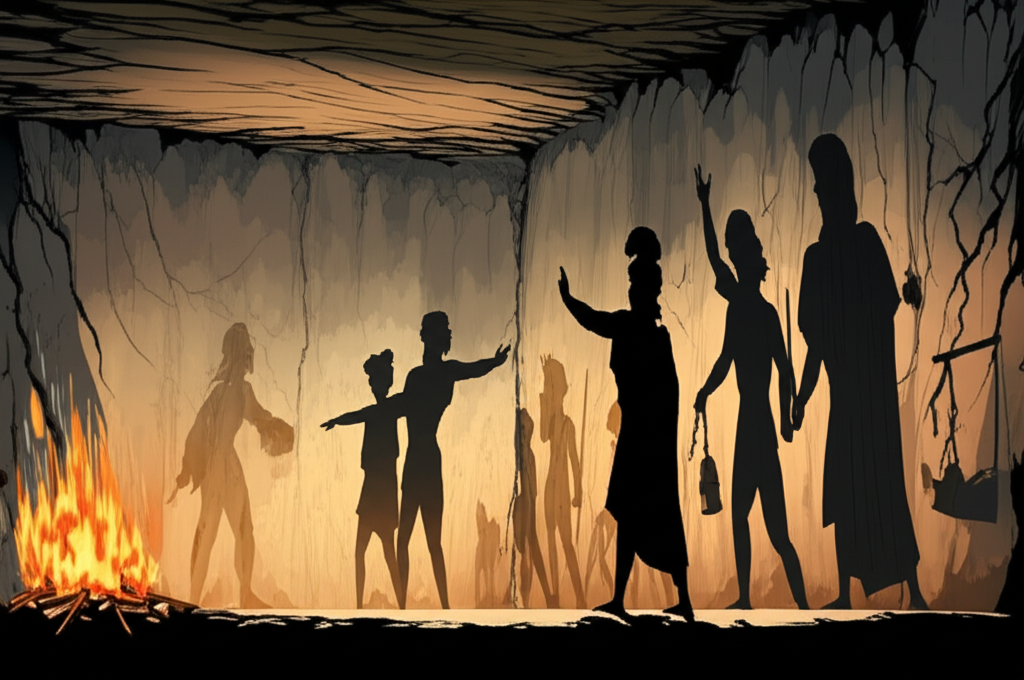
📹 Related Video: PLATO ON: The Allegory of the Cave
Video by: The School of Life
💡 Want different videos? Search YouTube for: ""Plato's Theory of Art and Mimesis Explained""
📹 Related Video: KANT ON: What is Enlightenment?
Video by: The School of Life
💡 Want different videos? Search YouTube for: ""Kant's Critique of Judgment and the Imagination""