

The Unseen Hand: How Imagination Forges the Art We Cherish
The common understanding of art often focuses on skill, technique, or the raw talent of the creator. Yet, beneath these visible attributes lies a more fundamental, often overlooked, architect: imagination. It is the crucible where disparate thoughts, fleeting memories, and abstract concepts are fused into tangible forms, giving birth to everything from a haunting melody to a soaring cathedral. Far from being mere fancy, the imagination, as explored by thinkers across the Great Books of the Western World, is a profound faculty of the mind, indispensable for not just the creation but also the very apprehension of beauty and meaning. It is the primal source, the wellspring from which all genuine artistic expression flows, allowing us to transcend the immediate and touch the infinite.
The Mind's Eye: Unveiling the Philosophical Roots of Imagination in Art
For centuries, philosophers have grappled with the elusive nature of the imagination. Is it merely a passive receptacle for sensory input, or an active, creative force? From Plato's discussions of mimesis (imitation) to Aristotle's meticulous examination of phantasia (the faculty by which images are presented to the mind, crucial for memory and thought), the role of imagination has been central to understanding human cognition and, by extension, artistic endeavor.
Plato, in his dialogues, often viewed art as an imitation of an imitation, a shadow of the true Forms. Yet, even in this hierarchical structure, the artist's ability to conceive and represent these shadows required a mental faculty beyond mere copying – an imaginative leap to translate abstract ideals into perceptible forms. Aristotle, with his more grounded approach, saw phantasia as vital, not only for memory but also for the very possibility of thought, allowing us to combine and manipulate mental images, forming new concepts and, crucially, new artistic visions. The mind, therefore, is not just a processor of reality but a projector of potential realities, powered by the imaginative faculty.
Imagination as the Architect: From Concept to Canvas
Art, in its myriad forms, is rarely a direct transcription of reality. Even the most hyper-realistic painting involves selection, emphasis, and interpretation – all acts of imagination. The artist doesn't just see; they envision.
Consider the process:
- The Initial Spark: An artist might be moved by a fleeting emotion, a vivid dream, or a profound observation. This initial impulse isn't yet art; it's a seed of an idea, nurtured by imagination.
- Conceptualization: The imagination then takes hold, shaping this spark into a coherent concept. What colors, forms, sounds, or words best convey this feeling? This is where possibilities are explored, boundaries are tested, and the unseen is brought into mental focus.
- Transformation and Synthesis: Here, the imagination acts as a powerful synthesizer. It draws upon a vast internal library of experiences, knowledge, and emotions, combining them in novel ways. A sculptor doesn't just chip away at stone; they imagine the form latent within, guiding their hands with an internal vision. A composer doesn't just arrange notes; they hear the symphony in their mind before it touches an instrument.
Table: The Stages of Artistic Creation through Imagination
| Stage | Description | Key Role of Imagination |
|---|---|---|
| Inspiration | The initial stimulus – an idea, emotion, or observation. | Translates raw input into a nascent concept; identifies potential for artistic expression. |
| Conception | Developing the core idea, exploring themes, and envisioning the final form. | Shapes abstract thoughts into concrete mental images; defines the artistic problem to be solved. |
| Incubation | A period of unconscious processing, allowing ideas to ferment and connect. | Works subconsciously, making novel connections between disparate elements; often leads to "aha!" moments. |
| Execution | The physical act of creating the art – painting, sculpting, writing, composing. | Guides technique and decision-making, ensuring the physical manifestation aligns with the internal vision; adapts to challenges. |
| Refinement | Reviewing and adjusting the artwork to enhance its impact and clarity. | Allows the artist to see the work anew, identifying areas for improvement and ensuring the piece fully expresses the initial imaginative intent. |
Memory and Imagination: The Wellspring of New Worlds
It's a common misconception that imagination is solely about creating something entirely new, divorced from reality. In truth, the most potent forms of imagination are deeply intertwined with memory. As Aristotle noted, imagination often involves the rearrangement and recombination of images derived from past sensory experience. We cannot imagine a color we have never seen, nor a sensation we have never felt, directly.
Instead, the imagination takes these stored fragments of memory – the sights, sounds, textures, and emotions we've accumulated – and reassembles them into novel configurations. A painter draws on memories of light and shadow to create an imagined landscape. A writer recalls conversations and emotions to craft compelling characters. This dynamic interplay between past experience and future possibility is what gives art its depth and resonance. It allows us to build fantastical worlds that still feel believable because they are constructed from the familiar building blocks of our shared human experience. Without memory, imagination would lack its essential raw material; without imagination, memory would remain a static archive, incapable of generating new insights or creative works.
The Mind's Infinite Canvas: Where Ideas Take Flight
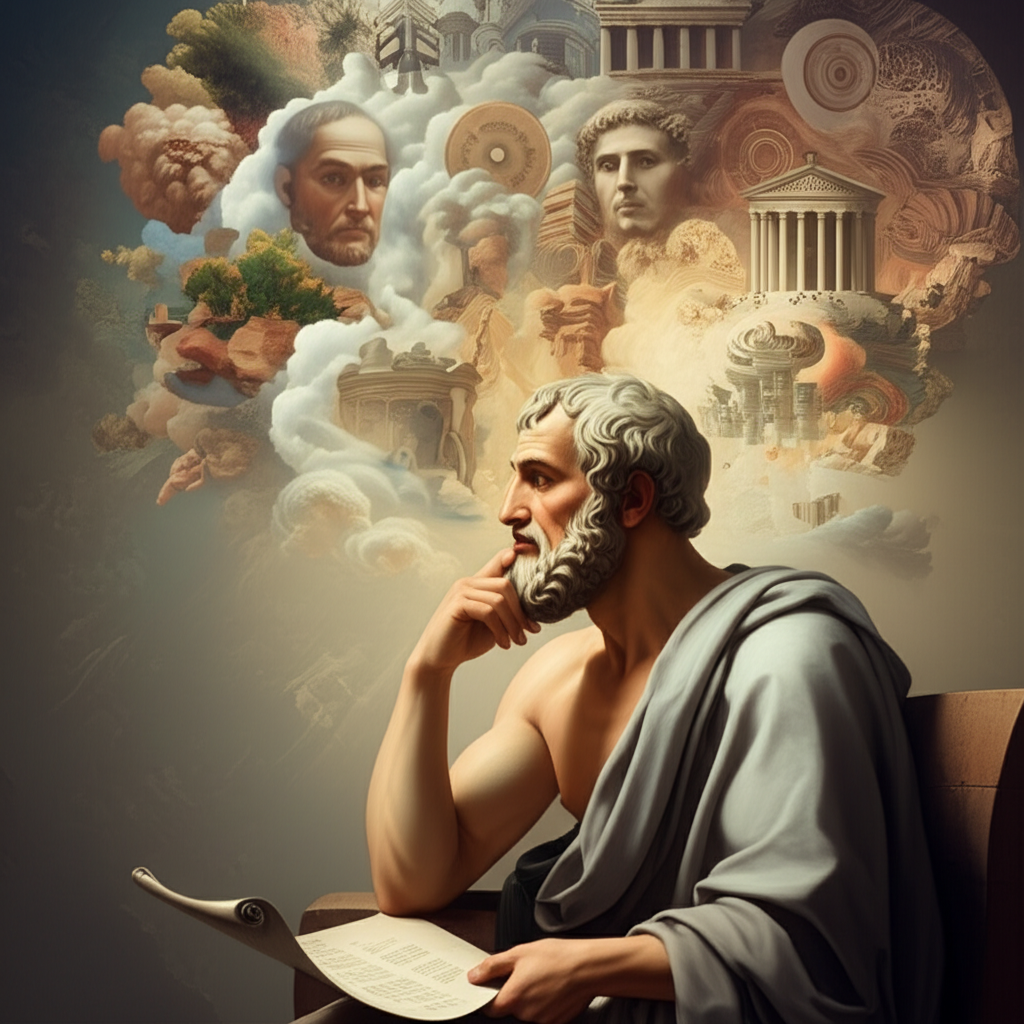
The creative act, therefore, is not merely a physical one but fundamentally an operation of the mind. It is within the vast expanse of our consciousness that the imagination performs its most intricate work. Before a single brushstroke is made, or a note is played, the artwork exists as a vivid impression within the artist's inner world. This internal landscape, sculpted by the imagination, is where the initial struggle and triumph of creation truly occur.
The mind, through its imaginative faculty, allows us to:
- Visualize the Unseen: To see forms, colors, and compositions that do not yet exist in the physical world.
- Auditory Construction: To hear melodies, harmonies, and rhythms before they are performed.
- Narrative Building: To construct complex stories, characters, and worlds with internal coherence.
- Empathic Projection: To step into the shoes of others, understanding and expressing their experiences, which is crucial for character development in literature and drama.
Beyond Imitation: Imagination's True Power
While art often begins with an imitation of nature or human experience, the imagination's true power lies in its capacity to transcend mere replication. It allows us to:
- Create New Realities: From the mythical beasts of ancient epics to the futuristic landscapes of science fiction, imagination builds worlds that exist only in the mind, yet profoundly impact our understanding of the real.
- Express the Ineffable: Art often communicates what words cannot. The imagination finds forms, colors, and sounds to convey emotions, spiritual insights, or philosophical concepts that defy direct description.
- Challenge and Transform: By presenting alternative realities or perspectives, imaginative art can challenge societal norms, provoke thought, and inspire change. It offers new ways of seeing and being.
Conclusion: The Indispensable Spark
In the grand tapestry of human endeavor, art stands as a testament to our unique capacity for creation. And at the heart of every masterpiece, every innovation, every profound artistic statement, lies the potent, transformative power of the imagination. It is the unseen hand that sculpts, paints, composes, and writes, drawing from the well of memory and imagination within the human mind to bring forth beauty, meaning, and new worlds into existence. To truly appreciate art, then, is to appreciate the boundless, fertile ground of the human imagination that birthed it.
📹 Related Video: ARISTOTLE ON: The Nicomachean Ethics
Video by: The School of Life
💡 Want different videos? Search YouTube for: ""Aristotle on Poetics: Imagination, Imitation, and Catharsis""
📹 Related Video: PLATO ON: The Allegory of the Cave
Video by: The School of Life
💡 Want different videos? Search YouTube for: ""Plato's Theory of Art: Forms, Mimesis, and the Artist""