

The Enduring Idea of Universal Justice: A Timeless Pursuit
Summary: The Quest for an Inviolable Standard
The Idea of Universal Justice represents humanity's profound and enduring aspiration for a standard of right and wrong that transcends the shifting sands of local customs, specific decrees, or individual whims. It posits that there exists a form of Justice that is not merely particular to a given society or historical moment, but is instead applicable to all people, everywhere, at all times. This concept, deeply rooted in the philosophical traditions chronicled in the Great Books of the Western World, seeks to identify principles of fairness, equity, and moral rectitude that are universally binding, forming the bedrock upon which legitimate Law can be built and evaluated. From ancient Greek city-states to modern international forums, the pursuit of this universal standard has shaped our understanding of morality, governance, and human dignity.
The Genesis of an Idea: Beyond Local Customs
From the earliest stirrings of philosophical thought, humanity has grappled with the question of what constitutes true Justice. Is it simply what the powerful dictate? Is it merely the prevailing custom of a community? Or is there something more fundamental, an inherent order that informs our moral compass? This fundamental inquiry gives rise to "The Idea of Universal Justice" – a conviction that certain moral truths and principles of fairness are not contingent but absolute.
This Idea stands in stark contrast to particular justice, which refers to the specific laws, conventions, and judicial practices of a given society. While particular laws are necessary for the functioning of any community, the concept of universal justice prompts us to ask whether these laws are themselves just. It challenges us to look beyond the letter of the Law to its spirit, to question whether a given statute aligns with a higher, more encompassing principle of right.
Pillars of Universal Justice: Insights from the Great Books
The quest for universal justice has been a central theme for many of the greatest minds in Western thought. Their contributions have shaped our understanding of what such a standard might entail and how it might be discovered or articulated.
Ancient Roots: Reason and the Polis
- Plato and Aristotle: In the classical Greek tradition, the Idea of justice was intrinsically linked to order and harmony, both within the individual soul and the polis (city-state).
- Plato's Republic envisions an ideal state structured according to reason, where each part (individual or class) performs its proper function, leading to a harmonious whole. Justice, in this sense, is the proper ordering of things, discoverable through reason.
- Aristotle, while more pragmatic, distinguished between distributive justice (fair allocation of goods and honors) and corrective justice (rectifying wrongs). He also spoke of "natural justice," which has the same force everywhere regardless of human opinion, contrasting it with "legal justice," which is conventional. This distinction is a nascent form of the universal and particular dichotomy.
Roman Law and Stoic Cosmopolitanism
- The Stoics championed a vision of a universal community governed by a Logos (universal reason), accessible to all rational beings. This led to the concept of natural law, which was seen as superior to human-made laws.
- Roman jurists like Cicero, influenced by Stoicism, articulated the Idea of a natural Law that is eternal, unchangeable, and binding on all nations. This natural Law was seen as the source of all legitimate human laws, providing a framework for a universal legal system.
Medieval Synthesis: Divine and Natural Law
- Thomas Aquinas synthesized Christian theology with Aristotelian philosophy, presenting a hierarchical structure of Law:
- Eternal Law: God's rational governance of creation.
- Divine Law: Revealed in scripture (e.g., Ten Commandments).
- Natural Law: Humanity's participation in the Eternal Law through reason, allowing us to discern good from evil. This is the foundation for universal moral principles.
- Human Law: Particular laws enacted by states, which must conform to Natural Law to be just.
Enlightenment and the Rights of Man
- Immanuel Kant: In the Enlightenment, the focus shifted towards individual autonomy and rational duty. Kant's categorical imperative proposed a moral Law that is universal and unconditional: "Act only according to that maxim whereby you can at the same time will that it should become a universal law." This emphasizes the Idea of treating all rational beings as ends in themselves, not merely as means.
- Thinkers like John Locke further developed the Idea of natural rights (life, liberty, property) inherent to all individuals, pre-dating and superseding any particular government or Law.
The Tension Between Universal and Particular Law
The grand Idea of Universal Justice, while inspiring, faces significant challenges in its practical application. The tension between the universal principle and the particular circumstance is constant.
Table: Universal vs. Particular Justice
| Aspect | Universal Justice | Particular Justice |
|---|---|---|
| Source | Reason, Natural Law, Divine Command, Moral Intuition | Enacted Legislation, Custom, Judicial Precedent |
| Scope | Applicable to all people, everywhere, at all times | Specific to a given society, culture, or historical era |
| Nature | Immutable, foundational, ideal | Variable, practical, contextual |
| Function | Standard for evaluating particular laws and actions | Governs daily life, maintains social order |
| Key Question | Is this law truly just? | Is this law being applied correctly? |
The Law as codified by human societies is an attempt to translate the abstract principles of universal justice into concrete rules. However, cultural diversity, differing historical contexts, and the complexities of human nature often lead to particular laws that may not perfectly embody the universal ideal. The ongoing debate about human rights, international criminal Law, and global ethical standards reflects this persistent struggle to bridge the gap.
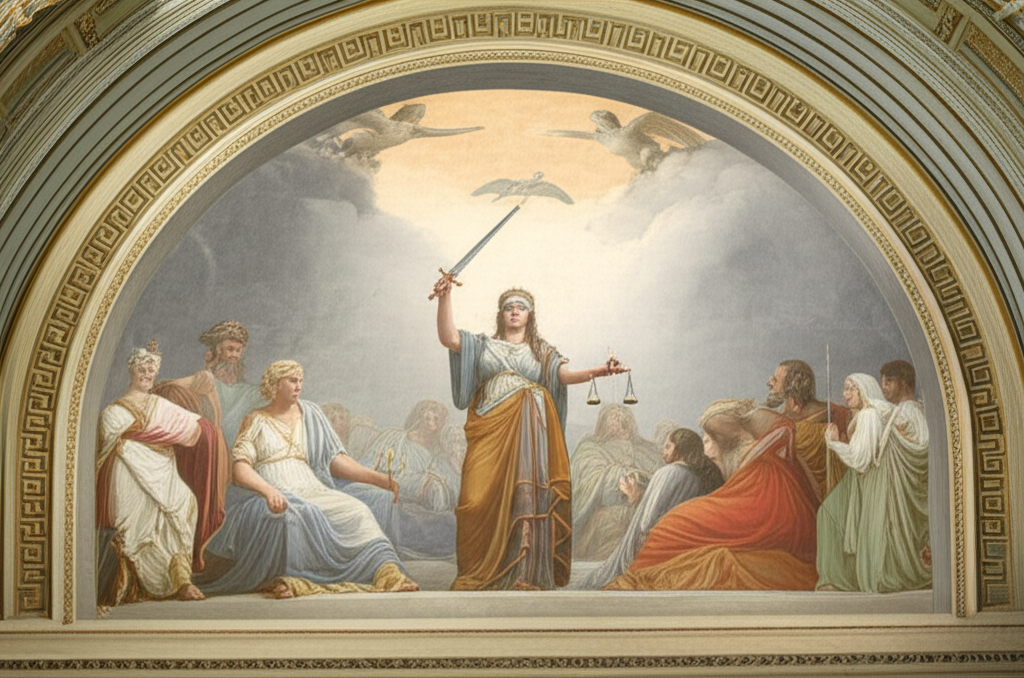
The Enduring Quest: Why the Idea Matters
Despite the inherent difficulties in achieving a perfectly universal system of Justice and Law, the Idea itself remains profoundly important.
- Moral Compass: It provides a critical standard against which to measure existing laws and social practices, urging us towards improvement.
- Foundation for Human Rights: The concept underpins the notion of inherent human dignity and rights that cannot be legitimately denied by any state or particular legal system.
- Basis for International Law: It informs the development of international treaties, conventions, and institutions aimed at establishing global standards of conduct and accountability.
- Stimulus for Philosophical Inquiry: The pursuit of universal justice continues to be a fertile ground for philosophical debate, pushing us to refine our understanding of ethics, politics, and the nature of human flourishing.
The journey towards fully realizing the Idea of Universal Justice is perhaps an unending one, a perpetual horizon that guides our moral and legal development. It is a testament to humanity's capacity for reason and its unwavering hope for a more equitable and just world.
Further Exploration:
📹 Related Video: PLATO ON: The Allegory of the Cave
Video by: The School of Life
💡 Want different videos? Search YouTube for: ""Plato's Concept of Justice - The Republic Explained""
📹 Related Video: ARISTOTLE ON: The Nicomachean Ethics
Video by: The School of Life
💡 Want different videos? Search YouTube for: ""Natural Law Theory - Aquinas and Cicero""