

The Enduring Quest for Universal Justice
The concept of justice, in its most profound sense, transcends mere legality or social convention. It is an idea that has captivated thinkers for millennia, prompting a relentless inquiry into what constitutes a truly fair and equitable order for all humanity. This article delves into the philosophical pursuit of universal justice, exploring its intricate relationship with particular manifestations, its embodiment in law, and the enduring challenges in its realization. We will navigate the rich intellectual landscape laid out by the Great Books of the Western World, seeking to understand whether such a grand concept is an achievable ideal or an eternal aspiration.
Unpacking the Idea of Justice: A Philosophical Foundation
At its core, the idea of justice is not simply about what is right or wrong in a given situation, but about a fundamental principle of balance, fairness, and desert. It asks: what ought to be? For Plato, as articulated in his Republic, justice was an intrinsic virtue, both of the individual soul and of the ideal state. It represented a harmonious ordering of parts, where each element performed its proper function. This wasn't merely a practical arrangement, but a reflection of a transcendent Form of Justice, an eternal and unchanging blueprint.
Aristotle, in his Nicomachean Ethics and Politics, further refined this concept, distinguishing between various forms: distributive justice (fair allocation of resources or honors according to merit) and corrective justice (rectifying wrongs through punishment or compensation). While more pragmatic than Plato, Aristotle still grappled with the underlying principles that make any distribution or correction just. The idea here is not just about rules, but about the rationale that underpins those rules, aiming for a state of equilibrium and flourishing.
The Tension Between the Universal and Particular
One of the most persistent challenges in discussing universal justice lies in reconciling its lofty, abstract nature with the messy realities of diverse cultures, traditions, and individual circumstances. How can a single, overarching principle of justice apply equally to every person, in every society, across all time?
This is the classic tension between the universal and particular.
- Universal Justice: Seeks principles that are valid everywhere, regardless of local customs or beliefs. Think of fundamental human rights – the right to life, liberty, and security of person – often posited as universally applicable.
- Particular Justice: Acknowledges that justice is often contextual, shaped by specific historical, cultural, and social conditions. What might be considered just in one society (e.g., a specific form of land ownership or legal punishment) might be seen as unjust elsewhere.
Philosophers throughout history have grappled with this dichotomy. Enlightenment thinkers like John Locke, in his Two Treatises of Government, posited natural law as a foundation for universal rights, asserting that reason could discern certain moral truths applicable to all. Immanuel Kant, with his categorical imperative, famously argued that moral actions must be capable of being universalized – if an action cannot be willed as a universal law, it is not moral, and by extension, not just.
However, the particular often asserts itself. Cultural relativists argue that justice is always a product of its environment, making a truly universal standard impossible. This debate forces us to ask: Is universal justice a fixed ideal we discover, or a shared aspiration we continually construct?
Justice as the Soul of Law
The relationship between justice and law is foundational. Ideally, law serves as the mechanism through which the idea of justice is codified, enforced, and made tangible within a society. Without law, justice might remain a mere philosophical abstraction; without justice, law risks becoming an arbitrary exercise of power.
Historically, this connection has been explored through:
- Natural Law Theory: Proponents, from Aquinas to Locke, argue that human law derives its legitimacy from a higher, inherent moral law – a universal order discernible by reason. Unjust laws, in this view, are not true laws at all. This perspective champions the idea that there are fundamental rights and wrongs that precede and ought to guide all human legislation.
- Positive Law Theory: In contrast, positive law asserts that law is simply what is enacted by legitimate authority. While not necessarily denying the existence of justice, this view separates law from morality, suggesting that a law's validity comes from its source and process, not necessarily its inherent justice.
The struggle to embed universal principles of justice into specific legal frameworks is ongoing. International human rights conventions, war crimes tribunals, and the very notion of crimes against humanity are all attempts to establish a universal legal standard that transcends national boundaries and particular laws, holding individuals and states accountable to a higher moral imperative.
Key Aspects of Law's Relation to Justice:
| Aspect | Description | Philosophical Origin (Great Books) To learn more about how to create content for a pillar page, here are some helpful resources:
- How to Create a Pillar Content Strategy That Drives Traffic + Leads (Includes Example) - YouTube
- Pillar Content: A Comprehensive Guide to Boosting Your SEO
The Enduring Quest for Universal Justice
The concept of justice, in its most profound sense, transcends mere legality or social convention. It is an idea that has captivated thinkers for millennia, prompting a relentless inquiry into what constitutes a truly fair and equitable order for all humanity. This article delves into the philosophical pursuit of universal justice, exploring its intricate relationship with particular manifestations, its embodiment in law, and the enduring challenges in its realization. We will navigate the rich intellectual landscape laid out by the Great Books of the Western World, seeking to understand whether such a grand concept is an achievable ideal or an eternal aspiration.
Unpacking the Idea of Justice: A Philosophical Foundation
At its core, the idea of justice is not simply about what is right or wrong in a given situation, but about a fundamental principle of balance, fairness, and desert. It asks: what ought to be? For Plato, as articulated in his Republic, justice was an intrinsic virtue, both of the individual soul and of the ideal state. It represented a harmonious ordering of parts, where each element performed its proper function. This wasn't merely a practical arrangement, but a reflection of a transcendent Form of Justice, an eternal and unchanging blueprint.
Aristotle, in his Nicomachean Ethics and Politics, further refined this concept, distinguishing between various forms: distributive justice (fair allocation of resources or honors according to merit) and corrective justice (rectifying wrongs through punishment or compensation). While more pragmatic than Plato, Aristotle still grappled with the underlying principles that make any distribution or correction just. The idea here is not just about rules, but about the rationale that underpins those rules, aiming for a state of equilibrium and flourishing.
The Tension Between the Universal and Particular
One of the most persistent challenges in discussing universal justice lies in reconciling its lofty, abstract nature with the messy realities of diverse cultures, traditions, and individual circumstances. How can a single, overarching principle of justice apply equally to every person, in every society, across all time?
This is the classic tension between the universal and particular.
- Universal Justice: Seeks principles that are valid everywhere, regardless of local customs or beliefs. Think of fundamental human rights – the right to life, liberty, and security of person – often posited as universally applicable. These are principles that, ideally, transcend specific cultural norms.
- Particular Justice: Acknowledges that justice is often contextual, shaped by specific historical, cultural, and social conditions. What might be considered just in one society (e.g., a specific form of land ownership or legal punishment) might be seen as unjust elsewhere. This perspective highlights the practical application and adaptation of general principles.
Philosophers throughout history have grappled with this dichotomy. Enlightenment thinkers like John Locke, in his Two Treatises of Government, posited natural law as a foundation for universal rights, asserting that reason could discern certain moral truths applicable to all. Immanuel Kant, with his categorical imperative, famously argued that moral actions must be capable of being universalized – if an action cannot be willed as a universal law, it is not moral, and by extension, not just.
However, the particular often asserts itself. Cultural relativists argue that justice is always a product of its environment, making a truly universal standard impossible. This debate forces us to ask: Is universal justice a fixed ideal we discover, or a shared aspiration we continually construct?
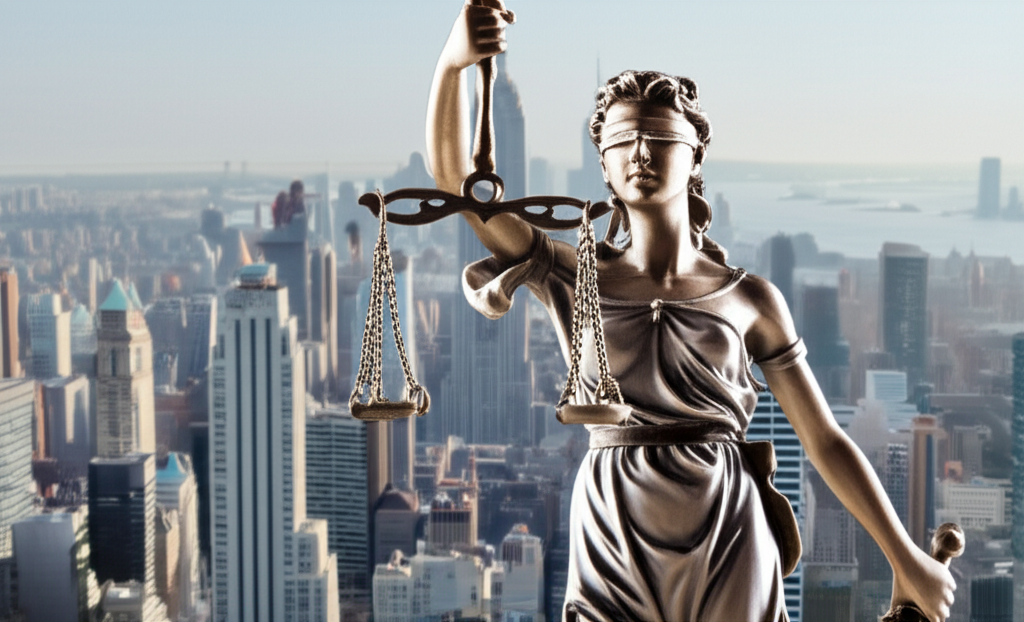
(Image: A classical Greek statue of Themis, the goddess of justice, blindfolded and holding scales and a sword, symbolizing impartiality, balance, and the power to uphold judgment. The background is a subtly blurred image of a diverse global city skyline, representing the modern, complex world where universal justice is sought.)
Justice as the Soul of Law
The relationship between justice and law is foundational. Ideally, law serves as the mechanism through which the idea of justice is codified, enforced, and made tangible within a society. Without law, justice might remain a mere philosophical abstraction; without justice, law risks becoming an arbitrary exercise of power.
Historically, this connection has been explored through:
- Natural Law Theory: Proponents, from Aquinas to Locke, argue that human law derives its legitimacy from a higher, inherent moral law – a universal order discernible by reason. Unjust laws, in this view, are not true laws at all. This perspective champions the idea that there are fundamental rights and wrongs that precede and ought to guide all human legislation.
- Positive Law Theory: In contrast, positive law asserts that law is simply what is enacted by legitimate authority. While not necessarily denying the existence of justice, this view separates law from morality, suggesting that a law's validity comes from its source and process, not necessarily its inherent justice.
The struggle to embed universal principles of justice into specific legal frameworks is ongoing. International human rights conventions, war crimes tribunals, and the very notion of crimes against humanity are all attempts to establish a universal legal standard that transcends national boundaries and particular laws, holding individuals and states accountable to a higher moral imperative.
Key Aspects of Law's Relation to Justice:
| Aspect | Description | Philosophical Origin (Great Books) body to achieve universal justice, particularly in its implementation.
- Constant Scrutiny: The pursuit of justice requires continuous scrutiny of existing laws and structures to ensure they remain fair and responsive to the changing needs of society.
The Enduring Quest
The idea of universal justice, though complex and often elusive, remains one of humanity's most compelling aspirations. It is the driving force behind movements for equality, human rights, and the rule of law that extend beyond the boundaries of any single nation or culture.
From the philosophical inquiries of ancient Greece to the modern discourse on international jurisprudence, the pursuit of universal justice is a testament to our shared human desire for a world governed by principles of fairness, dignity, and equity. While the universal and particular will always present a dynamic tension, the ongoing dialogue, critique, and refinement of our understanding of justice move us closer to realizing this profound and necessary ideal.
YouTube Video Suggestions:
- YouTube: "What is Justice? Crash Course Philosophy #40" (for a broad overview and introduction to the concepts)
- YouTube: "Plato's Republic: Justice and the Ideal State Explained" (for a deeper dive into classical ideas of justice)
📹 Related Video: What is Philosophy?
Video by: The School of Life
💡 Want different videos? Search YouTube for: "The Idea of Universal Justice philosophy"