

The Idea of the Angel in Art: Glimpses of the Ethereal
The idea of the angel, deeply woven into the fabric of human belief and imagination, finds one of its most compelling expressions in art. Far more than mere decorative figures, angels in art serve as profound signs and symbols, bridging the divine and the human, embodying theological concepts, and reflecting evolving cultural and religious understandings. From ancient cherubim to Renaissance putti and modern interpretations, their depiction is a rich tapestry illustrating humanity's perennial quest to visualize the ethereal, to give form to the formless, and to understand the nature of divine communication. They are, in essence, humanity's artistic attempt to grasp the transcendent, a visual vocabulary for the sacred.
Angels: Messengers of the Divine in Human Imagination
At its core, the angel is a messenger, a divine intermediary. This fundamental role, rooted deeply in religion across various traditions, has shaped their artistic representation for millennia. In Western thought, heavily influenced by the Abrahamic faiths, angels are understood as spiritual beings created by God, existing outside the material realm yet capable of interacting with it. Their presence in art is never purely aesthetic; it is always laden with meaning, pointing beyond the canvas or sculpture to a deeper spiritual reality. Through their forms, gestures, and attributes, artists communicate complex theological narratives and philosophical ideas about divine order, grace, judgment, and revelation.
A Historical Canvas: The Evolution of Angelic Forms
The visual language of angels has undergone a fascinating transformation, reflecting changing theological perspectives, artistic styles, and cultural values.
Ancient Roots and Early Christian Art
Before Christianity, winged figures abounded in Near Eastern and Greco-Roman mythologies, often signifying divine power or swiftness. These ancient motifs provided a visual precursor. In early Christian art, particularly in catacomb paintings and mosaics from the 3rd to 6th centuries, angels were often depicted as youthful, beardless figures, sometimes with wings, or even as simple disembodied heads with wings (cherubim). Their primary function was symbolic: to represent divine presence, protection, or the souls of the departed. They were less individualized and more abstract, focusing on their spiritual essence rather than human likeness.
Medieval Grandeur: The Celestial Hierarchy
The Middle Ages saw the codification of angelic hierarchies, famously articulated by Pseudo-Dionysius the Areopagite (whose ideas influenced scholastic thinkers like Thomas Aquinas, central to the Great Books of the Western World tradition). This period gave rise to angels of immense power and majesty, often depicted in grand Byzantine mosaics and Gothic cathedrals. They were typically tall, solemn, often genderless or distinctly masculine figures, adorned in rich robes, sometimes multi-winged (seraphim and cherubim) to emphasize their proximity to God. Their role in art was to inspire awe and reverence, illustrating the vast, ordered cosmos and humanity's place within it, a testament to God's omnipotence and the intricate structure of the divine court.
Renaissance Humanism and the Angelic Ideal
The Renaissance brought a profound shift towards humanism, impacting the portrayal of angels. Artists like Fra Angelico, Botticelli, and Raphael began to depict angels with greater anatomical accuracy, grace, and human emotion. While still ethereal, they became more relatable, embodying ideals of beauty, purity, and divine love. The putto—a chubby, often naked winged child—emerged as a popular motif, particularly in secular contexts, symbolizing innocence and joy, though also retaining religious connotations as cherubic figures. This era saw angels as symbols of divine intervention, compassion, and celestial harmony, often participating directly in biblical narratives with serene expressions and flowing drapery.
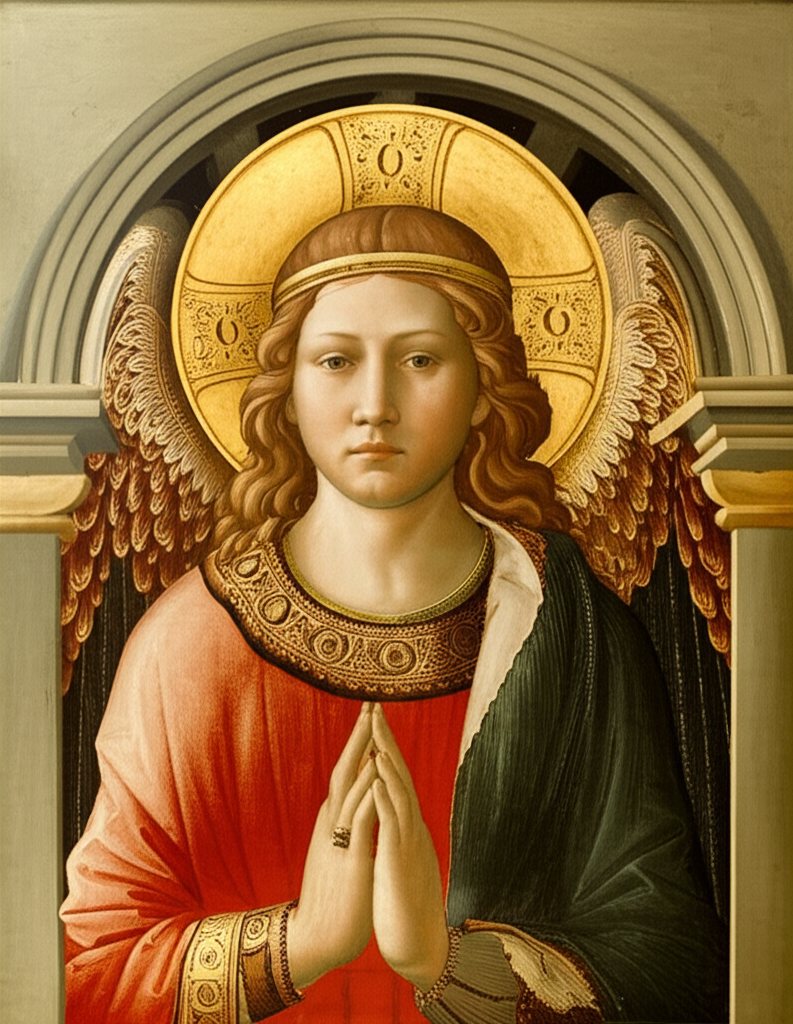 , depicted with delicate, iridescent wings and flowing, pastel-colored robes, kneeling reverently before the Virgin Mary. His youthful, serene face radiates an ethereal grace, framed by a soft halo, as he extends a hand in a gesture of divine communication, bathed in a soft, heavenly light that emanates from an unseen source, symbolizing purity, divine grace, and the sacred transmission of God's message.)
Baroque Drama and Beyond
The Baroque period infused angelic depictions with dramatic movement, heightened emotion, and dynamic compositions. Angels soared, wept, or engaged in celestial battles, reflecting the era's emphasis on intense religious experience and theatricality. Later periods saw angels take on various roles, from allegorical figures in secular art to decorative elements, and eventually, in modern times, their interpretation has broadened to include abstract representations, psychological symbols, or even figures of pop culture.
The Angel as Sign and Symbol: A Philosophical Lens
Beyond their visual evolution, angels consistently function as powerful signs and symbols within philosophical and theological discourse. They are not merely pictures but intellectual constructs rendered visible, pointing to profound truths about existence.
| Angelic Attribute | Symbolic Meaning | Philosophical Implication |
|---|---|---|
| Wings | Transcendence, freedom, swiftness of thought, divine message, ability to bridge realms | The human aspiration for the spiritual, the capacity for intellectual ascent, bridging the material and immaterial existence |
| Light/Halo | Divinity, holiness, enlightenment, presence of God, divine favor | The illumination of truth, spiritual revelation, the emanation of ultimate goodness |
| Youth/Purity | Innocence, incorruptibility, eternal nature, new beginnings | The ideal state of being, untouched by worldly corruption, timeless spiritual essence |
| Swords/Trumpets | Justice, divine wrath, judgment, proclamation, protection | The moral order of the universe, the call to spiritual awakening, the defense of righteousness |
| Hierarchy | Order, structure, divine administration, cosmic design | The concept of an ordered cosmos, the chain of being, the systematic unfolding of divine will |
Philosophically, angels confront us with questions about the nature of being, the relationship between the finite and the infinite, and the human capacity to imagine the inconceivable. They represent the "other" – a spiritual reality that both mirrors and transcends our own. As signs, they direct our gaze towards the divine; as symbols, they embody complex theological doctrines, making abstract concepts like grace, redemption, or divine will palpable to the human mind. Their presence in art is a continuous dialogue between the visible and the invisible, the earthly and the heavenly, inviting contemplation on the very nature of existence.
The Artist's Vision: Crafting the Ethereal
The challenge for artists has always been how to render the intangible. How does one paint a spirit? The solution lies in a masterful manipulation of light, form, and composition. Artists employ soft illumination to suggest a divine glow, delicate drapery to imply ethereal movement, and serene expressions to convey spiritual peace. The very act of portraying an angel is an exercise in philosophical art, attempting to capture a truth that lies beyond direct sensory experience. It is a testament to humanity's persistent drive to visualize its deepest beliefs and highest aspirations.
Conclusion
The idea of the angel in art is a testament to humanity's enduring fascination with the spiritual realm and its relentless pursuit of meaning. From ancient mosaics to Renaissance masterpieces, these celestial beings have served as powerful signs and symbols, reflecting evolving theological understanding, artistic innovation, and the perennial human desire to connect with the divine. They remind us that art is not merely imitation but interpretation, a profound means by which we explore the boundaries of our knowledge and give form to our most profound spiritual yearnings.
📹 Related Video: What is Philosophy?
Video by: The School of Life
💡 Want different videos? Search YouTube for: ""Philosophy of Angels in Western Thought""
📹 Related Video: PLATO ON: The Allegory of the Cave
Video by: The School of Life
💡 Want different videos? Search YouTube for: ""Symbolism of Angels in Renaissance Art History""