

The Celestial Canvas: Exploring the Idea of the Angel in Art
Summary: From ancient cherubim to ethereal Renaissance figures and contemporary interpretations, the idea of the angel has captivated artists for millennia. More than mere decorative elements, angels in art serve as profound signs and symbols, embodying divine messages, spiritual purity, and humanity's yearning for transcendence. Their depiction across cultures and religions offers a unique lens through which to examine evolving theological concepts and artistic expressions, making them a cornerstone of philosophical and aesthetic inquiry.
The Enduring Allure of the Angelic Form
Few figures possess the universal recognition and profound resonance of the angel. Across disparate cultures and belief systems, the concept of a celestial intermediary between the divine and the mortal realm persists, finding its most vivid expression in art. These winged messengers, protectors, and guides transcend mere mythology; they are deeply embedded in our collective consciousness, shaping our understanding of spirituality, morality, and the unseen forces at play in the universe.
Philosophical and Theological Roots: Angels in the Great Books
To understand the idea of the angel in art, one must first delve into the rich philosophical and theological traditions that birthed their imagery. The "Great Books of the Western World" offer invaluable insights into how these celestial beings were conceptualized long before they took definitive artistic form.
- Aquinas and the Angelic Intellect: Thomas Aquinas, in his Summa Theologica, provides a meticulous philosophical examination of angels, defining them as purely intellectual, incorporeal substances. This rigorous theological framework, found within the Great Books, profoundly influenced subsequent Christian iconography, emphasizing their spiritual rather than physical nature, even as artists struggled to represent the unrepresentable.
- Milton's Poetic Visions: John Milton's Paradise Lost, another cornerstone of the Great Books, offers vivid, dramatic portrayals of angels, both fallen and faithful. His epic poetry, while literary, provided a powerful visual language that artists later drew upon, shaping perceptions of angelic majesty, power, and even vulnerability.
These foundational texts didn't just describe angels; they articulated their very essence, their purpose, and their place in the cosmic order, providing the intellectual scaffolding upon which art would later build.
Angels as Sign and Symbol in Visual Culture
In art, angels function as powerful signs and symbols, their forms imbued with layers of meaning. Their visual attributes—wings, halos, celestial light—are not accidental; they are deliberate choices designed to communicate abstract concepts.
Symbolic Roles of Angels in Art:
- Divine Messengers: As their name (from Greek angelos, meaning messenger) suggests, angels often convey God's will, as seen in Annunciation scenes.
- Guardians and Protectors: Depicted shielding individuals or guiding souls, they symbolize divine providence and comfort.
- Harbingers of Judgment: In apocalyptic scenes, angels signify divine justice and the end of times.
- Embodiments of Purity and Innocence: Their ethereal forms and often youthful appearance represent spiritual cleanliness and heavenly grace.
- Connectors of Heaven and Earth: Their ability to traverse realms makes them a visual metaphor for the bridge between the material and the spiritual.
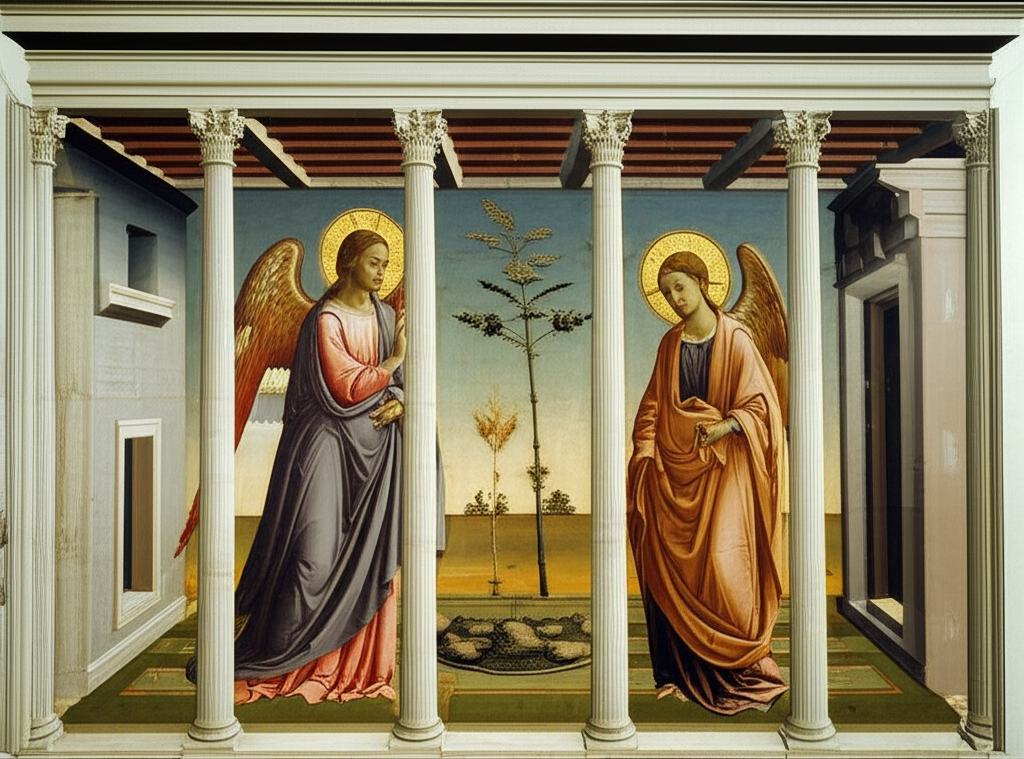 at the Museo di San Marco in Florence. The Archangel Gabriel, with vibrant, multi-colored wings and a serene expression, kneels before the Virgin Mary in a simple, arcaded loggia. His gesture conveys reverence and the profound weight of his divine message, while Mary's posture suggests humble acceptance. The scene is rendered with an ethereal light and delicate forms, emphasizing the spiritual purity and gravity of the encounter.)
The Evolution of Angelic Depictions
The art of depicting angels has evolved dramatically, reflecting changing theological understandings, artistic styles, and cultural sensibilities.
- Early Christian and Byzantine Art: Angels were often depicted as solemn, robed figures, sometimes with multiple wings (seraphim and cherubim), emphasizing their wisdom and proximity to God. Their forms were less human, more iconic, focused on their symbolic function within religion.
- Renaissance and Baroque Periods: A significant shift occurred as artists like Giotto, Fra Angelico, and later, Bernini and Rubens, began to humanize angels. They gained more realistic anatomy, expressive faces, and dynamic poses, reflecting a renewed interest in human experience even within divine narratives. Wings became more feathery and grand, emphasizing movement and grace.
- Romanticism and Beyond: In later periods, angels continued to appear, sometimes as figures of sorrow or hope, or even as purely allegorical beings, detached from strict religious dogma. The emphasis shifted from their divine nature to their emotional impact or symbolic power.
The Modern Angel: Beyond Strict Religion
In contemporary art, the idea of the angel persists, often reinterpreted. Artists may explore the psychological dimensions of angelic encounters, question traditional iconography, or use the angelic form to comment on themes of hope, despair, or the search for meaning in a secular age. While the explicit religious context may recede, the angel's power as a sign and symbol of transcendence, protection, or spiritual longing remains potent.
Conclusion: A Timeless Sign and Symbol
The idea of the angel in art is a testament to humanity's enduring fascination with the divine and the unseen. From the profound theological treatises of the "Great Books of the Western World" to the masterful strokes of countless artists, angels have served as a visual language for spiritual truths, emotional depths, and philosophical inquiries. They are more than just beautiful figures; they are powerful signs and symbols that continue to inspire, challenge, and connect us to a realm beyond the purely material.
YouTube Video Suggestions:
-
📹 Related Video: ARISTOTLE ON: The Nicomachean Ethics
Video by: The School of Life
💡 Want different videos? Search YouTube for: ""The Art of Angels: From Renaissance to Baroque""
2. ## 📹 Related Video: What is Philosophy?
Video by: The School of Life
💡 Want different videos? Search YouTube for: ""Aquinas Angels Philosophy Explained""