

The Philosophical Journey of Space: From Ancient Axioms to Modern Mathematics
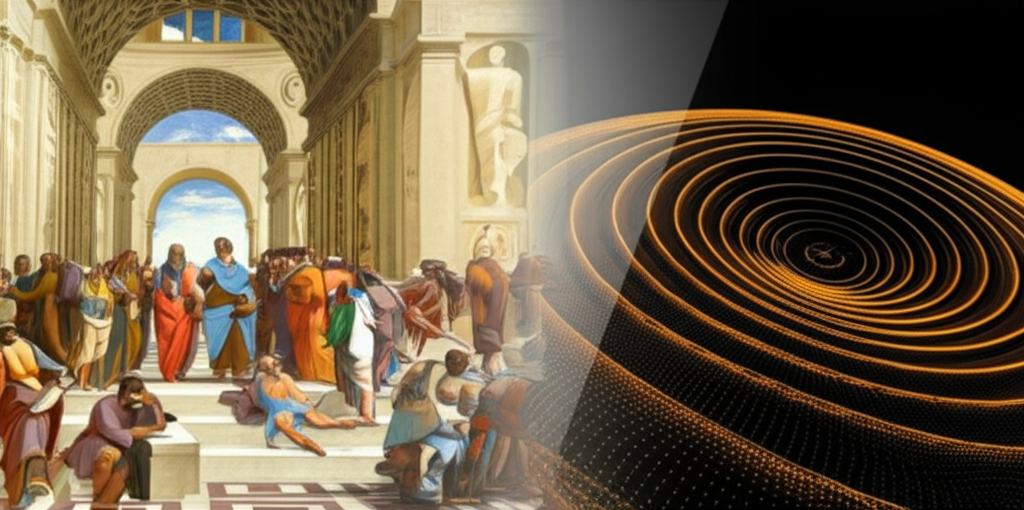
The idea of space has captivated thinkers for millennia, evolving from an intuitive backdrop for existence to a profoundly abstract and flexible mathematical construct. For us at planksip, exploring such fundamental concepts means tracing their intellectual lineage, understanding how our perception and definition of reality shifts with each philosophical and scientific paradigm. This pillar page delves into the transformative journey of space, examining its conception not merely as an empty container, but as a dynamic quantity and idea that has shaped our understanding of the universe, from the ancient Greeks to the most cutting-edge theories of mathematics and physics. We will explore how space transitioned from a given, self-evident reality to a malleable entity, defined by its internal properties and quantifiable relationships, fundamentally altering our philosophical landscape.
The Intuitive Origins of Space – Early Philosophical Musings
Before space became a playground for abstract mathematics, it was a primal intuition, a fundamental aspect of how we perceive the world. Early philosophers grappled with its nature, often through the lens of place and existence.
Space as a Container: Aristotle and the Problem of Place
For Aristotle, as detailed in the Great Books of the Western World, space wasn't an infinite void but rather the sum of all places. A place, for Aristotle, was the innermost motionless boundary of what contains a body. This meant that space was inherently tied to matter; without bodies, there was no place, and thus no space. This conception avoided the paradoxes of an infinite void, which many ancient thinkers found problematic, but it also limited space to a rather concrete, relational idea. It was less about an independent quantity and more about a property of objects in relation to each other.
Euclid's Geometry: The Axiomatic Foundation of Space
While Aristotle pondered the philosophical nature of place, Euclid, whose Elements stands as a monumental achievement in the Great Books, provided the first rigorous mathematical framework for space. Euclidean geometry, with its axioms and postulates, described a space that was flat, infinite, and homogeneous. Points, lines, and planes were the fundamental ideas, and their relationships were governed by self-evident truths. This mathematical space was not just a container; it was a system of quantifiable relationships. The distance between two points, the area of a shape, the angles of a triangle – these were all quantities defined within this Euclidean framework. For centuries, this was the mathematical idea of space, considered absolute and immutable, reflecting the very structure of reality.
The Dawn of Modern Mathematics – Space and the Cartesian Revolution
The scientific revolution brought with it new ways of thinking about the universe, and with it, a radical reimagining of space. The emphasis shifted from qualitative descriptions to precise, quantifiable measurements.
Descartes and Analytical Geometry: Bridging Algebra and Space
René Descartes, another titan within the Great Books collection, revolutionized mathematics with his invention of analytical geometry. By introducing coordinate systems, he showed how geometric points could be represented by numbers – quantities – and geometric shapes by algebraic equations. This was a monumental leap. Suddenly, the idea of space was no longer just about visual intuition or axiomatic deductions; it was about numbers, variables, and calculations. A point's position became a set of coordinates (x, y, z), making space a quantifiable entity par excellence. This unification of algebra and geometry laid the groundwork for much of modern mathematics and physics, making space a subject ripe for rigorous, quantitative analysis.
Newton's Absolute Space: A Divine Stage for the Universe
Isaac Newton, whose Principia Mathematica is a cornerstone of the Great Books, articulated a concept of absolute space that dominated scientific thought for centuries. For Newton, space was not merely a relation between objects, nor was it defined by them. Instead, it was an independent, infinite, eternal, and unchangeable entity—a kind of divine sensorium. It was the unchanging stage upon which all physical events unfolded, existing prior to and independently of any matter within it. This mathematical idea of space allowed for the formulation of his laws of motion and universal gravitation, where forces and accelerations could be precisely measured and related to quantities of mass and distance within this absolute framework.
Kant's Epistemological Turn – Space as an A Priori Intuition
The Enlightenment brought a profound shift in philosophical inquiry, focusing on the nature of human knowledge itself. Immanuel Kant, a central figure in the Great Books, challenged both empirical and rationalist views of space.
Space as a Condition for Experience: The Mind's Framework
In his Critique of Pure Reason, Kant argued that space is not an objective reality existing independently "out there," nor is it merely an empirical concept derived from experience. Instead, space is an a priori intuition, a fundamental structure of the human mind, without which we could not even begin to perceive or understand the world. It is the necessary form of all outer appearances. For Kant, the idea of space is a transcendental condition for us to have any experience of objects existing side-by-side. This means that Euclidean geometry, for Kant, isn't just a mathematical description of an external reality, but rather a description of how our minds must necessarily organize sensory input. This epistemological turn elevated the idea of space from a physical entity to a foundational mental construct, a quantity of perception.
Challenging Euclidean Dogma – Non-Euclidean Geometries and the Abstract Idea of Space
For millennia, Euclid's geometry was considered the only possible description of space. However, the 19th century witnessed a revolutionary shift, demonstrating that the idea of space could be far more diverse and abstract than previously imagined.
The Fifth Postulate and the Birth of New Spaces
For centuries, mathematicians struggled with Euclid's fifth postulate (the parallel postulate), which states that through a point not on a given line, there is exactly one line parallel to the given line. Attempts to prove it from the other axioms failed, leading to the groundbreaking realization that one could deny it and still create consistent geometries. This gave birth to non-Euclidean geometries:
- Hyperbolic Geometry (Bolyai, Lobachevsky): Where infinitely many parallel lines can be drawn through a point not on a given line. Visualized as a saddle-shaped space.
- Elliptic Geometry (Riemann): Where no parallel lines can be drawn, and all lines eventually intersect. Visualized as the surface of a sphere.
These developments shattered the notion of a single, absolute mathematical space. They showed that space was not an immutable given, but a concept whose properties depended entirely on the axioms one chose. The idea of space became plural, a family of possible mathematical structures, each with its own quantifiable properties.
Riemann's Manifolds: Space as a Flexible Mathematical Construct
Bernhard Riemann, building upon the work of Gauss, formalized the concept of non-Euclidean geometries into a more general framework known as Riemannian manifolds. He proposed that space could be locally Euclidean but globally curved, and that its curvature could vary from point to point. This was an incredibly powerful idea: space was no longer necessarily flat or uniform, but could be curved and warped, with its properties defined by a "metric tensor" that allowed for the precise quantification of distances and angles at every point. This abstract mathematical idea of space was no longer tied to our intuitive perceptions but was instead a purely formal structure defined by its internal geometric properties.
Space in Contemporary Mathematics and Physics
The abstract and flexible idea of space formulated in the 19th century paved the way for some of the most profound scientific discoveries of the 20th and 21st centuries.
Einstein's Relativistic Space-time: Space and Time Intertwined
Albert Einstein's theories of relativity fundamentally reshaped our understanding of space. Influenced by Riemann's work, Einstein proposed that space and time are not separate entities but are interwoven into a single, four-dimensional continuum called space-time. Moreover, this space-time is not a passive stage but an active participant in the universe, being curved and warped by the presence of mass and energy. Gravity, in this view, is not a force acting across space, but a manifestation of the curvature of space-time itself. This mathematical idea of space-time makes the quantity of mass and energy directly dictate the geometry of the universe, merging physics and geometry in an unprecedented way.
Topology and Abstract Spaces: Beyond Geometric Intuition
In modern mathematics, the idea of space has been further generalized by topology. Topology studies the properties of spaces that are preserved under continuous deformations – stretching, bending, twisting, but not tearing or gluing. In topology, a coffee cup and a donut are considered topologically equivalent because one can be continuously transformed into the other. This branch of mathematics moves even further away from our intuitive, geometric understanding of space, focusing instead on properties like connectivity, compactness, and continuity. Here, space is defined as a set of points endowed with a "topology" – a collection of open sets that satisfy certain axioms. This is the ultimate abstraction of the idea of space, where its quantity is often about cardinality and relationships between sets, rather than traditional metrics.
Here's a quick overview of how the idea of space has evolved:
| Era/Thinker | Conception of Space | Key Characteristics | Relation to Quantity |
|---|---|---|---|
| Ancient Greece | Place (Aristotle) / Axiomatic Geometry (Euclid) | Relational (Aristotle), Absolute & Flat (Euclid), Intuitive | Euclid: Direct measurement of distances, areas, angles. |
| Descartes | Coordinate Space | Algebraic representation, points as numerical quantities, unified geometry and algebra | Direct numerical representation of position and extent. |
| Newton | Absolute Space | Infinite, eternal, independent of matter, uniform stage for physics | Basis for quantifiable laws of motion and gravitation (mass, distance, force). |
| Kant | A Priori Intuition | Mental framework for perception, necessary condition for experience, not external reality | Structures how we perceive and measure quantities in the world. |
| Non-Euclidean | Multiple Geometries (Hyperbolic, Elliptic) | Axiom-dependent, curved, challenging Euclidean dogma | Different metrics and relationships for quantities like angles and distances. |
| Riemann | Manifolds, Curved Space | Locally Euclidean, globally curved, properties defined by metric tensor, flexible | Metric tensor defines quantifiable curvature and distances at every point. |
| Einstein | Space-time | Four-dimensional continuum, curved by mass/energy, dynamic, intertwined with time | Curvature is a quantity determined by mass-energy distribution. |
| Topology | Abstract Space (e.g., Topological Space) | Focus on connectivity and continuity, independent of specific metrics, highly generalized | Quantities like number of "holes" (Betti numbers), cardinality of sets. |
📹 Related Video: KANT ON: What is Enlightenment?
Video by: The School of Life
💡 Want different videos? Search YouTube for: ""Non-Euclidean Geometry Explained Simply""
📹 Related Video: KANT ON: What is Enlightenment?
Video by: The School of Life
💡 Want different videos? Search YouTube for: ""Kant's Philosophy of Space and Time""
Conclusion: The Enduring Philosophical Significance of the Idea of Space
The journey of the idea of space is a testament to the dynamic interplay between philosophy, mathematics, and physics. From Aristotle's relational place to Euclid's axiomatic geometry, Descartes' quantifiable coordinates, Newton's absolute stage, and Kant's a priori intuition, space has continually morphed under the scrutiny of human intellect. The revolutionary advent of non-Euclidean geometries and Riemann's manifolds shattered the notion of a singular space, revealing a universe of possible mathematical structures. This abstraction culminated in Einstein's space-time and the even more generalized spaces of topology, where space is understood not just as a container, but as a complex, quantifiable entity defined by its internal relationships and properties.
For planksip, this evolution underscores a profound philosophical truth: our understanding of reality is not static. The idea of space, once an intuitive given, has become a sophisticated mathematical construct, a quantity whose nature is deeply intertwined with our chosen axioms and observational frameworks. This ongoing exploration of space continues to challenge our perceptions, pushing the boundaries of what we consider real and knowable, reminding us that the universe, and our minds, are far more complex and fascinating than we can ever fully grasp. The idea of space remains a fertile ground for philosophical inquiry, continuously inviting us to question the fundamental fabric of existence.