

The Enduring Idea of Space in Mathematics: A Philosophical Journey
The concept of space is one of the most fundamental yet elusive ideas that has captivated thinkers across millennia. From our earliest attempts to measure land to the most abstract theories of modern physics, space serves as the silent stage upon which all existence unfolds. But what is space, truly? Is it an empty container, a property of matter, or a construct of the mind? This pillar page delves into the profound evolution of the idea of space, tracing its journey from a foundational intuition to a complex mathematical entity, exploring how mathematics has been both its language and its crucible, and how its nature as a quantity has transformed our understanding of reality.
The Genesis of an Idea: Space in Antiquity
Before the advent of sophisticated mathematics, the idea of space was deeply intertwined with our sensory experience and practical needs. Early civilizations measured plots of land, navigated by the stars, and built structures, all implicitly engaging with spatial relationships. However, it was the ancient Greeks, whose works form a cornerstone of the Great Books of the Western World, who first began to formalize this intuitive understanding.
Euclid and the Axiomatic Foundation
The most enduring legacy of ancient spatial thought is undoubtedly Euclid's Elements. Here, space is presented axiomatically, built upon definitions, postulates, and common notions.
- Points, Lines, Planes: These are the irreducible components, abstract ideas that define the very fabric of Euclidean space.
- Postulates: Euclid's famous five postulates, particularly the parallel postulate, laid the groundwork for a consistent, logical system of geometry. This was not merely a description of the physical world but a rigorous mathematical construction of an ideal space.
For centuries, Euclidean geometry was considered the absolute truth about space, a perfect reflection of reality. The quantity of space – its length, area, volume – was precisely measurable and predictable within this framework.
Philosophical Musings: Plato and Aristotle
While Euclid formalized the mathematical quantity of space, philosophers like Plato and Aristotle grappled with its ontological status.
- Plato's Forms: For Plato, the geometric shapes and spatial relations described by Euclid were not mere physical approximations but reflections of perfect, eternal Forms. The idea of a perfect circle or a perfect cube existed independently in a realm of pure intellect, making mathematical space a glimpse into a higher reality.
- Aristotle's Topos (Place): Aristotle, ever the empiricist, viewed space not as an empty void but as the "place" occupied by a body. He rejected the notion of an infinite void, arguing that space is always tied to matter. This perspective emphasized space's relational aspect rather than its absolute nature.
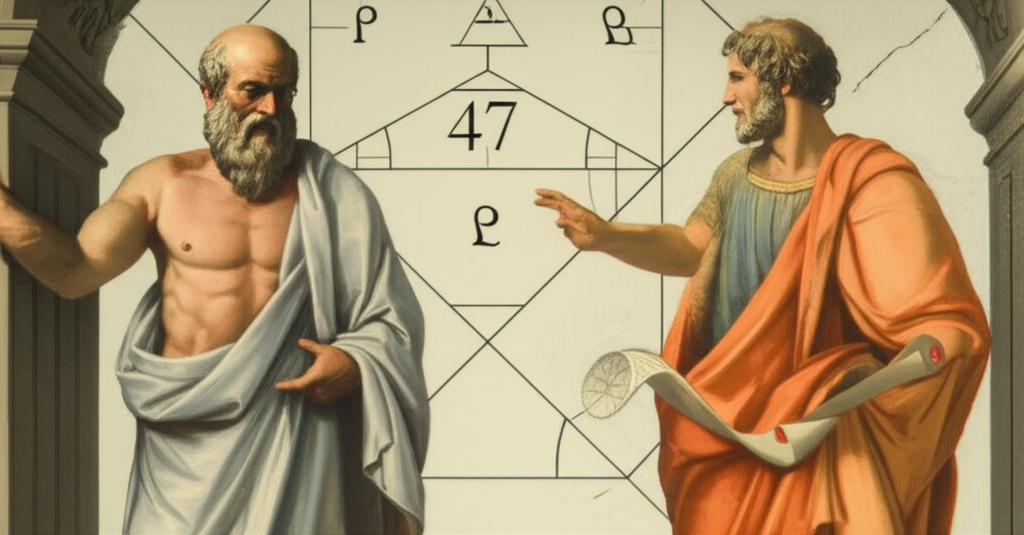 subtly etched into the background, symbolizing the philosophical and mathematical foundations of space.)
The Modern Revolution: From Absolute to Relative Space
The Renaissance and Enlightenment periods witnessed a dramatic re-evaluation of the idea of space, spurred by scientific advancements and new mathematical tools.
Descartes and Coordinate Geometry
René Descartes revolutionized mathematics by introducing coordinate geometry, effectively merging algebra and geometry. This innovation allowed spatial points and figures to be represented by numerical coordinates, making the quantity of space amenable to algebraic manipulation. This was a crucial step in abstracting space from physical intuition to a purely conceptual, analytical domain.
Newton's Absolute Space
Isaac Newton, in his Principia Mathematica, posited the existence of absolute space – an infinite, homogeneous, and immovable container existing independently of matter. This absolute space provided the fixed reference frame necessary for his laws of motion and universal gravitation. For Newton, space was a fundamental attribute of God, a divine sensorium. The quantity of space was absolute, unchanging, and uniform.
Leibniz's Relational Space
Newton's contemporary, Gottfried Wilhelm Leibniz, offered a powerful counter-argument. He contended that space was not an absolute entity but a system of relations between objects. Remove all objects, and space vanishes. This relational idea of space emphasized its dependence on the arrangement of matter, foreshadowing later developments in physics.
Kant and the A Priori Nature of Space
Immanuel Kant, in his Critique of Pure Reason, presented a groundbreaking synthesis. He argued that space is not an empirical concept derived from experience, nor an absolute entity, but an a priori intuition – a fundamental structure of the human mind through which we perceive and organize sensory data. We cannot conceive of objects without space, because space is the very form of our outer intuition. For Kant, the idea of space is thus a subjective necessity, making Euclidean geometry appear self-evident.
Non-Euclidean Geometries and the Expanding Idea of Space
The 19th century brought a profound challenge to Kant's view and the long-held certainty of Euclidean space. Mathematicians like Carl Friedrich Gauss, Nikolai Lobachevsky, and Bernhard Riemann began to explore geometries where Euclid's parallel postulate did not hold true.
The Rise of New Spaces
These non-Euclidean geometries demonstrated that space could have different curvatures and properties, without logical contradiction.
- Hyperbolic Geometry (Lobachevsky, Bolyai): Here, through a point not on a given line, infinitely many lines can be drawn parallel to the given line. This space has negative curvature, like a saddle.
- Elliptic Geometry (Riemann): In this geometry, no lines can be drawn parallel to a given line through a point not on it. This space has positive curvature, like the surface of a sphere.
This mathematical breakthrough fundamentally altered the idea of space. It moved from a singular, absolute entity to a diverse family of possible spaces, each with its own unique properties and ways of quantifying distance and shape. The question shifted from "What is space?" to "What kind of space are we in?"
Table: Euclidean vs. Non-Euclidean Space Properties
| Property/Concept | Euclidean Space | Hyperbolic Space | Elliptic Space |
|---|---|---|---|
| Parallel Lines | Exactly one through a point not on a line | Infinitely many through a point not on a line | No parallel lines through a point not on a line |
| Sum of Triangle Angles | Exactly 180° | Less than 180° | Greater than 180° |
| Curvature | Zero (flat) | Negative | Positive |
| Circumference of Circle | 2πr | > 2πr (for large r) | < 2πr (for large r) |
| Nature of Space | Infinite, flat, homogeneous | Infinite, curved inwards | Finite, curved outwards |
Space, Time, and Quantity in Modern Physics
The ultimate test and transformation of the idea of space came with Albert Einstein's theories of relativity.
Special Relativity: Space-Time Continuum
Einstein's Special Relativity (1905) demonstrated that space and time are not independent entities but are interwoven into a single four-dimensional space-time continuum. The quantity of distance and duration is relative to the observer's motion. This dissolved Newton's absolute space and time, showing that the idea of space is inseparable from the idea of time.
General Relativity: Dynamic, Curved Space-Time
General Relativity (1915) took this even further, asserting that mass and energy curve space-time. Gravity is not a force acting in space but a manifestation of the curvature of space-time itself. The presence of matter dictates the geometry of space around it. This means space is no longer a passive background but a dynamic participant, its quantity and geometry influenced by the distribution of matter and energy. The idea of space became profoundly relativistic and dynamic.
Conclusion: The Evolving Idea of Space
From the axiomatic ideals of Euclid and Plato to the curved space-time of Einstein, the idea of space has undergone a remarkable evolution. It began as an intuitive container, was formalized by mathematics into a rigorous system, debated by philosophers as an absolute or relational entity, and ultimately transformed into a dynamic, interwoven component of reality.
The journey of understanding space is a testament to the power of human inquiry, where philosophical contemplation and mathematical rigor continually refine our perception of the universe. The quantity of space, once a simple measure, has become a complex metric influenced by gravity and relative motion. As we continue to probe the cosmos, from quantum foam to the vast expanse of the universe, the idea of space remains at the forefront of our intellectual adventure, constantly challenging our assumptions and expanding our horizons.
YouTube Video Suggestions:
-
📹 Related Video: What is Philosophy?
Video by: The School of Life
💡 Want different videos? Search YouTube for: "The nature of space and time philosophy"
2. ## 📹 Related Video: ARISTOTLE ON: The Nicomachean Ethics
Video by: The School of Life
💡 Want different videos? Search YouTube for: "Non-Euclidean geometry explained history"