

The Idea of Space in Mathematics: A Philosophical Odyssey
Summary
The concept of space, an intuitive backdrop to our existence, undergoes a profound transformation when viewed through the lens of mathematics. From the tangible container of ancient philosophy to the abstract, multi-dimensional constructs of modern algebra and topology, the idea of space has evolved dramatically. This journey reveals not only how mathematics provides a language to describe and quantify space but also how philosophical inquiry into its nature has continually pushed the boundaries of its definition. This pillar page explores this evolution, tracing how space, initially conceived as a physical quantity, became an increasingly abstract and flexible mathematical concept, challenging our very understanding of reality.
The Philosophical Genesis of Space
For millennia, the idea of space has been a cornerstone of philosophical and scientific thought. Before mathematics offered its rigorous formalisms, thinkers grappled with space as an inherent aspect of existence. Was it a void? A boundless container? Or an emergent property of objects themselves?
Ancient Greek philosophers, whose insights form a significant part of the Great Books of the Western World, laid much of the groundwork. Plato, in his Timaeus, speaks of the chora, a receptacle or "space" that receives the forms and allows them to manifest as physical phenomena. Aristotle, in his Physics, debated the nature of "place" (topos) and the existence of a void, defining place as the inner boundary of a surrounding body. These early contemplations highlight space as a fundamental quantity or condition for being, intrinsically linked to the physical world.
However, it was Euclid's Elements that provided the first systematic mathematical formalization of this intuitive idea. By establishing a set of axioms and postulates, Euclid transformed space into a logical construct, defining points, lines, and planes based on self-evident truths. This monumental work effectively turned the idea of space into a subject of rigorous mathematics, where its properties could be deduced and explored systematically.
From Physical Reality to Abstract Quantity: Euclidean Space
Euclidean geometry, as codified in the Elements, became the bedrock of our mathematical understanding of space for over two millennia. It presented space as:
- Homogeneous: Every point in space is identical to every other point; there's no special center.
- Isotropic: Space looks the same in all directions from any point.
- Infinite: Space extends without limit.
- Flat: The shortest distance between two points is a straight line, and the sum of angles in a triangle is always 180 degrees.
This idea of space was deeply intertwined with our physical experience, providing a precise framework for measuring lengths, areas, and volumes – quantifying the world around us. The quantity of space could be measured, divided, and manipulated according to geometric rules.
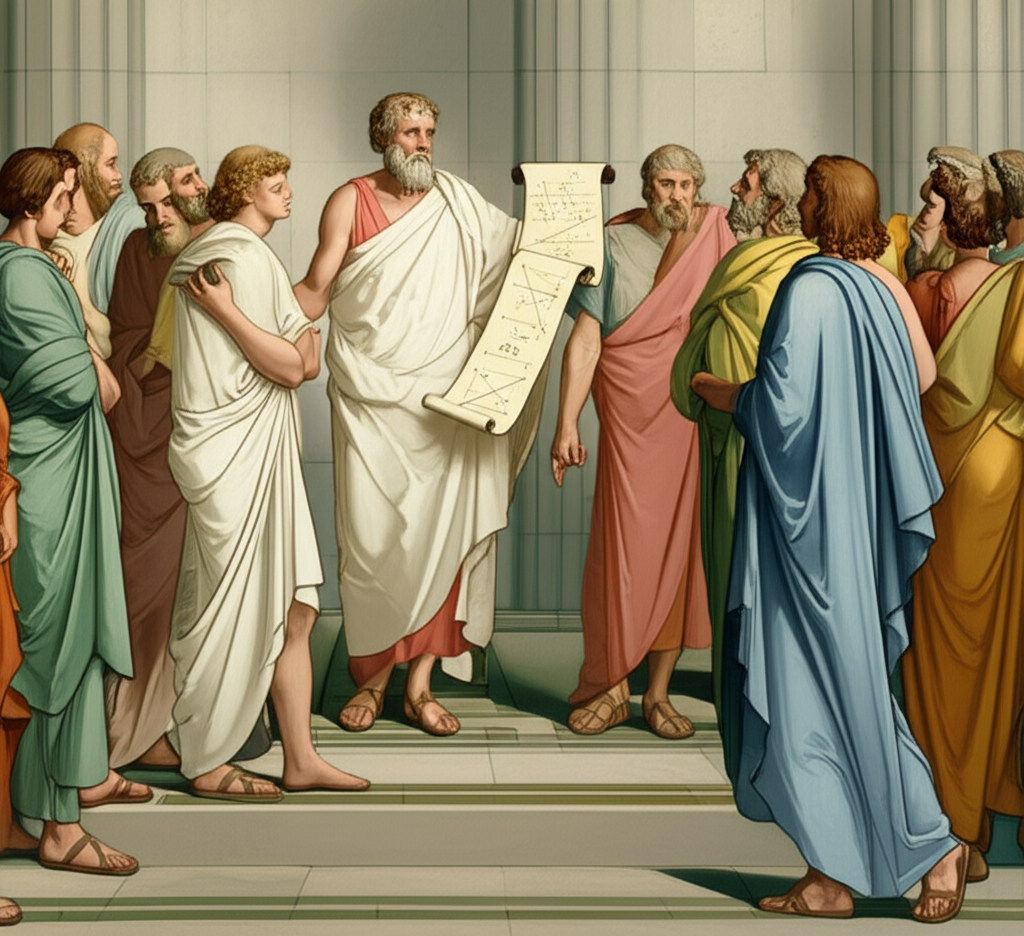 subtly integrated into the background, symbolizing the foundational shift from philosophical contemplation to mathematical formalization of space.)*
Key Characteristics of Euclidean Space:
| Characteristic | Description | Philosophical Implication |
|---|---|---|
| Homogeneity | All points in space are equivalent. | No inherent "center" or privileged location. |
| Isotropy | Space appears the same in all directions. | Directional symmetry; no preferred orientation. |
| Flatness | Governed by Euclid's parallel postulate; lines behave as expected on a plane. | Intuitive, "straight" space; basis for classical physics. |
| Infinite Extent | Space has no boundaries. | Philosophical debates on the finitude or infinitude of the universe. |
The Cartesian Revolution: Space as Coordinate Quantity
The 17th century brought a revolutionary shift with René Descartes' invention of analytic geometry. As detailed in his Discourse on Method and La Géométrie, Descartes introduced the concept of coordinates, effectively merging algebra with geometry.
This innovation transformed the idea of space from a purely geometric construct into an algebraic one. A point in space could now be represented by a set of numbers (x, y, z), and geometric shapes could be described by equations. This was a profound abstraction:
- Quantification of Position: Every location in space was assigned a unique numerical address.
- Algebraic Manipulation: Geometric problems could be translated into algebraic equations and solved through calculation, rather than purely visual or constructive methods.
- Universal Language: It provided a universal mathematical language for describing spatial relationships, paving the way for calculus and modern physics.
Descartes' work cemented the idea of space as a quantity in a new and powerful way, making it amenable to symbolic manipulation and opening doors to dimensions beyond our immediate perception.
Beyond Euclidean Shores: Non-Euclidean Geometries
For centuries, Euclid's geometry was considered the only possible mathematical description of space. However, the 19th century witnessed a paradigm shift with the development of non-Euclidean geometries by mathematicians like Carl Friedrich Gauss, Nikolai Lobachevsky, and Bernhard Riemann. These new geometries arose from questioning Euclid's controversial fifth postulate (the parallel postulate).
Instead of assuming that through a point not on a given line, exactly one parallel line can be drawn, these mathematicians explored alternatives:
- Hyperbolic Geometry (Lobachevsky, Bolyai): Through a point not on a given line, infinitely many parallel lines can be drawn. This results in a space with negative curvature, where the sum of angles in a triangle is less than 180 degrees.
- Elliptic Geometry (Riemann): Through a point not on a given line, no parallel lines can be drawn. This describes a space with positive curvature (like the surface of a sphere), where the sum of angles in a triangle is greater than 180 degrees, and lines eventually intersect.
The emergence of non-Euclidean geometries demonstrated that the idea of space was not singular but plural. Mathematics could construct multiple, self-consistent models of space, each with different properties. This profound realization had immense philosophical implications, particularly when Albert Einstein later adopted Riemannian geometry to describe the curved spacetime of general relativity, linking abstract mathematical ideas of space directly to the physical universe. The quantity of space, it turned out, was not fixed but dependent on its intrinsic curvature.
Space in Modern Mathematics: Topology and Abstract Spaces
Modern mathematics has pushed the idea of space far beyond its geometric origins. Fields like topology, functional analysis, and algebraic geometry explore spaces that bear little resemblance to our intuitive three-dimensional world.
Topology, for instance, studies properties of space that are preserved under continuous deformations (stretching, bending, twisting, but not tearing or gluing). A coffee mug and a donut are topologically equivalent because one can be continuously transformed into the other. Here, the quantity of dimensions or precise measurements becomes secondary to connectivity, boundedness, and holes.
- Topological Spaces: Defined by open sets, these spaces generalize the notion of "nearness" without requiring a specific distance metric.
- Metric Spaces: Spaces where a distance function (metric) is explicitly defined, allowing for measurement.
- Vector Spaces: Collections of "vectors" that can be added together and multiplied by scalars, forming the foundation for linear algebra and multi-dimensional analysis.
- Hilbert Spaces: Infinite-dimensional vector spaces equipped with an inner product, crucial in quantum mechanics and signal processing.
In these abstract spaces, the idea of space is stripped down to its most fundamental properties, often defined purely by axioms. The quantity of elements, dimensions, or relationships within these spaces can be vast and complex, far removed from the simple lengths and areas of Euclidean geometry. They represent the ultimate abstraction of the idea of space as a purely mathematical construct, a playground for logical exploration.
The Enduring Philosophical Questions
The mathematical evolution of space continuously fuels philosophical debate. Thinkers from the Great Books of the Western World like Isaac Newton and Gottfried Wilhelm Leibniz debated whether space was an absolute, independent container (Newton) or merely a system of relations between objects (Leibniz). Immanuel Kant, in his Critique of Pure Reason, argued that space is an a priori intuition, a fundamental structure of the human mind through which we perceive the world, rather than an objective reality "out there."
The advent of non-Euclidean geometries and abstract spaces complicates these questions:
- Is physical space Euclidean or Non-Euclidean? Physics now tells us that spacetime is curved, aligning with Riemannian geometry, suggesting our intuitive Euclidean idea is an approximation.
- Do abstract mathematical spaces have any bearing on reality? Or are they purely mental constructs, products of logical deduction?
- What does it mean for space to have "dimensions" beyond three? While we can mathematically define and work with N-dimensional spaces, their "reality" remains a profound philosophical puzzle.
The journey of the idea of space in mathematics is a testament to the human mind's capacity for abstraction. It shows how a seemingly simple concept can be transformed into a vast, intricate landscape of quantities and relationships, continually pushing the boundaries of our understanding of both the universe and ourselves.
Conclusion
From the earliest philosophical ponderings on "place" and "void" to Euclid's axiomatic geometry, Descartes' coordinate systems, and the mind-bending complexities of modern topology, the idea of space in mathematics has undergone a remarkable metamorphosis. It began as an intuitive physical quantity and has evolved into a myriad of abstract mathematical constructs, each offering a unique lens through which to understand structure, relationship, and extent. This ongoing dialogue between philosophical inquiry and mathematical innovation continues to refine our understanding of space, revealing it not as a static backdrop, but as a dynamic and multifaceted concept at the very heart of existence.
YouTube Video Suggestions:
-
📹 Related Video: KANT ON: What is Enlightenment?
Video by: The School of Life
💡 Want different videos? Search YouTube for: ""The Geometry of Spacetime - Brian Greene""
2. ## 📹 Related Video: PLATO ON: The Allegory of the Cave
Video by: The School of Life
💡 Want different videos? [Search YouTube for: ""What is a Manifold? (Topology Basics"](https://www.youtube.com/results?search_query="What is a Manifold%3F (Topology Basics) - 3Blue1Brown")